 Why choose Breeze
 Marketing
 Creative
 Sales
Sales Remote work
 Managers
 Product teams
 Project management
 Task management
 Kanban tool
 Time tracking
 Project reporting
 Project calendars
 Project timeline
 Team workload
 Project automation
 Project customization
 Chat
Chat Web forms
 Project roadmap
 AI
AI What's new
 Articles & guides
 Help center
 Mobile apps
 Integrations
 Developers & API
 Free tools
What is the product development process from idea to launch?

Contents
- What are the six stages of the product development process?
- How do you turn a messy idea into a clear problem to solve?
- How do you test an idea without building the whole product?
- What should you design before you build?
- How do you validate and test before launch?
- What does commercialization and launch actually include?
- How do you run product development on a simple board?
- How do you know when to move to the next stage?
- How do you keep stakeholders aligned without slowing down?
- What should you do next if you are starting today?
- Questions and answers
The product development process is the set of steps that takes you from an idea to something real that people can use and pay for. A practical version has six stages: ideation, definition, prototyping, design, testing, and commercialization (launch). This structure is common because it keeps the work moving while reducing risk step by step.
This is not just a software thing. You can use the same flow for a physical product, a new service, or an internal tool. And if the process feels overwhelming, it usually means the work is not visible. A simple Kanban board in Breeze can turn the whole thing into something you can manage: to do, doing, done, with clear owners and checklists. If you need product management software that keeps the stages visible, this is the core workflow to set up. If you are also trying to keep strategy and execution connected, tracking roadmap milestones ties planning to real work, and the product vs project split helps clarify who is deciding what.
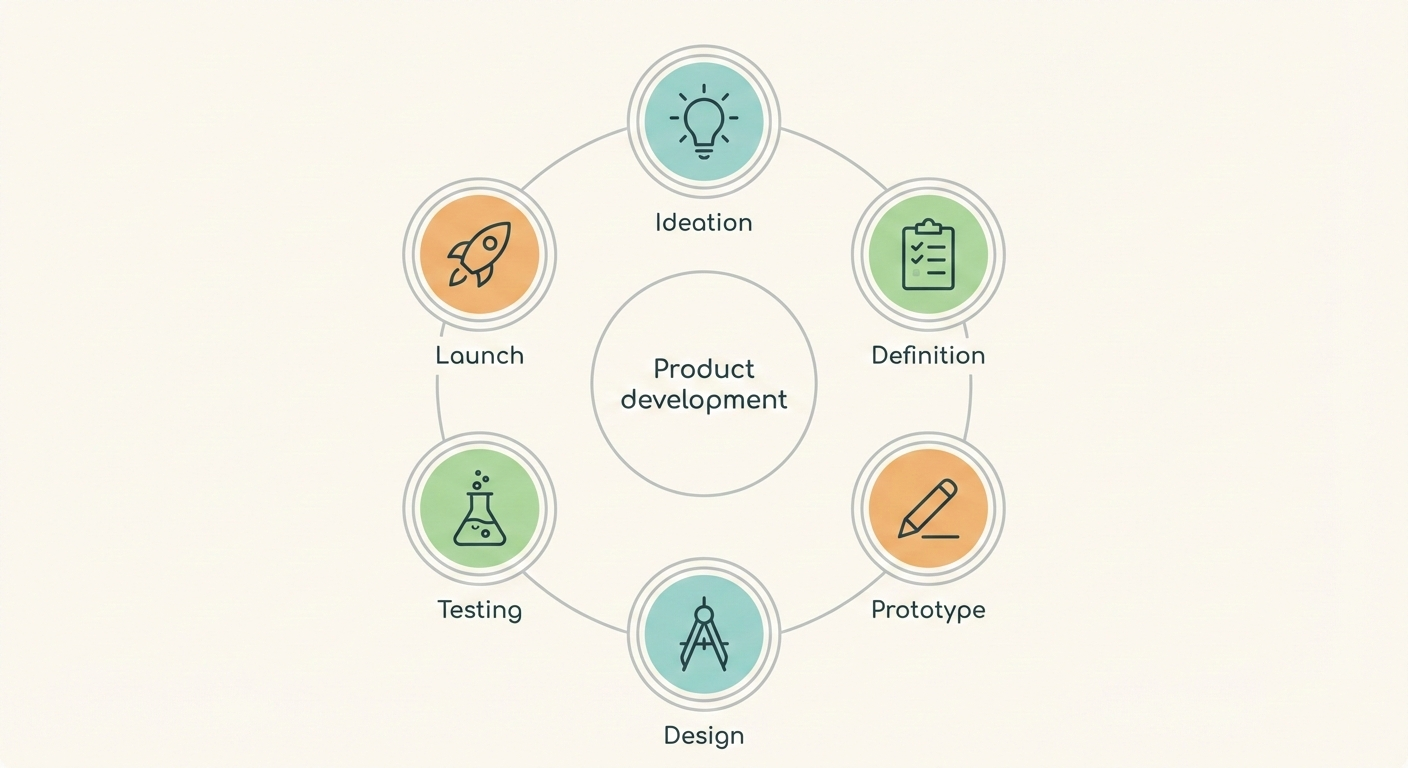
A lot of teams miss the last stage because they treat launch as "shipping." Solid launch planning covers the work around shipping, like docs, support prep, and post-launch follow-ups.
Key takeaways
- Clarity beats a perfect process, because most product development is coordination.
- Use the six stages as a map, and loop back as you learn.
- Define the problem and success metrics early.
- Prototype and test in small slices to reduce risk step by step.
- Treat launch as more than shipping: support, docs, and follow-up matter.
1. What are the six stages of the product development process?
The six stages are ideation, product definition, prototyping, initial design, validation and testing, and commercialization. This breakdown works because each stage ends with a clear output, so the team can stop guessing what "done" means.
If you prefer a more formal version of this idea, the classic stage gate model is the same basic concept: reduce risk by learning, deciding, and moving forward in steps.
Here is a simple way to think about the stages, what you are trying to produce, and how a small team can map it onto a Breeze board.
| Stage | Goal | Output | Easy Breeze mapping |
|---|---|---|---|
| Ideation | Generate and collect promising ideas. | Short list of ideas worth checking. | Ideas list + tags like 'customer request' and 'internal'. |
| Definition | Decide what you are building and why. | One page brief, success metrics, and constraints. | Definition list + checklist for 'problem, audience, metrics'. |
| Prototyping | Test the concept with the least effort. | Prototype or MVP plan. | Prototype list + linked feedback cards. |
| Initial design | Turn the concept into something buildable. | Flow, mockups, or spec that reduces ambiguity. | Design list + design review checklist. |
| Validation and testing | Prove it works and is usable enough to ship. | Test results, fixes, and go or no go decision. | Testing list + bug triage labels. |
| Commercialization | Launch and support it in the real world. | Release checklist, comms plan, and follow-ups. | Launch list + post-launch retro card. |
Teams get stuck when stages are treated like gates you must pass perfectly. Use stages as shared language, not a set of rules. Your real goal is to reduce risk as you go and keep learning moving.
2. How do you turn a messy idea into a clear problem to solve?
You turn a messy idea into a clear problem by writing down who it is for, what pain it removes, and what you will measure if it works. If you cannot explain the problem in two sentences, you do not have enough definition yet.
A simple definition step usually includes a one sentence problem statement (who, pain, outcome), a clear target user, one primary success metric with one guardrail metric, a few assumptions you need to test, and constraints like budget and timeline. If you can write those down cleanly, the team usually stops arguing about what the work is and starts deciding what to do next.
Put the brief on a single card in Breeze, then add a checklist for each of the items above. Keep discussion in the comments so decisions are searchable. If you want a separate space for research, attach links and files right to the card instead of spreading them across chat.
Once the brief is clear, the next step is turning it into owned work. An action plan is a simple way to move from "we agreed" to "we are doing," because it forces owners and next steps into the open.
If your team is also figuring out ongoing planning, the same approach used in roadmap milestones helps you avoid trying to build everything at once and gives you a simple way to say what is next.
3. How do you test an idea without building the whole product?
You test an idea by building the smallest believable version and putting it in front of real people. That can be a sketch, a clickable mockup, a landing page, a concierge test, or a small pilot. The point is to learn fast, not to impress anyone.
Eric Ries popularized the idea of the MVP as the fastest way to start learning, and that mindset still holds up: ship the smallest thing that produces trustworthy feedback. The key is the learning-first framing, not the acronym.
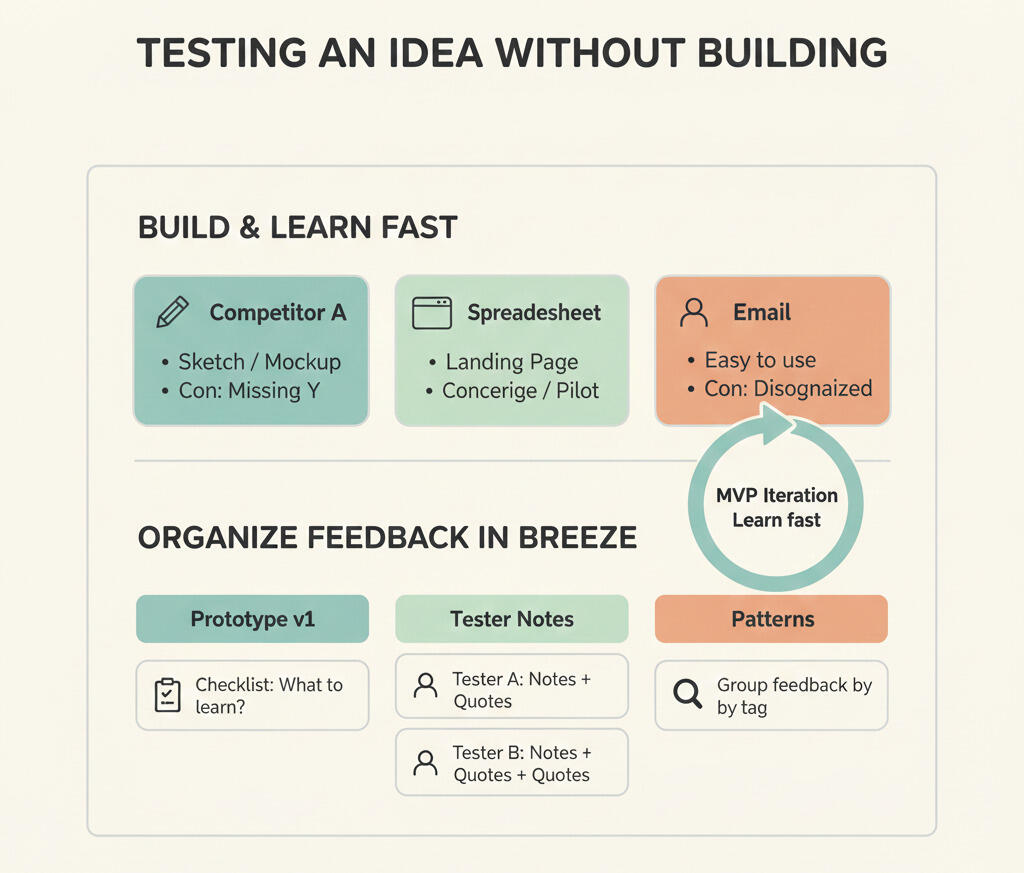
In Breeze, treat each prototype like a mini project. Put the prototype tasks on a board, create a checklist for what you are trying to learn, and add one card per tester with notes and quotes. This keeps feedback tied to the version that created it. Prototype testing is how you run those tests without writing code.
4. What should you design before you build?
You should design the key flows and the risky parts before you build the full system. That usually means the first-time user experience, the most common workflow, and any screens where mistakes are expensive, like payments, permissions, or data loss.
Design is not only visuals. It is also deciding what happens when things go wrong: empty states, error states, edge cases, and what the user sees next. Writing these decisions down is what prevents endless rework during development.
In Breeze, add a design review checklist to the card that holds your main mockups. Include the happy path, a few edge cases, copy review, an accessibility pass, and handoff notes. When the checklist is done, you know the work is actually ready for the next step.
5. How do you validate and test before launch?
You validate and test by checking three things: the product works, the product is usable enough, and the product is reliable enough for the promises you are making. For many teams, a small beta plus focused usability sessions catches most issues that would otherwise appear on launch week.
Usability researchers at Nielsen Norman Group have long argued that a handful of users can uncover most usability problems. You do not need a huge test program to learn something useful.
During testing, keep a lightweight bug and feedback board in Breeze. Use labels like 'bug', 'copy', 'missing', and 'confusing', and sort by severity. The best part is that testing feedback stays next to the work, so you do not lose context when you start fixing.
If you want a broader lens than bugs, these success factors can help you check whether the project is healthy before you ship.
6. What does commercialization and launch actually include?
Commercialization is the work that makes the product real in the market: pricing, packaging, documentation, training, support readiness, and the launch plan. Shipping the build is only one part of it. A calm launch happens when you treat release day as a checklist, not a heroic moment.
If you are launching with a cross-functional team, the biggest risk is hidden dependencies. Breeze helps by putting marketing tasks, product tasks, docs, and support tasks on one board so no one is guessing what is ready.
If part of your launch is date-driven work (like a campaign or a coordinated release window), pairing the board with a simple timeline view can help. Gantt charts can work fine alongside Kanban when the timeline is there to show deadlines, not to micromanage every task.
If launch coordination is the hard part for you, the workflows in cross-team tasks and launch updates show how to keep marketing, product, and support moving from the same plan.
7. How do you run product development on a simple board?
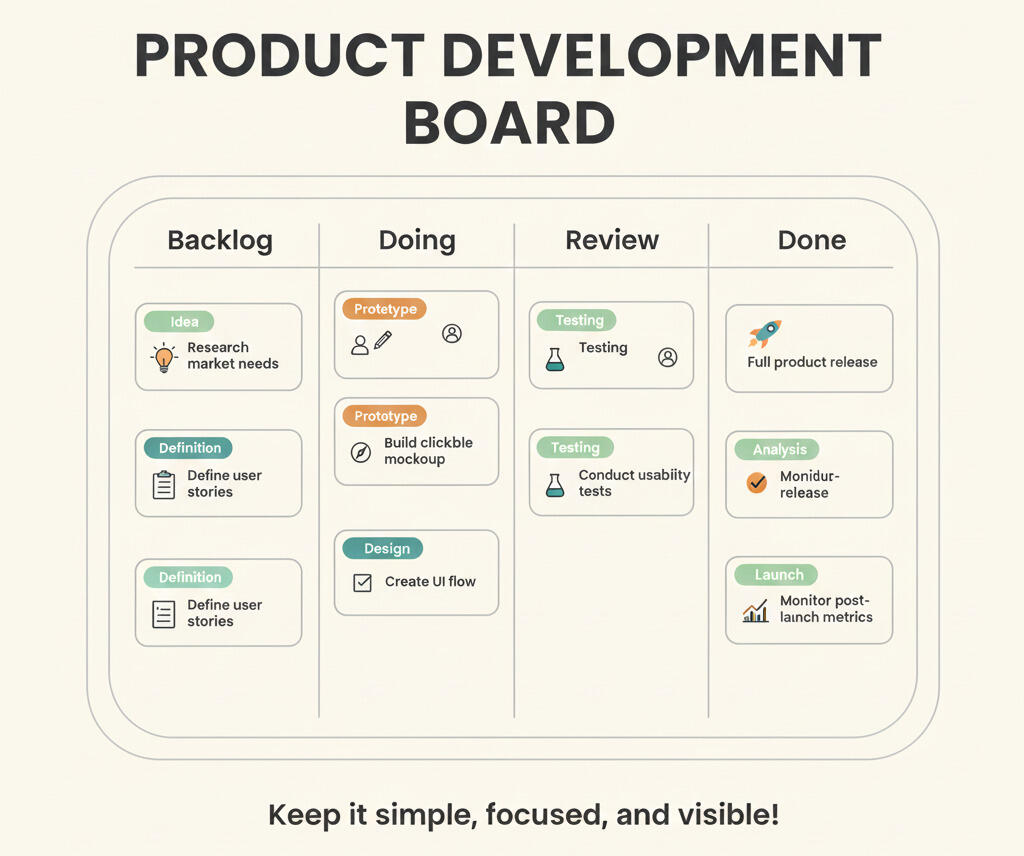
You run product development on a simple board by making the work visible and limiting how much is in progress at once. Most teams do not have a process problem, they have a visibility problem. A board fixes that by forcing decisions into the open: what is next, what is blocked, and what is done.
A basic Breeze setup is four lists (backlog, doing, review, done), a simple stage label (idea, definition, prototype, design, testing, launch), and one clear owner per card. Add watchers for stakeholders who need visibility, and use checklists for definition, review, and launch readiness so the team does not have to remember everything under pressure.
If you have to choose between a detailed process doc and a board everyone actually uses, pick the board. Adoption beats perfection.
If you are tempted to keep adding layers, it helps to remember that complexity usually lowers adoption. Teams often end up with fancy systems that no one updates, and why tools fail is usually about adoption, not effort.
If you are evaluating tools while you set this up, simple software is often the difference between a board people use and a board people ignore.
8. How do you know when to move to the next stage?
You know it is time to move to the next stage when the current stage has produced the output you need to reduce the next risk. You do not move because the calendar says so. You move because you can explain what you learned and what decision that learning supports.
In Breeze, this is where checklists shine. Put the "stage exit" checklist on the main card for the initiative, and only move the card when the checklist is actually complete. It keeps the team honest without turning the process into a ceremony.
Here are simple stage exits most teams can live with:
| Stage | Done looks like | Common trap | Simple fix |
|---|---|---|---|
| Ideation | You can name the user and the pain in plain language. | Collecting ideas without picking one. | Force a short list of 3 and write a one sentence big why for each. |
| Definition | You have success metrics and top assumptions to test. | Debating instead of testing. | Turn the biggest argument into a prototype test next week. |
| Prototyping | You learned something that changes the plan. | Making a prototype too polished. | Make it believable, not complete. Keep the scope tiny. |
| Design | The key flow and edge cases are decided. | Handing off half-finished decisions. | Add an edge-case checklist to the design card before build starts. |
| Testing | Known issues are triaged and the go decision is made. | Launching with unknown quality. | Label issues by severity and decide what blocks launch. |
| Launch | Users can find it, try it, and get help if stuck. | Shipping without comms or support prep. | Use a launch checklist that includes docs, training, and follow-up. |
If you cannot describe what risk you are reducing in this stage, the stage will turn into busywork. A board makes that visible fast, because cards pile up where decisions are missing.
If you want a concrete way to make progress visible, treat stage exits like project milestones rather than fuzzy status updates. When the milestone is clear, it is easier to agree on what "ready" means.
9. How do you keep stakeholders aligned without slowing down?
You keep stakeholders aligned by making decisions visible and giving people a predictable way to review work. The best alignment is asynchronous. It is a clear board, clear owners, and written context, not a calendar full of meetings.
A simple pattern in Breeze works well: one "decision card" per major decision, with a short summary at the top (what we decided, why, and what changed). Link that decision card to the work cards it affects. When someone asks "why did we do this," the answer is attached to the work, not buried in chat.
A practical stakeholder rhythm for small teams is to do one short weekly board review where you look for stuck cards and unclear owners, use the decision card for sign-off when a scope change is coming, and post a short summary after each prototype test that explains what you learned and what you are doing next. That is usually enough to keep people aligned without slowing everything down.
If your launches involve multiple teams, cross-team tasks can help you keep ownership and dependencies visible even before launch. Visibility is not only a launch problem. It is the whole product development problem.
10. What should you do next if you are starting today?
If you are starting today, do two things: define what you are trying to learn, and make the work visible. Then choose the smallest test that can teach you something true. That is how you avoid spending weeks building the wrong thing.
If you want an easy way to keep momentum, set up a small Breeze board with three lists (to do, doing, done) and add labels for each stage. You can keep the process lightweight while still staying organized.
For ideation and definition, start with idea validation. For prototyping and early feedback, use prototype testing. For launch readiness and release day work, use stress-free launch.
Questions and answers
- Do the six stages happen in order every time?
- No. The stages are a map, not a straight line. Most teams loop between definition, prototyping, and design several times, especially when feedback changes what you thought you were building.
- What is the difference between product development and product management?
- Product development is the work of creating the product. Product management is the work of deciding what should be built, why, and in what order. In small teams, the same people often do both.
- How long should the definition stage take?
- Long enough to agree on the problem, user, and success metric. For many small teams, that is a few days to two weeks. If it drags on, you probably need to run a small prototype test instead of debating.
- What is a simple success metric to start with?
- Pick one behavior that shows the product is useful, like activation rate, repeat usage, or time saved. Add one guardrail like churn or support tickets so you do not optimize in the wrong direction.
- How do you keep stakeholders aligned without more meetings?
- Keep the plan on one board, write decisions on the relevant cards, and use comments for updates. When people can see the work moving in Breeze, you can replace a lot of status meetings with a quick glance.
- What is the biggest mistake teams make in product development?
- Building before they have a clear learning goal. A little structure in definition and a small prototype test can save months of work.