 Why choose Breeze
 Marketing
 Creative
 Sales
Sales Remote work
 Managers
 Product teams
 Project management
 Task management
 Kanban tool
 Time tracking
 Project reporting
 Project calendars
 Project timeline
 Team workload
 Project automation
 Project customization
 Chat
Chat Web forms
 Project roadmap
 AI
AI What's new
 Articles & guides
 Help center
 Mobile apps
 Integrations
 Developers & API
 Free tools
AI project management statistics and trends for 2026

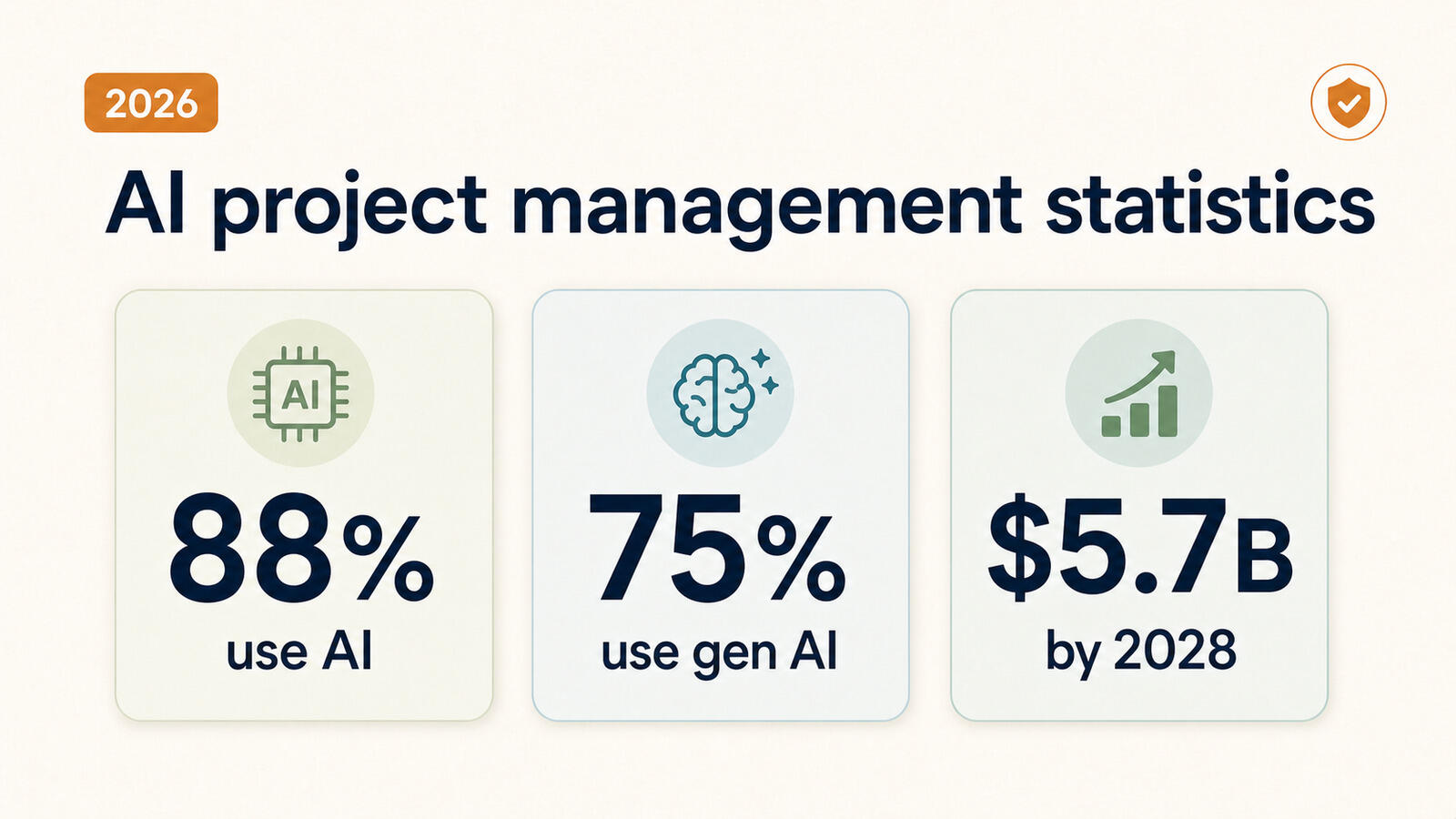
AI in project management is no longer a "nice-to-have" feature. In 2026, it is becoming the default layer that helps teams predict risks, automate reporting, and keep work moving without constant meetings. The stats below focus on adoption, what teams actually use day to day, and how fast the market is changing.
Key AI project management statistics (2026)
- 88% of organizations use AI in at least one business function, up from 78% a year earlier.
- 75% of knowledge workers already use generative AI at work.
- 81% of project professionals say their organization is being impacted by AI.
- The AI project management market is projected to grow from $2.5B (2023) to $5.7B (2028), a 17.3% CAGR.
- The average project performance rate is 73.8%, leaving plenty for AI to improve.
- Up to 30 million more project professionals will be needed by 2035.
1. AI adoption in project work
What percentage of organizations use AI in at least one business function?
88% of organizations report using AI in at least one business function.
What this means: AI adoption has crossed the "default" threshold. The differentiator in 2026 is not whether you have AI tools, but whether your workflows and data are set up so the tools actually help.
How many project professionals expect AI to impact their work soon?
81% of project professionals report that their organization is already being impacted by AI technologies.
What this means: The timeline is short. If your organization is waiting for a "perfect" AI strategy, you will likely end up with shadow AI instead (people using tools in private, without shared norms). A better approach is to pick a safe, narrow use case, then expand.
Source: PMI - AI Innovators (2023)
How common is generative AI usage at work?
75% of global knowledge workers report using generative AI at work.
What this means: Even if your PM tool is not "AI-first", your team is probably already using AI in ad hoc ways (drafting updates, summarizing notes, rewriting requirements). The opportunity is to formalize the safest, most useful use cases.
Source: Microsoft and LinkedIn - 2024 Work Trend Index (PDF)
How new is generative AI usage in organizations?
46% of respondents who use generative AI at work have used it for less than six months.
What this means: A lot of AI usage is still fresh and informal. In project management, this is a window to set norms early (what is allowed, what must be reviewed, and where outputs are stored).
Source: Microsoft and LinkedIn - 2024 Work Trend Index (PDF)
How much of a team's time is spent on formal projects?
Respondents report spending an average of 68% of their time on formal projects and 23% on informal projects.
What this means: Project work is the default work. AI helps most when it reduces project overhead (status chasing, reporting, and handoff confusion) so people can spend more time doing the actual project work.
2. What teams use AI for
What AI capabilities show up first in project management?
In most teams, AI adoption starts with three use cases: automated status reporting, task suggestions (next steps, owners, due dates), and early warning signals (risks and delays).
What this means: These are "work about work" tasks. Automating them frees time without changing the core craft of project management: clarifying scope, aligning stakeholders, and making tradeoffs. It is worth being clear on where AI actually helps before rolling it out, and worth checking whether your tool has an MCP server, since connecting the assistant you already pay for often covers these three cases without a separate AI subscription.
Sources: Wellingtone - The State of Project Management (PDF)
Asana - Work about work
How much time is spent on "work about work"?
Knowledge workers spend 60% of their time on "work about work" such as status chasing, unnecessary meetings, and switching between tools.
What this means: This is where AI helps first. If your PM tool can reduce status chasing and automate routine rollups, it creates time for the work that still needs humans: decisions, tradeoffs, and stakeholder alignment.
Source: Asana - Work about work
How much time do teams spend on manual reporting and status chasing?
50% of respondents spend one day or more each month manually collating project status information, and 47% say they do not have access to real-time project KPIs.
What this means: This is the obvious ROI target for AI in 2026. If AI cannot pull clean status from your tasks, the fix is rarely "more AI" - it is clearer task ownership, consistent statuses, and fewer parallel systems.
How often do organizations deliver projects on time and on budget?
34% of organizations say they mostly or always complete projects on time, and 34% say they mostly or always complete projects on budget.
36% say they mostly or always deliver the full benefits of their projects.
What this means: Most project delivery is still inconsistent. AI can help with earlier risk signals and faster reporting, but it cannot fix unclear scope, missing owners, or weak stakeholder decisions. Use AI to reduce noise, then fix the basics.
How many organizations say they have a strong track record of project success?
45% say their organization has a track record of project success.
What this means: More than half of organizations do not describe themselves as consistently successful. In 2026, AI is often pitched as the fix, but the real pattern is that AI helps the teams who already keep their project data current. If your board is stale, AI will mostly automate stale reporting.
3. AI project management market growth
What do traditional market forecasts suggest for AI in project management?
One market forecast projects AI in project management growing from $2.5B (2023) to $5.7B (2028), a 17.3% CAGR.
What this means: CAGR depends on how a report defines the market (AI features inside PM tools vs. the standalone "AI in PM" category). Use market stats as direction, then validate with a pilot in your workflow.
How big is the overall project management software market?
The project management software market is projected to grow from $10.56 billion in 2026 to $39.16 billion by 2035, representing a 12.8% CAGR.
What this means: Even if you do not buy an "AI-only" tool, AI will be bundled into the mainstream PM platforms your team already considers. The practical question becomes which tool can turn your project data into reliable rollups and risk signals.
4. What AI changes first
What changes first when AI becomes part of the PM tool?
The first visible change is faster communication: fewer status meetings, faster written updates, and more consistent project snapshots.
What this means: AI works best when the system of record is already clean. Lightweight tools like Breeze can help here because task status, owners, and decisions stay close to the work, which makes automation more reliable.
Sources: Asana - Work about work
Wellingtone - The State of Project Management (PDF)
What is the average project performance rate across organizations?
The average project performance rate across organizations is 73.8% (defined as the mean percentage of completed projects that met business goals).
What this means: Roughly 1 in 4 projects fail to meet business goals. This is why AI risk prediction matters in 2026, not as magic, but as earlier signals that a project is drifting (late decisions, slipping milestones, and rising blockers).
How common is hybrid delivery now?
The share of organizations using hybrid approaches increased from 20% in 2020 to 31% in 2023.
What this means: Most teams are already mixing approaches, which increases complexity. AI is useful here when it standardizes the basics across workflows (clear status, clear ownership, and consistent rollups) even when different teams work differently.
How do teams mix predictive and Agile methods in hybrid delivery?
When project managers report using a hybrid approach, the most common patterns include:
38%: chiefly predictive with small Agile components
37%: Agile and predictive components combined throughout the life cycle
15%: chiefly Agile with small predictive components
8%: Agile development followed by predictive rollout
What this means: Hybrid is not one thing, which makes reporting harder. AI helps when it can normalize status and highlight risk across mixed delivery styles, but it needs consistent inputs (owners, due dates, and clear task states).
How big is the project professional talent gap?
There is a projected global shortage of nearly 30 million project professionals by 2035.
The PM workforce is expected to grow from 39.6 million in 2025 to 58.5 million by 2035, a 48% increase.
What this means: AI is arriving at the same time as a talent gap. The most valuable PMs in 2026 are the ones who can use AI to scale their impact without turning project work into more process.
Source: PMI - Talent Gap 2025 (PDF)
5. Risks and governance
Is AI adoption the hard part, or scaling and governance?
In a McKinsey survey, 88% reported using AI in at least one function, but only a small share reported AI fully scaled across the organization.
What this means: The gap is not tooling. It is governance, workflow redesign, and clear accountability for AI outputs. For project management, that means being explicit about what AI can draft vs. what a human must approve (scope, dates, budgets, and risk calls).
Key takeaways for 2026
The data paints a clear picture of AI in project management in 2026:
- AI is mainstream: 88% of organizations use AI in at least one business function, and 75% of knowledge workers report using generative AI at work.
- Adoption is wide but shallow: 88% of organizations use AI in at least one business function, yet far fewer have it genuinely embedded in day-to-day project work.
- The market is growing steadily: the AI project management market is projected to roughly double from $2.5B in 2023 to $5.7B by 2028, a 17.3% CAGR.
- The biggest ROI target is reporting overhead: Knowledge workers spend 60% of time on "work about work", and many organizations still lack real-time KPIs or spend significant time manually collating status.
- Basics still decide outcomes: Project success rates remain inconsistent, so AI helps most when it supports clear ownership, clean task data, and faster decisions rather than adding more process.
- Governance is the gap: Adoption is high, but scaling is harder. Teams need clear rules for what AI can draft and what humans must approve.
Use these statistics as a reality check. Teams that pair AI features with simple, disciplined workflows and real-time visibility will outperform teams that treat AI as a layer on top of messy project data.