 Why choose Breeze
 Marketing
 Creative
 Sales
Sales Remote work
 Managers
 Product teams
 Project management
 Task management
 Kanban tool
 Time tracking
 Project reporting
 Project calendars
 Project timeline
 Team workload
 Project automation
 Project customization
 Chat
Chat Web forms
 Project roadmap
 AI
AI What's new
 Articles & guides
 Help center
 Mobile apps
 Integrations
 Developers & API
 Free tools
How do you involve clients in your projects without the chaos?

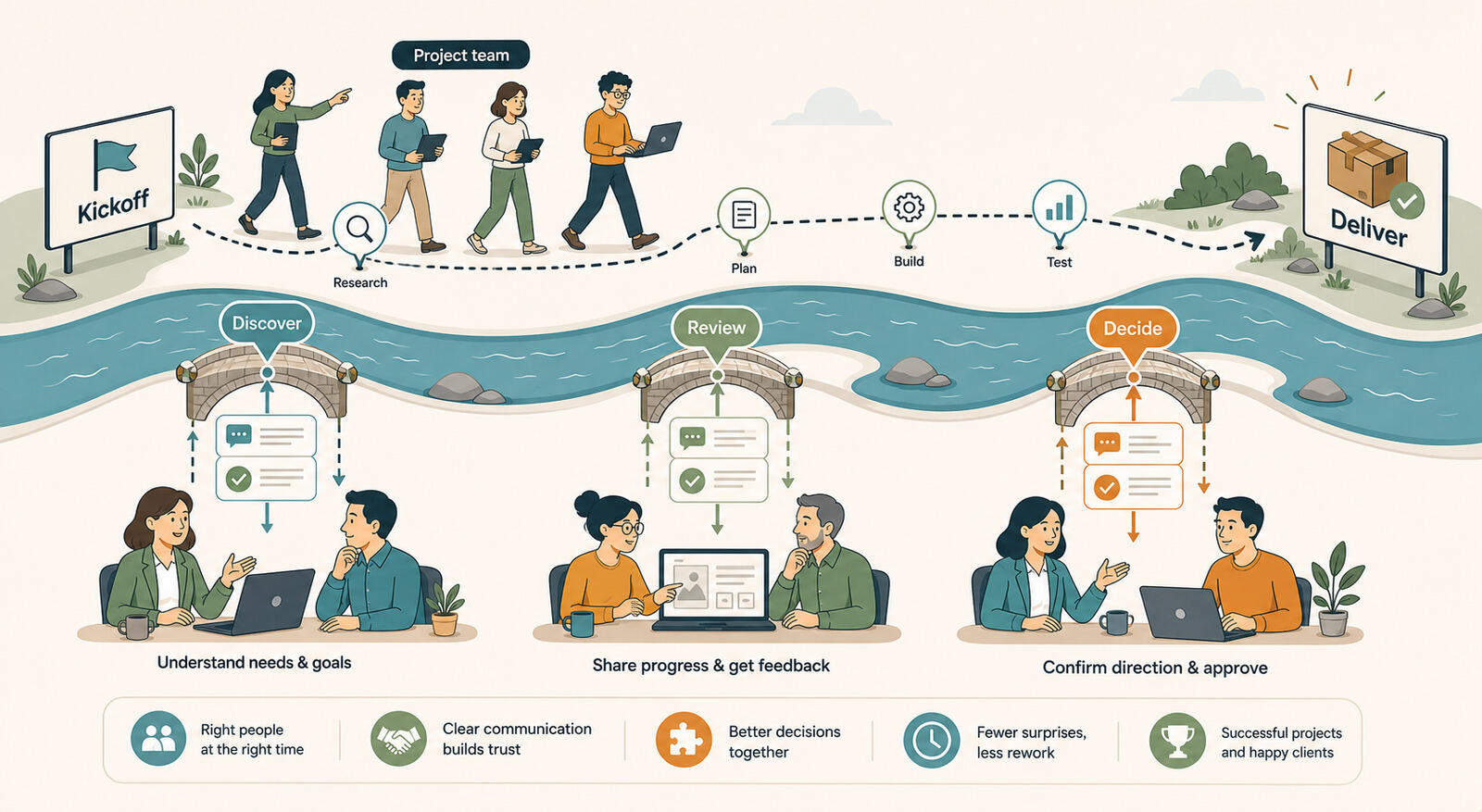
You involve clients by giving them a clear window into the work and a small, well-defined say over its direction - then keeping that window honest and current. Most teams treat involvement as a volume dial, where more contact equals more partnership. It does not. A client cc'd on everything is buried, not involved, and one who hears from you only when something breaks is not involved either. The sweet spot is a steady, predictable rhythm: they always know where the project stands, they weigh in at the moments that matter, and they are never surprised. Get it wrong in either direction and you get the two classic failures - a client who micromanages every pixel, or one who vanishes until the invoice and then disputes the whole thing.
What is the right level of client involvement
The right level keeps the client informed and consulted on decisions that affect them, without dragging them into work they hired you to handle. That line differs for every client, which is why a single default rarely fits. Some want to approve every deliverable; some want a weekly summary and otherwise to be left alone. Find their real preference early, rather than guess and renegotiate it under stress.
A useful way to think about it is to separate three things: decisions, direction, and execution. Decisions are theirs - budget, scope, which option to ship. Direction is shared - you propose, they steer, and you both adjust as you learn. Execution is yours - the how, the sequencing, the day-to-day work. Most friction comes from a mismatch on direction: the client thinks they are steering and you think you are, or nobody is, and the project drifts. Naming these three buckets out loud, with the client in the room, removes most of that friction before it starts.
Over-involving a client is not generous, it is a liability. When a client is in every detail, your timeline becomes hostage to their availability, and small approvals turn into bottlenecks. Pulling them in at the right altitude protects the project from both extremes - the absent client who derails launch with late objections, and the present-everywhere client who slows it to a crawl.
How to set expectations before work starts
Involvement is decided at the start, whether you do it deliberately or not. The kickoff is where you gather the real requirements and, just as importantly, agree on how you will work together. Skip that conversation and the client's expectations form on their own, usually in a direction that surprises you later.
Start by gathering project details with the client, not for them. Walk through the brief line by line and ask why behind each item, because the reason often matters more than the request itself. This is the moment to surface assumptions while they are cheap to correct - what counts as done, who signs off, what is out of scope. A solid kickoff is where a clear scope gets written down, and writing the boundaries down early is the best defense against the slow drift of extra requests later. If you write proposals before this stage, framing deliverables and approvals in the project proposal gets the involvement conversation off to a solid start.
Then agree on the working rhythm explicitly. How often will you share progress, and through what channel? Who is the single point of contact on their side, so feedback does not arrive from five people pulling in three directions? When are the decision points? Five minutes on these questions saves hours of confusion later. Write the answers somewhere both sides can see, so the agreement is a reference, not a memory.
Three involvement levels at a glance
Not every client gets the same treatment, and pretending otherwise is how you end up over-serving one and neglecting another - a trap the patterns busy agencies rely on are built to avoid. Here are three common levels and the client each fits. Pick the row that matches, then set your cadence to it.
| Level | What it looks like | Best fit |
|---|---|---|
| Hands-on partner | Shared board access, decisions made together, frequent check-ins. | Strategic work where the client owns deep context you cannot replace. |
| Informed reviewer | Weekly status report, approvals at milestones, light day-to-day contact. | Most agency and service work - the common, comfortable middle. |
| Trusting delegator | Short summary at agreed checkpoints, sign-off at the end. | Repeatable or low-risk work where the client trusts your process. |
The level is not fixed for life. A new client often starts as an informed reviewer and earns their way to delegator as trust builds, or moves the other way when a project gets risky. Choose a level on purpose and revisit it, rather than discovering the mismatch when something goes wrong.
How to get feedback you can actually use
Feedback is where involvement either pays off or backfires. Done well, it surfaces problems while they are cheap to fix and makes the client feel heard. Done badly - a vague "what do you think?" thrown over the wall - it produces silence or a flood of contradictory notes that arrives too late to act on.
The fix is to ask narrow questions at defined moments. Instead of "any thoughts on the design?", ask "does this homepage layout match the priority you set for the signup flow?" A specific question gets a specific answer you can build on. Tie those questions to the checkpoints you agreed at kickoff - a milestone reached, a draft ready for review - so feedback lands at a natural decision point. Timing matters: input on a wireframe is a quick adjustment, the same input after launch is a rebuild.
It also helps to give clients a small, real task now and then. Reviewing a shortlist, approving a milestone, supplying the one piece of content only they have - these move the project forward rather than just commenting on it. A client with a concrete checkpoint to clear stays engaged in a way passive recipients of updates never do. The goal is the same as at the start: keep the client close enough to steer, far enough to let you work, and clear on where things stand.
Quick decision points
- How often should I update a client?
- Match it to the involvement level. A hands-on partner gets live board access; an informed reviewer gets a weekly status report; a delegator gets a short note at agreed checkpoints. The exact frequency matters less than keeping it predictable.
- What if a client wants to be involved in everything?
- Name the three buckets early - decisions are theirs, direction is shared, execution is yours - and point back to that agreement when approvals start to bottleneck the work. Most over-involvement comes from anxiety about visibility, which a shared board quietly solves.
- How do I involve a client without giving away access to internal work?
- Share a single project, board, or report through a public link rather than adding them to your whole workspace. They see exactly what you choose to show, with no account to manage on either side.
The short version
Involving clients well is not about contacting them more, it is about giving them a clear, steady view of the work and a real say at the points that matter, set to a level you both agreed on at the start. Decide that level on day one, share progress in a format that fits it, and ask for feedback in narrow questions at defined checkpoints.
The practical next step is to put each current client into a level - partner, reviewer, or delegator - then set the matching cadence for sharing progress. The mismatches you find are almost always the source of the friction you have been feeling, and fixing them is usually one honest conversation about how you work together.