 Why choose Breeze
 Marketing
 Creative
 Sales
Sales Remote work
 Managers
 Product teams
 Project management
 Task management
 Kanban tool
 Time tracking
 Project reporting
 Project calendars
 Project timeline
 Team workload
 Project automation
 Project customization
 Chat
Chat Web forms
 Project roadmap
 AI
AI What's new
 Articles & guides
 Help center
 Mobile apps
 Integrations
 Developers & API
 Free tools
How can sales and marketing coordinate deals, assets, and updates in one place?

Contents
- Why do sales and marketing alignment efforts fall apart?
- How do you build a shared Breeze board for campaigns and deals?
- How do you keep content assets connected to the pipeline?
- How do you manage handoffs from marketing campaigns to sales conversations?
- How do you turn deal feedback into better campaigns?
- What should your first shared sales and marketing workspace include?
- Questions and answers
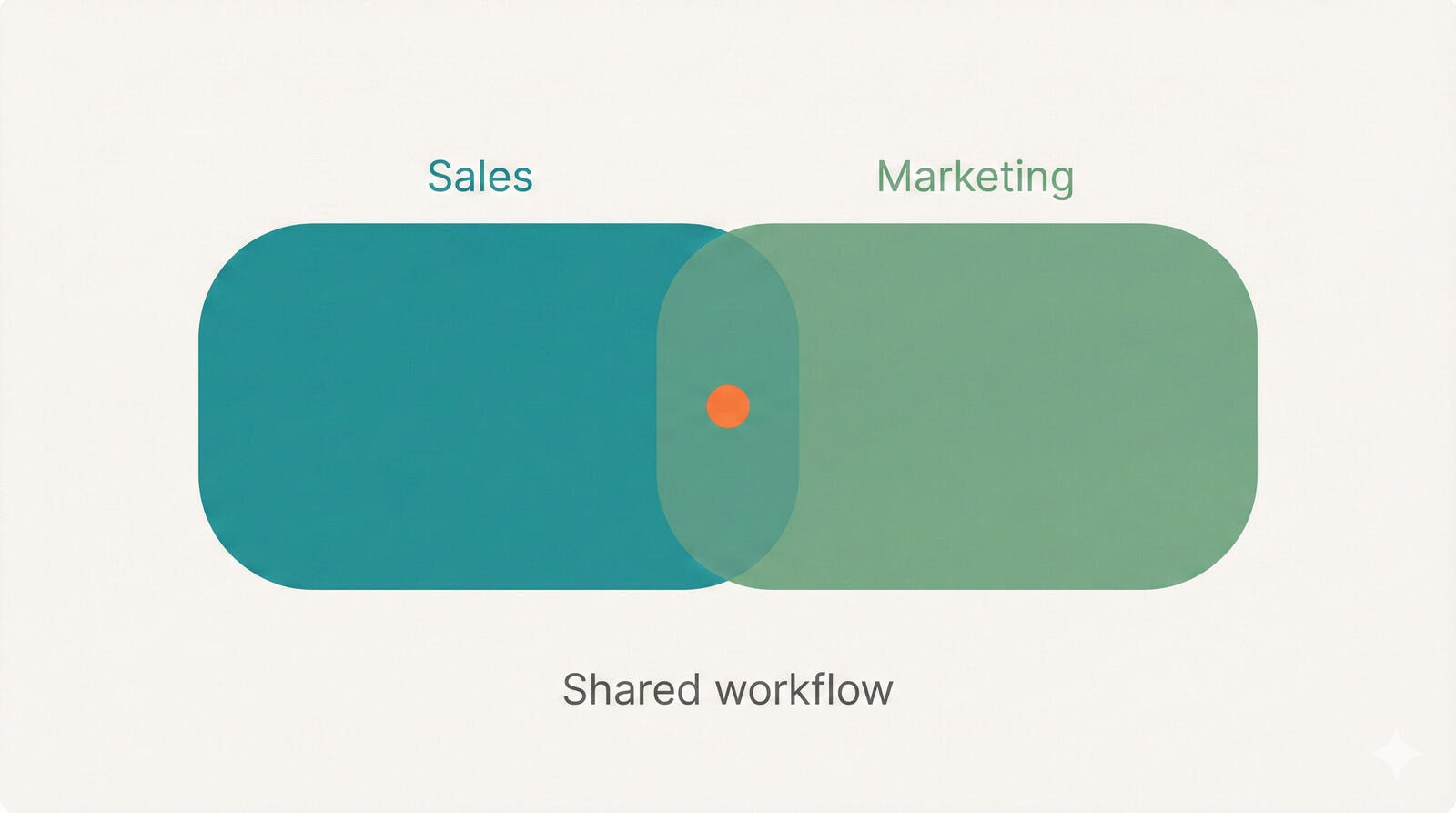
Sales and marketing coordinate deals, assets, and updates in one place when they share the same workspace instead of separate tools and reports. A shared project space helps here because you can run campaigns, track leads, and manage deals on connected boards that both teams can see and update.
This article assumes you already have a basic pipeline structure in place. If you are still designing that, start with a simple sales pipeline and a sales board.
Research from firms like Forrester research and Gartner has shown that aligned revenue teams grow faster and waste less spend. Alignment is less about one more meeting and more about having a shared view of work, status, and results.
With a shared workspace, marketing can see which campaigns generate real opportunities, and sales can see which assets and messages are available for each segment. That reduces friction, duplicated work, and last minute scrambles for new collateral.
Key takeaways
- Sales and marketing alignment improves when both teams work from the same shared workspace instead of separate tools.
- Shared boards make it easier to connect campaigns, leads, and deals without building a custom reporting stack.
- Keeping assets and feedback attached to deals helps teams learn which content and messages actually move revenue.
- Regular reviews inside Breeze replace fragmented updates across email, decks, and spreadsheets.
1. Why do sales and marketing alignment efforts fall apart?
Sales and marketing alignment efforts often fall apart because they rely on quarterly presentations and static reports instead of everyday collaboration. Teams agree on goals in a kickoff, then drift back into separate tools, dashboards, and chat channels.
Operators interviewed in long form case studies frequently describe the same pattern. Marketing teams optimize for leads and campaign metrics, while sales teams optimize for closed revenue and speed. Without a shared system of record, it is hard to see how those goals connect. Analyses such as a Gartner insight highlight how misaligned incentives and fragmented tools often undermine revenue performance.
Misalignment also shows up in small everyday decisions. Marketing might schedule a campaign launch when sales is focused on renewals, or sales might promise assets that marketing did not know existed. When work and updates live in a shared workspace, both teams can see what is happening in the next few weeks and adjust plans before conflicts create friction.
A shared project space provides a middle ground. You can keep your CRM and analytics tools, but treat the workspace as the visible place where both teams see campaigns, content work, and live deals in a straightforward way.
3. How do you keep content assets connected to the pipeline?
You keep content assets connected to the pipeline by attaching them to cards that represent campaigns, themes, or specific deals. That makes it easy for sales to find the right deck or case study and for marketing to see which pieces are actually being used.
Content marketing leaders often stress the importance of a content library that sales can trust. That library can live on the same boards where sales tracks deals. You can use tags to mark assets for awareness, consideration, or decision stages, and link them from campaign cards to individual opportunities.
In practice, this might look like:
- Cards for flagship assets, like a case study or webinar, with attached files and links.
- Tags that identify which personas or industries each asset supports.
- Comments from sales on which assets helped move specific deals forward.
Because everything sits inside the same workspace, you can review asset performance during pipeline and campaign reviews without switching tools.
Over time, patterns will emerge. You might notice that certain case studies show up repeatedly on closed won deals, or that some decks rarely get used in late stage opportunities. When those insights are tied to real cards and comments instead of scattered notes, marketing can decide which assets to refresh, retire, or promote more strongly in future campaigns. A common pattern is to create a card for each flagship asset and link it from the deals where it was influential, so you can see its real impact on revenue.
4. How do you manage handoffs from marketing campaigns to sales conversations?
You manage handoffs from marketing campaigns to sales conversations by turning each qualified lead or account into a card and updating its status in a visible way. That means marketing does not just send a list to sales, but helps create well prepared cards with context such as source, engagement, and key interests.
Thought leaders in revenue operations often describe this as moving from lead handoffs to opportunity handoffs. Instead of saying here are the leads, marketing shares here are the accounts that engaged with the campaign and what they cared about. Cards on the shared board are a natural home for that context.
The table below outlines how this type of handoff compares to a more traditional approach.
| Handoff style | Marketing action | Sales experience |
|---|---|---|
| List export | Send a CSV of leads after a campaign. | Manual import, limited context, hard to prioritize. |
| Board handoff | Create or update cards with source, engagement, and suggested next steps. | Clear owners, visible context, easier prioritization. |
Because shared boards also support checklists and due dates, marketing and sales can agree on how quickly each lead or account should be contacted and track whether that is happening. For example, you might add a checklist to each high intent campaign lead with steps for first contact, discovery call, and follow-up, and then set due dates based on your service level targets.
This shared view also makes capacity planning easier. If a large campaign generates more interest than expected, you can see exactly how many new cards landed in the pipeline and which reps own them. That information helps you decide whether to adjust routing rules, temporarily shift coverage, or prioritize certain segments while you add capacity.
5. How do you turn deal feedback into better campaigns?
You turn deal feedback into better campaigns by capturing it on deal cards and revisiting it during regular joint reviews. Instead of anecdotes disappearing in chat, you keep notes about objections, feature requests, and competitor mentions in a place where marketing can act on them.

Product marketing teams often run win and loss analysis to refine positioning. A shared board can support this by giving you a list where you tag deals with common themes and outcomes. Over time, patterns emerge that inform messaging, content, and targeting.
Practically, this can include:
- Tags for common objections, such as price, timing, or missing features.
- Comments that capture phrases prospects use to describe their problems.
- Linked cards for follow up work, like a new case study or updated comparison page.
Because this all sits in one workspace, it is easier for sales and marketing to collaborate on fixes and track whether new campaigns address the issues the pipeline reveals.
Some teams create a dedicated list for insights and experiments, where they add cards summarizing patterns they want to explore in future campaigns. When a new launch or playbook goes live, they can link back to those insight cards and later record whether the experiment moved the needle on win rates or cycle times.
6. What should your first shared sales and marketing workspace include?
Your first shared sales and marketing workspace in Breeze should include a pipeline board, a campaign planning board, and a lightweight content library. You do not need to replace your CRM or analytics tools. Instead, you are creating a shared place where both teams see the work and discuss it in real time.
Start small. Invite both teams into the same project space, set up a few boards, and run your next campaign and pipeline review inside that workspace. As people get used to seeing the same boards, alignment shifts from occasional meetings to everyday collaboration.

If alignment has been a long standing challenge, it can help to define a few shared success measures for the workspace itself. For example, you might agree that every new campaign will have a card with clear goals, that all high intent leads will have owners assigned within a set time, and that feedback on key campaigns will be captured in comments instead of private chats. Those simple rules, supported by shared boards, make collaboration easier to sustain.
Once sales and marketing are comfortable working together in Breeze, you can extend the same patterns to other teams. Many companies use shared boards to coordinate cross functional work with product, customer success, or operations.
7. Questions and answers
- Do we need to move everything into Breeze?
- No. Breeze works well alongside your CRM, analytics, and content tools. Think of it as the workspace where you plan and track work, not the system where every record lives.
- Who should own the shared boards?
- In many teams, revenue operations or a joint sales and marketing lead owns the shared boards. The important part is that both teams feel empowered to suggest improvements.
- How often should we review boards together?
- Weekly reviews are common for active campaigns and pipelines, with a deeper monthly or quarterly review focused on strategy. Breeze makes these reviews easier because you can walk the boards live.
- Can we share parts of the workspace with other teams?
- Yes. Many companies invite product, customer success, or leadership into selected Breeze projects so they can see campaign and pipeline work without joining every meeting.