 Why choose Breeze
 Marketing
 Creative
 Sales
Sales Remote work
 Managers
 Product teams
 Project management
 Task management
 Kanban tool
 Time tracking
 Project reporting
 Project calendars
 Project timeline
 Team workload
 Project automation
 Project customization
 Chat
Chat Web forms
 Project roadmap
 AI
AI What's new
 Articles & guides
 Help center
 Mobile apps
 Integrations
 Developers & API
 Free tools
How do you build a remote team that actually works?

Building a remote team that actually works is mostly a structural problem, not a tooling one. The teams that succeed pick people who can run without supervision, default to writing things down, keep one shared source of truth for project state, and make their working agreements explicit. Zoom and Slack are the easy part. The decisions below are what separate a remote team that ships from one that slowly turns into a group chat with deadlines.

Written for founders, ops leads, and hiring managers running a remote or hybrid team of 5-50 people.
What actually decides whether a remote team works?
The structural choices decide it. In rough order of impact: who you hire, how you communicate by default, where the project lives, and what your team treats as written versus implied. Get those four right and most other things sort themselves out. Get them wrong and no amount of off-sites or new tools will fix the underlying drift.
Hiring dominates everything else. The single best predictor of someone thriving on a remote team is whether they can take a vague goal and produce a sensible plan without anyone hovering. Call it self-direction or ownership. Hiring remote workers well comes down to spotting that self-direction during the process. People who need a manager to translate intent into tasks will struggle remotely, no matter how senior they look on paper. In an office that gap gets papered over by hallway conversations. Remotely there is no hallway.
The second decision is the default communication mode. GitLab's all-remote handbook is still the most thorough public reference for what "writing first" looks like in practice. If your default is a meeting, you have a colocated team that happens to be on video. The day fills with calls and real work gets pushed to evenings. If your default is writing, meetings become the exception you call when writing is not enough. That single inversion does more for a remote team than any tool purchase.
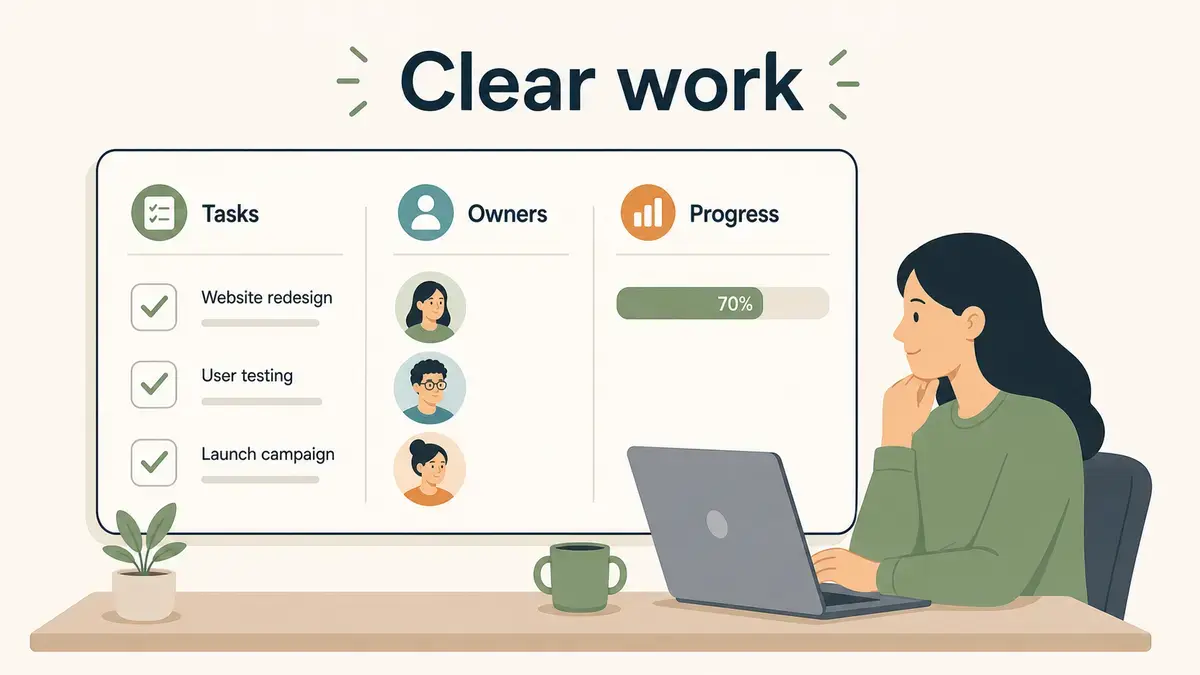
The third is having one place where project state lives. Not three. Not a board plus a doc plus a thread. One. When the work, the owner, the status, and the next step all live on the same shared boards, anyone can answer 'what is happening with X' without asking a human. When status lives in a Slack DM from Tuesday, you are paying a tax every day and you cannot see it.
The fourth is the line between written and implied. Healthy remote teams write down what colocated teams leave implicit: response windows, when it is fine to ignore notifications, how decisions get made, what 'urgent' means. The annual state of remote work report has consistently shown that the teams who write these down report less burnout and higher satisfaction than the ones running on folklore. Boring as it sounds, this prevents the slow-motion conflicts that eat remote teams alive.
Tools versus structural choices, at a glance
Most articles about remote work talk about tools. That is the wrong layer. Here is what each layer actually decides.
| Layer | What it looks like | What it actually decides | What goes wrong if you skip it |
|---|---|---|---|
| Hiring | Interview loop, references, trial project | Whether anyone can run without supervision | Managers become full-time babysitters |
| Default communication | Async writing first, meetings on demand | How much of the day is available for real work | Calendars fill up, output drops, people burn out |
| Source of truth | Shared project boards with owners and status | Whether status is visible without asking a human | Status lives in DMs and standups, nothing is trusted |
| Working agreements | Written norms on hours, response, deep work, time off | Whether people share the same expectations | Quiet conflict, resentment, eventually attrition |
| Real-time moments | Occasional unforced calls, off-sites that have a point | Whether the team feels like a team | People drift, trust erodes, hiring gets harder |
Where do remote teams quietly fall apart?
Remote teams rarely fail dramatically. They fail by drift. Output slows, meetings multiply to compensate, the best people get quieter, and one day someone notices that nobody really knows what anybody is working on. By the time it is obvious, the team has been in trouble for months.
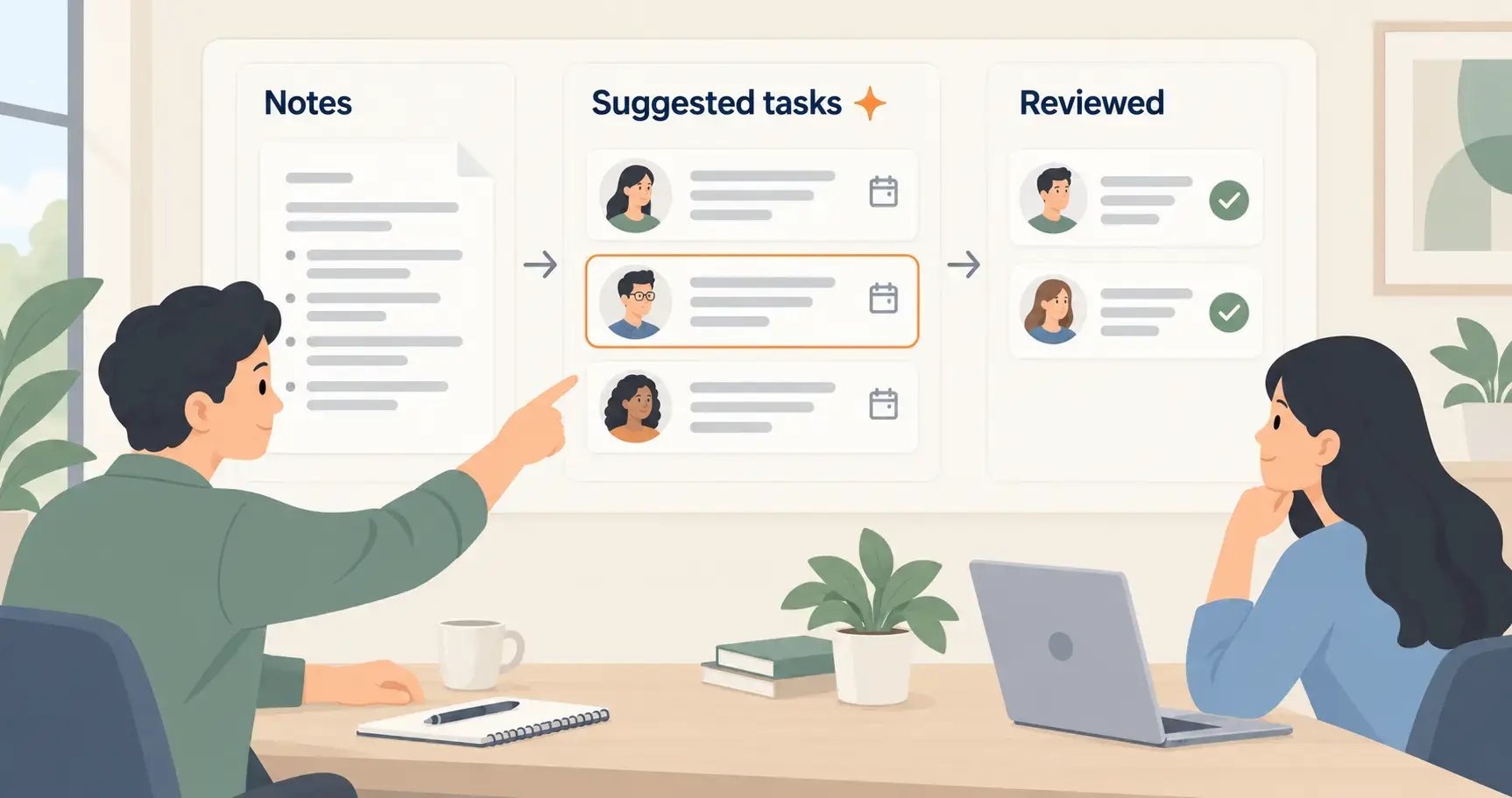
The most common failure mode is status moving into chat. Someone asks how a project is going in a DM, someone else replies in a thread, a decision gets made in a huddle, and none of it shows up anywhere a new person could find it. Three months later the team runs on tribal knowledge living in five private conversations. The fix is unromantic: every meaningful update, decision, and blocker lives on a shared board with an owner and a date, and chat is for the talking around the work, not the work itself. The huddle is the hardest one to catch, which is why some teams use AI note taking apps to get the decision out of the call and onto the board.
The second is meeting bloat. It starts with a daily standup added because 'we lost visibility', then a weekly sync to compensate, then a sync of the syncs. The real problem is that the team has no async update habit. People think a written update has to be polished, so they wait for the call. Microsoft's Work Trend Index data on the "infinite workday" shows the cost in lost focus time once meetings start multiplying. Make the async update the lowest-friction thing on the team: three lines, every couple of days, attached to the actual work. Half the recurring meetings can then be killed without anyone noticing.
The third is junior people quietly drowning. A junior in an office picks up enormous context just by being around. Remotely, none of that happens automatically. If you do not engineer mentorship and a low-stakes way to ask dumb questions, your juniors will look fine for about four months and then start to disengage. Pair every junior with a specific senior, and make it culturally fine to ask basic questions in public.
The fourth is the weak manager problem. Remote does not create weak managers, but it exposes them within weeks. A manager whose value was being visible and reacting to whatever surfaced loudest has nothing to do remotely. Their week fills with 'syncs', and none of their reports can describe a clear priority. If a manager cannot write down their team's top three priorities on a Friday afternoon, the format is not the problem.
What changes when async writing becomes the default
The cleanest pattern we have seen across the small teams that use Breeze is the shift from meeting-driven to writing-driven status. Before the shift, every project has a weekly call, someone is scrambling to remember what happened, and the doc shared afterward is read by maybe two people. The board exists but nobody trusts it because the real status is in someone's head.
After the shift, the board is the status. Every task has one owner and a current state. Async updates sit next to the work. The weekly call still happens, but it is 20 minutes on the two or three things that need a conversation, not a recital of what everyone already wrote. When project state is genuinely visible, you can onboard someone in a new timezone in a week, because they can read the boards instead of needing a human tour guide. If that new hire sits in another country, the legal side matters too; many teams use an employer of record to handle local payroll, taxes, and compliance.
When remote works and when it is a forcing function for problems
Remote works well for some kinds of teams and badly for others. Splitting the decision by team type is more useful than splitting it by ideology.
Where remote is a strong fit
Teams of mostly senior individual contributors doing deep, output-shaped work tend to thrive remotely. So do teams where the work is naturally chunkable into things one person can own end to end: product engineering, design, content, ops, most consulting. If your team already writes things down and runs on clear ownership, remote will feel like turning off a noisy fan you did not realize was on.
Where remote works but takes deliberate effort
Mixed-seniority teams, customer-facing teams, and teams whose work crosses many people in short bursts can work remotely, but they need the structural choices in place before they need them: real mentorship for juniors, written runbooks for customer issues, and shared boards that make handoffs explicit. These teams fail when they treat office habits as the baseline and bolt remote on top.
Where remote is a forcing function for problems
If a team's culture is mostly ad-hoc, priorities change three times a week, decisions are made in the loudest meeting, or the manager cannot describe what each person is doing without asking, going remote will not break the team. It will reveal what was already broken. A lot of the 'remote does not work' stories are really 'our company was held together by hallway pressure' stories. The fix is not coming back to the office. The fix is writing things down, naming owners, and managing by output.
One honest exception: very small founding teams in the messy first year often benefit from being in the same room. After that phase, the same team usually benefits from going remote.
What to actually build first
If you are starting a remote team or fixing one that is drifting, the order matters. Doing these out of order is how teams end up with a great tool stack and no change in behavior.
Start with the hiring filter
Add a short paid trial project that the candidate runs mostly on their own, with one written check-in. You will learn more from a week of that than from five interviews. The trait you are looking for is whether they take a vague goal and turn it into a concrete plan and visible progress. If they keep asking what to do next, they are not a remote hire.
Pick one place for project state
Settle on a single tool where work, owners, status, and updates all live. The specific choice matters less than the commitment to one place. We use Breeze for this, but the principle is what matters: shared boards the whole team treats as the truth, with async updates attached to the work, not floating in a doc nobody opens. Introducing a project board works best when it does not trigger tool fatigue on the team.
Write the working agreements down
Put the boring stuff in writing. Core overlap hours. Response windows for chat versus email. What deep-work blocks look like. How time off is announced. What 'urgent' means and who can declare it. Three pages, max. Revisit once a quarter. Most quiet conflict on remote teams comes from two people holding different unwritten versions of these rules.
Engineer the real-time moments
Real-time still matters, but it has to be earned. A short weekly call on the two or three things that need discussion. One-on-ones that are conversations, not status reports. An off-site once or twice a year with a clear purpose. The goal is for synchronous time to feel valuable, not mandatory. If your calendar is the real bottleneck, killing status meetings is the more practical move. The benefits of remote only really compound for teams who pull this off.
Choose remote if your work is chunkable, your hires are self-directed, and you are willing to write things down. Choose hybrid if you have a mentorship case for juniors or a customer pattern that needs in-person bursts. Avoid pure remote if your culture is ad-hoc or your managers manage by presence.
Three questions to ask before you commit
- Can your managers describe each person's top priority in writing right now?
- If not, the format is not the issue. Fix the management gap first. Remote will turn that gap into attrition faster than an office will.
- Is there one place where someone new could see the current state of every project?
- If status lives across chat threads, three docs, and a few people's heads, you are not ready to scale remotely. Pick one source of truth, even an imperfect one, and migrate before you grow.
- Are your juniors actively paired with seniors, or are they 'figuring it out'?
- Junior people without explicit mentorship are the early-warning system. If they are drifting at month four, that pattern will repeat with every new hire until you fix it.
The honest version
A remote team that works is mostly a well-run team that happens to be remote. The structural choices, hiring for self-direction, defaulting to written async, keeping one source of truth, and naming the working agreements out loud, decide far more than the tool stack. Get those right and remote is one of the most productive ways to work. Get them wrong and remote will quietly expose every weakness the office was hiding.
The practical next step is small. Pick the one of those four that is weakest on your team right now, and spend the next month fixing only that one. If it is the source-of-truth problem, that is the easiest to start on: move project state onto shared boards in Breeze or whatever single tool your team will actually use, and stop accepting status updates that live anywhere else.