 Why choose Breeze
 Marketing
 Creative
 Sales
Sales Remote work
 Managers
 Product teams
 Project management
 Task management
 Kanban tool
 Time tracking
 Project reporting
 Project calendars
 Project timeline
 Team workload
 Project automation
 Project customization
 Chat
Chat Web forms
 Project roadmap
 AI
AI What's new
 Articles & guides
 Help center
 Mobile apps
 Integrations
 Developers & API
 Free tools
How do you manage a remote team without losing the plot?

Managing a remote team is mostly about replacing what an office gave you for free: a shared sense of what is happening, the casual trust that builds when people sit near each other, and the ability to glance over and see work moving. Get those three back deliberately and remote management stops feeling like herding ghosts. The mistake almost everyone makes is recreating the office hour for hour, cameras on and people pinned to a schedule, when the whole point of remote is that you do not have to. The job is to manage visible outcomes, build trust without physical presence, and protect people from the always-on creep that burns remote teams out.
Why trust is the whole game
Trust is not a soft add-on to remote management, it is the load-bearing wall. In an office you lean on proximity: you see people at their desks, you overhear the problem being solved, and any unease about whether someone is pulling their weight gets answered just by looking. Remote takes that away, and managers who do not trust their team fill the vacuum with surveillance - status pings, mandatory cameras, activity trackers. That backfires. People who feel watched do the minimum that looks good on the tracker, and your best performers, the ones who joined for the autonomy, start job hunting.
The way out is to manage outcomes instead of presence. Decide what done looks like, agree the deadline, and leave people to get there. Whether someone did it at 7am or in two bursts after lunch is not your problem, as long as the work is good and on time. It is uncomfortable at first, because it means defining expectations up front rather than hovering. The payoff is a team that owns its work and a manager who is not a bottleneck.
Trust also runs the other direction. Your team needs to trust that you will be predictable: that you will not message at 11pm and expect an answer, that priorities will not reverse twice a week, and that you will share the context behind decisions instead of handing down orders. Predictability is what lets a distributed team plan its own days.
How communication has to change
In an office, communication is mostly ambient. You absorb half of what you need by being in the room, and grab the rest by walking to someone's desk. Remotely none of that happens, so communication has to become intentional, and the biggest upgrade is writing things down. Decisions, priorities, the reasoning behind a change - if it only lives in someone's head, half the team will be working from a stale reality by Thursday.
That does not mean drowning everyone in messages. The failure mode of remote communication is not silence, it is noise: a chat channel that never stops, where the actual decision is buried under forty reactions. The fix is to separate the two kinds. Quick, low-stakes back-and-forth belongs in chat and can be messy. Anything that matters - a goal, a deadline, a decision, an owner - belongs somewhere durable and searchable, where a colleague three time zones away can read it without asking you to repeat yourself.
Keep the informal channel alive
The other thing that vanishes remotely is small talk, and it matters more than it sounds. Water-cooler chat is where loose trust forms, the kind that makes people comfortable asking a dumb question or flagging a problem early instead of hiding it. You have to manufacture that on purpose: a channel for non-work chatter, an occasional virtual coffee, a real-life meetup if the budget allows. For a more structured version, light team-building games get people interacting as humans rather than avatars. A team that never connects as people will silo up, and silos are what a remote team cannot afford.
When to work async and when to meet
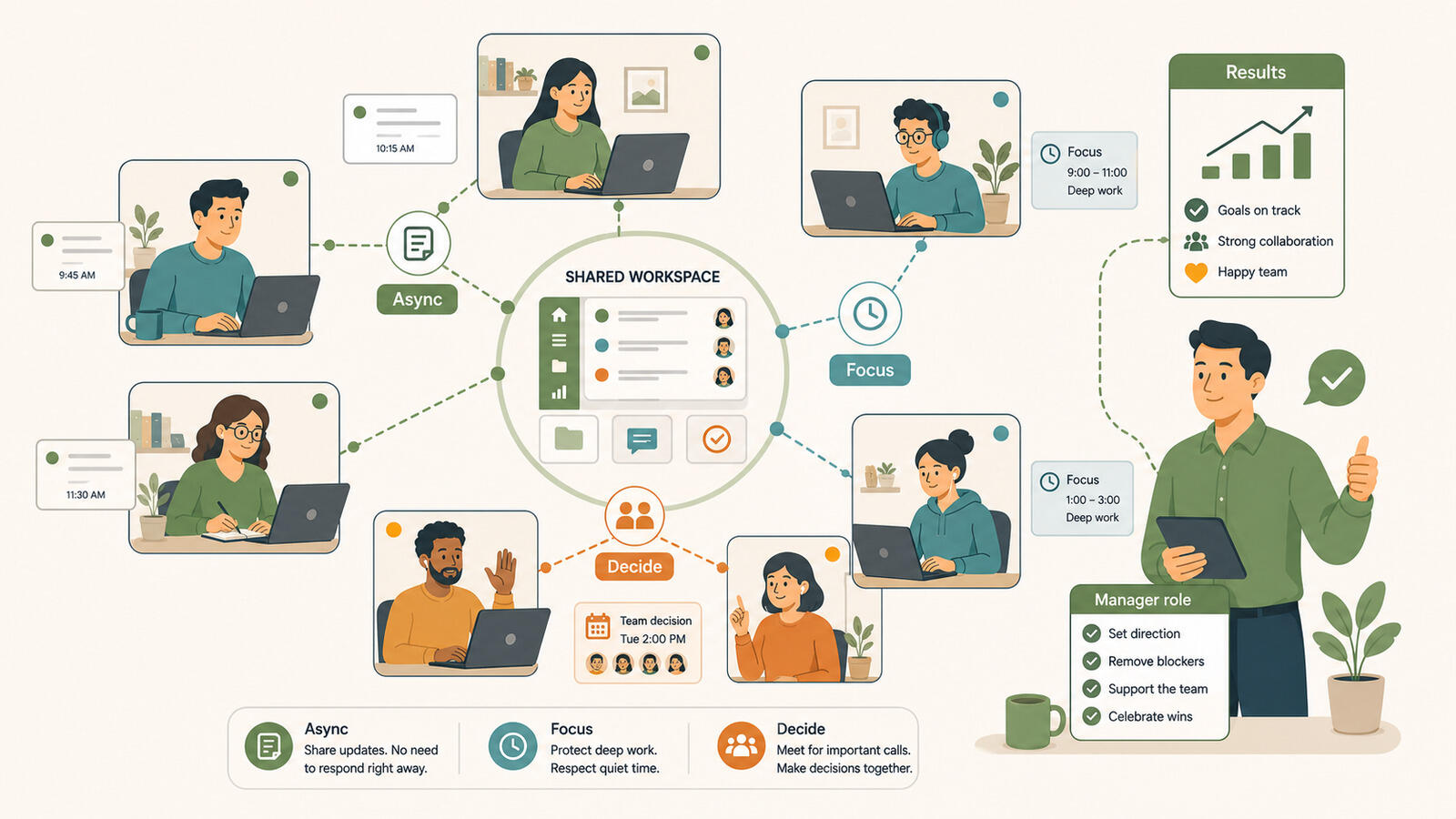
Async-first is the default that makes remote pay off, and most teams under-use it. Working asynchronously means a colleague can do their part without waiting for you to be awake or free - the context is written down, the task is clearly theirs, and they pick it up on their own schedule. Done well, async lets a team across several time zones move almost as fast as one in a single room.
The trap is assuming async means never talking. Some things genuinely need a live conversation: a thorny decision full of unknowns, tense feedback, the early shaping of a project where ideas bounce. Forcing those into a thread is slow and breeds misunderstanding. A good rule: if the goal is to share information or get a routine sign-off, do it async. If the goal is to think together or work through disagreement, meet - with an agenda and a clear purpose, because a bad video call is more draining than a bad in-person one.
When you do meet live, video earns its keep. Seeing reactions, not just hearing voices, is most of what makes a conversation feel human, and it catches the confusion a muted call hides. Keep a standing weekly sync short and focused on goals, blockers, and team-wide feedback, and handle individual matters in one-on-ones. If you run calls regularly, a few formats for virtual meetings will respect people's time.
Async versus synchronous, at a glance
Most remote friction comes from using the wrong mode for the job. Here is a quick map.
| Situation | Async (write it down) | Synchronous (meet live) |
|---|---|---|
| Status updates | Post on the board or in a thread. | Rarely worth a meeting. |
| Routine decisions | Propose in writing, let people weigh in. | Only if it stalls in text. |
| Complex or high-stakes calls | Share context first so people arrive prepared. | Yes - think together in real time. |
| Difficult feedback | Avoid - tone is too easy to misread. | Yes, with video on. |
| Brainstorming and kickoff | Collect ideas async beforehand. | Yes - energy and momentum matter. |
| Onboarding a new hire | A written handbook they can read at their pace. | A few live intros to put faces to names. |
How to keep work visible without micromanaging
Visibility quietly replaces both the status meeting and the over-the-shoulder glance, and it is where most remote teams either thrive or fall apart. The goal is simple: at any moment, anyone should be able to see what is being worked on, who owns it, and how far along it is, without messaging anyone. Then status meetings shrink to nothing and the manager stops being a progress bar.
A shared board does this better than anything. One card per task, one named owner, a due date, and a column showing where it sits in the workflow. The named owner matters more than it looks - a task that belongs to "the team" belongs to nobody and sits untouched until it becomes a fire. In Breeze, that is a project per initiative and a board with a card for each task, owner, and due date. The board is the source of truth, so your weekly sync can be about removing blockers instead of reciting what everyone did.
Visibility also exposes the other silent killer of remote teams: overload. When work is spread across chat, email, and people's memories, you cannot see that one person is buried while another is idle, and you find out only when the buried person burns out. A board that shows who owns what makes imbalance obvious. If balancing capacity is a recurring headache, managing team workload well is about spotting the imbalance before it costs someone.
How to keep a remote team from burning out
Remote burnout does not look like the office kind. There is no late-night office light, no obvious crash - just people who slowly stop logging off, answer messages at midnight, and skip lunch because the kitchen is ten feet from the desk. The boundary between work and life, which a commute used to enforce, dissolves, and many remote workers put in more hours than they ever did in an office while feeling worse about it. The manager has to redraw that line, because nobody else will.
Most of the fix is modeling and permission. If you message at all hours and reply instantly on weekends, your team will assume that is the expectation no matter what your policy says. Set a norm that messages outside someone's working hours can wait, and honor it. Make it explicit that being offline is fine and that responsiveness is not the metric - finished work is. Async habits help: when people are not expected to be reachable in real time, they step away without guilt.
Watch for the warning signs a board makes visible - someone whose tasks are all overdue, someone who has quietly stopped chatting in the team channel, a person whose card count keeps climbing while everyone else's holds steady. These are easy to miss when you cannot see people, so look on purpose. A short, genuine check-in about the person and not the project does more for retention than any perk, and on a remote team it is one of the few moments where you get to manage humans rather than route tasks.
The short version
Managing a remote team well is not about reproducing the office on video calls, it is about deliberately rebuilding the three things distance takes away - trust, clear communication, and visible progress - while protecting people from the burnout that creeps in when work has no walls. Lead with outcomes over hours and the rest gets easier.
If you want one concrete next step, put your team's current work on a single shared board this week, give every task one owner and a due date, and replace your longest status meeting with a glance at that board. It is the fastest way to swap anxious oversight for the calm visibility that makes remote work work.