 Why choose Breeze
 Marketing
 Creative
 Sales
Sales Remote work
 Managers
 Product teams
 Project management
 Task management
 Kanban tool
 Time tracking
 Project reporting
 Project calendars
 Project timeline
 Team workload
 Project automation
 Project customization
 Chat
Chat Web forms
 Project roadmap
 AI
AI What's new
 Articles & guides
 Help center
 Mobile apps
 Integrations
 Developers & API
 Free tools
How do you hire remote workers who will actually deliver?

Hiring remote workers who actually deliver comes down to one thing: you have to evaluate signals that you cannot see in an office. A confident handshake and the ability to look engaged in a meeting tell you almost nothing about whether someone can move work forward when nobody is watching. The traits that predict remote success - clear written communication, real self-direction, comfort with ambiguity, and respect for async timing - take longer to spot and show up months after the offer is signed if you skip them in the process.
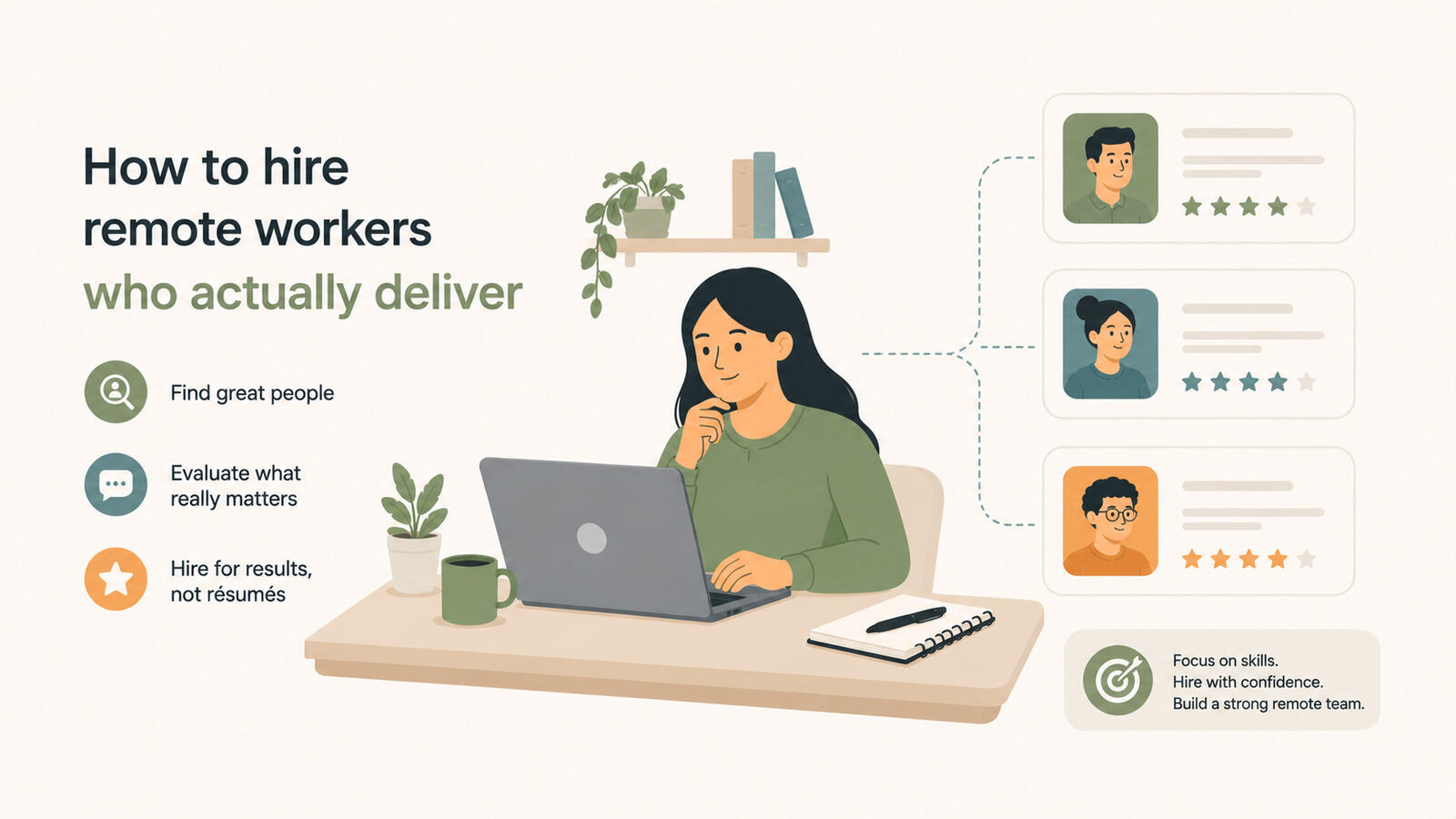
Years into mostly-remote being the default, the failure pattern has not changed. Stanford's WFH research has been making the same point in different ways for half a decade: outcomes track structure and selection, not policy. The hires that quietly stall are the ones who looked great in a 45 minute video call and then turned out to need constant unblocking. The fix is to build a hiring process that surfaces those signals on purpose, before the offer.
What actually predicts remote performance?
The signals that matter for remote roles are written communication, self-direction, comfort with ambiguity, and respect for async timing. Everything else is downstream of those four. If you optimize for them in the process, the rest of the hire usually sorts itself out. If you ignore them, no amount of culture fit or technical talent will save the relationship.
Written communication quality
If their messages are unclear, their work will be unclear. In a remote team, most of the work moves through writing. GitLab's all-remote handbook spells out why written communication is treated as a hiring discipline rather than a soft skill in remote-first companies. Task descriptions, status updates, comments on a pull request, a note left on a board for the next person picking it up - all of it is text. A candidate who writes vague three-line emails will leave vague three-line updates on every task they touch, and you will spend the rest of the year asking what they meant.
You test this by giving them something to write. Not a personality quiz. An actual short written exercise: a follow-up email to a fictional client, a project status update, a one-page summary of how they would approach a problem. Read it the way the rest of the team will read their work after they are hired.
Self-direction and real finishing
Self-direction is the trait that gets faked the most in interviews and falls apart the fastest after the hire. Everyone says they are a self-starter. What you are actually looking for is evidence of finished work - a side project shipped, a course completed, a freelance engagement closed cleanly. The pattern is whether they finish things without someone on top of them.
Ask for specifics. What did they own end to end in the last twelve months? Who decided when it was done? If the answer is always "my manager set the deadline," that is a serious risk for a remote role. When you are building a remote team, self-direction is the trait that compounds most over a hire's first year.
Comfort with ambiguity
Remote work pushes a lot of small decisions down to the individual. The Slack response is not coming for four hours. The doc does not quite cover the case in front of them. A candidate who needs every decision pre-approved will produce a slow trickle of work and a steady stream of clarifying questions. A candidate who can make the reasonable call, document it, and move on will produce far more with a fraction of the management load.
Ask about a time the spec was wrong. Ask what they did. The honest answers are messy and specific. The rehearsed answers are smooth and useless.
Async respect
The last signal is whether a candidate understands that an unanswered message is not a snub. Some people, often new to remote, treat a four hour response delay like an emergency. That energy in a hiring process becomes a daily tax once they are on the team. Look for people who batch their questions, write a complete message the first time, and let the other person come back when they come back.
In-office signals vs remote signals at a glance
The hiring instincts that work in an office actively mislead you when you are hiring remote. Here is the swap, side by side.
| Area | In-office hiring signal | Remote hiring signal |
|---|---|---|
| Communication | Articulate in conversation, good in meetings | Writes clearly, leaves complete updates, no follow-up needed |
| Drive | Enthusiastic energy in person, asks lots of questions | Has finished real projects without a manager pushing |
| Collaboration | Team player, friendly, easy to be around all day | Unblocks themselves, documents decisions, hands off cleanly |
| Responsiveness | Available, visible at their desk, fast in person | Replies in a reasonable window, batches questions, respects others' focus |
| Trust signal | Manager sees them working | Work shows up on the board, on time, with clear notes |
What are the red flags during a remote hiring process?
Most failed remote hires send signals during the process. They are easy to miss because they look small. They are not small. Each one of these usually compounds into a real problem within the first ninety days.
They need to be unblocked constantly
If a candidate is messaging you with clarifying questions about a take-home that has a clear two-page brief, that is the pattern continuing forever. Remote work demands the muscle of figuring out the next step from incomplete information. Watch how they handle the parts of the brief you intentionally left a little open.
They struggle with written async
Short replies that do not actually answer the question. Messages split into seven bursts instead of one complete thought. Long delays followed by a request to hop on a call instead of writing it out. None of these are deal breakers on their own. The pattern is.
They complain about response times
If a candidate complains about not hearing back within twenty four hours during hiring, they will treat their future teammates the same way. A candidate who cannot extend that grace during interviews will not extend it on Tuesday afternoon either.
Their portfolio is all collaborative
Be careful with candidates who can only point to work they did as part of a large team where their personal contribution is impossible to isolate. Sometimes that is genuine. Sometimes it is a sign that they have never owned a deliverable from start to finish. Ask which specific decisions were theirs. The answer should come quickly.
Which roles actually work remote, and which usually do not?
Not every role becomes a great remote role just because the company decided to go remote. The split is less about job title and more about how much of the work is self-contained and writeable, and how often the person needs to read a room they cannot see.
Roles that tend to work well remote
Engineering, design, writing, content, marketing operations, finance, data analysis, customer support, most product work. Buffer's state of remote reports have shown these roles consistently as the cleanest fit year after year. Anything where the deliverable is a file, a ticket, a piece of code, a document, or a response, and where the inputs can be passed in async. These roles fit naturally with a board-driven workflow where tasks get picked up, worked on, and handed off without anyone needing to schedule a meeting first. In Breeze we see this constantly - a designer drops the file on the task, leaves a comment, and the developer picks it up four hours later in a different timezone. Nothing was lost.
Roles that work remote with effort
Sales, partnerships, founder roles, anything with heavy stakeholder management. These can absolutely be done remote, but the hire needs to be very strong on async writing and explicit about scheduling synchronous time when it actually matters.
Roles that usually struggle remote
Pure people management at scale, anything that involves a lot of in-person coaching, complex multi-party negotiations, and very senior leadership roles where reading the room is half the job. Junior hires in any function are also harder remote, because they need more frequent feedback loops than async naturally allows.
A hiring process that actually tests for remote work
The process matters more than the questions. If every step of your hiring process is a video call, you have not learned anything about how this person performs remote. The fix is to mirror the actual work in the evaluation.
One written round before any call
Before you spend a single hour on video, send the candidate a small written exercise. Not a personality questionnaire. Something with a concrete output - a short brief they need to respond to, a problem they need to outline an approach for, a fictional client message they need to reply to. Twenty minutes of their time, ten minutes of yours to read. This filter alone removes more weak candidates than the next three interview rounds combined.
An async take-home with realistic scope
Pay for it. Two to four hours of work, capped, with a clear deliverable. The exercise should look like real work the person would do in the first month. For an engineer, a small feature with intentionally incomplete requirements. For a marketer, a draft of content with a brief. For an ops hire, a process they need to map out.
What you are evaluating is not just the output. It is also how they handled the ambiguous parts, whether they asked clarifying questions before starting, how they wrote up the result. Run the project through the same tools the team uses day to day. If your team lives in Breeze, give them a real task on a sandbox board with a deadline and let them work it the way a teammate would. The way they leave notes and updates on that task is exactly how they will leave them after they are hired. Pair this with the broader picture in our benefits of remote work rundown if you are making the case for the heavier process internally.
A short paid trial for senior roles
For anything beyond a junior hire, consider a one to two week paid trial before the full offer. Properly paid and scoped, it is the single highest-signal step in remote hiring. You will know within five working days whether the async rhythm is going to work.
References that specifically address remote delivery
When you call references, do not ask whether the person was great. Ask remote-specific questions. Did they leave clear updates? Did they finish work without being chased? How did they handle being blocked when nobody was around? Most references default to vague positive answers. Specific questions force specific answers.
Watch how they use your tools
If your remote workflow runs through a project tool, pay close attention to how the candidate uses it during the trial. Do they update the task as they go, or only at the end? Do they leave a clear comment when they hand off, or do they ping in Slack and skip the board entirely? In Breeze, the pattern we see in healthy remote teams is that the board is the single source of truth - if it is not on the task, it did not happen. A candidate who naturally gravitates toward writing things down on the work itself, instead of in side channels, is showing you exactly what their first six months will look like.
Choose a heavier process if the role is senior, the team is small, or a bad hire would block other people's work. Skip the trial only if the role is genuinely junior and the written rounds already gave you a clean signal. Once the hire is on board, the practices in our remote team management piece are what protect the investment.
Questions to ask before sending the offer
- Would I be comfortable with this person on a four day async stretch with no calls?
- If the honest answer is no, the hire is not ready yet. The job is async by default. Calls are a treat, not a default.
- Did the candidate make my life easier or harder during the hiring process?
- Hiring is a preview of working together. Clear emails, on-time replies, and complete answers in the process predict the same after the offer.
- Can I point to a specific finished thing they own?
- If not, you are guessing on self-direction. Slow down and ask for more evidence before committing.
Remote hiring is slower for a reason
Hire remote workers by testing for the things that actually break remote teams: unclear writing, weak self-direction, and a need for constant unblocking. Almost everything else can be coached. Those three usually cannot, at least not on your timeline.
The honest tradeoff is that a proper remote hiring process takes longer than an in-office one. Two written rounds, a paid take-home, sometimes a trial, references with real questions. It feels heavy. The reason to do it anyway is that the cost of a bad remote hire is higher too - they are harder to manage, harder to coach, and the symptoms take longer to show. Investing the extra two weeks up front saves you the six months on the back end.
If you want a sandbox to run a realistic trial task on, set the candidate up with a small project in Breeze and watch how they work through it. The way they use the board will tell you most of what you need to know.