 Why choose Breeze
 Marketing
 Creative
 Sales
Sales Remote work
 Managers
 Product teams
 Project management
 Task management
 Kanban tool
 Time tracking
 Project reporting
 Project calendars
 Project timeline
 Team workload
 Project automation
 Project customization
 Chat
Chat Web forms
 Project roadmap
 AI
AI What's new
 Articles & guides
 Help center
 Mobile apps
 Integrations
 Developers & API
 Free tools
Which productivity habits actually work when you have a real job?

Most productivity advice falls apart the moment you have a real job with real interruptions. The habits that hold up are the boring ones: protecting deep work blocks, reducing decision friction, treating meetings as the expensive option. The ones that don't hold up are the photogenic ones - the 5am routine, the colour-coded time-tracking spreadsheet, inbox zero as identity. This post is opinionated on purpose. Most of it comes from watching small teams in the wild and noticing which habits survive a busy quarter and which quietly disappear.

Why does most productivity advice fall apart in a real job?
Because most of it is written for an empty calendar. A 25 minute Pomodoro is great if nothing else is on fire, but Microsoft's Work Trend Index found employees get interrupted on average every two minutes during the workday. If your morning starts with three urgent Slack threads and a teammate blocked on your review, the timer is already lying to you.
The other problem is that generic advice ignores the shape of the work. A designer doing four hours of focused craft needs a different setup than a customer success lead who lives inside a shared inbox. When advice ignores the work, the advice loses.
So the question isn't "which 10 habits should everyone adopt." It's "which habits reduce friction for the work you actually do, and which ones just feel productive." Those two lists overlap less than you'd think.
What gets repeated vs what actually moves the needle
Here's the short version, before the longer one. The left column is what shows up in every productivity listicle. The right column is what tends to stick after a busy quarter.
| Area | Advice that gets repeated | What actually moves the needle |
|---|---|---|
| Focus | Pomodoro timers, 25 on 5 off, all day | Two protected deep work blocks per day, calendar-blocked, notifications off |
| Inbox | Inbox zero as a daily ritual | The 2 minute rule for replies, batched email twice a day, nothing else |
| Planning | Detailed daily to-do lists with priorities A through F | Three things that have to ship today, written down before lunch |
| Time tracking | Track every minute across 12 categories | One weekly 10 minute review of where the week actually went |
| Meetings | Better agendas, faster meetings, standing meetings | Default to async, meet only when a decision is genuinely stuck |
| Mornings | 5am wake-up, journal, cold plunge, meditation, gratitude | Know what you're starting with before you open your laptop |
Which productivity habits are actually worth keeping?
The habits that hold up have one thing in common: they reduce the number of small decisions you have to make in a day. Decision fatigue is real, and most "productivity" problems are actually decision problems in disguise. Here are the ones worth keeping.
Time blocking, but for two blocks not twelve
The version that works is simple. Pick the two windows when you're sharpest, usually mid-morning and early afternoon, and treat them as time-blocked deep work. Notifications off, Slack closed, one task. Everything else fits around those blocks, not the other way around.
The version that doesn't work is the one where you colour-code every half hour from 7am to 9pm. That's not a schedule, it's a fantasy. The first interruption breaks it and you stop trusting the calendar. Two blocks you defend beats twelve you ignore.
The 2 minute rule for inbox and comment debt
If a reply, a Slack message, or a task comment will take under two minutes, do it now. Don't add it to a list, don't promise to come back to it. That's the heart of the two-minute rule in practice. The cost of tracking it is higher than the cost of just answering. This is the one piece of David Allen advice that survives contact with real teams.
In practice, this means twice a day you scan unread comments on tasks in Breeze, reply to anything that's a quick answer, and only convert the rest into actual work items. The comment debt that crushes teams is the 30-message thread where everyone is waiting for someone else to make the first reply.
Define what "done" looks like before you start
The biggest source of rework on small teams isn't sloppy work. It's a fuzzy finish line. Someone starts a task thinking "done" means a draft, the reviewer thinks "done" means shippable. Cue another round.
The fix is a one-line definition of done, written into the task before any work happens. "Done means the landing page copy is approved by Anna and live on staging." Ten seconds, and the back and forth disappears. If your project tool makes this easy to do inline, you'll do it. If it requires a form and a workflow, you won't.
The weekly 10 minute reset
Every Friday afternoon, or Monday morning if that's when you think clearly, run a short Friday reset on three questions. What shipped this week? What's still open and why? What two or three things have to move next week? Write the answers somewhere you'll see them.
That's the entire system. No template, no app, no Notion database with seven views. The point is to spend ten minutes thinking about your week instead of just plunging into the next. Teams that do this catch problems weeks earlier than teams that don't.
Batching context-heavy work
Switching between pieces of work that need different context is expensive. APA research on multitasking pegs the productivity cost at up to 40% of someone's time. Writing a proposal, then a code review, then a customer call, then back to the proposal, takes roughly twice as long as doing them in clean blocks. The practical version: group similar work. All reviews in one block, all customer replies in another, all writing in a third. The work doesn't change. The cost of switching between modes does.
Treat meetings as the expensive option
A 30 minute meeting with five people is two and a half hours of payroll, plus the context-switch tax on either side. The default should be async: write the question down, give people a few hours to respond, and only escalate to a meeting when the thread is going in circles.
The teams that get this right have a single place where decisions live. Inside a task in Breeze, on a project board, in a doc, but one place. When the answer to "where did we land on that?" is "let me find the Slack thread", you've already lost.
What changes when a team stops chasing productivity theatre?
The clearest pattern across the teams we work with is that the ones who stop trying to "optimise productivity" end up more productive. Teams who treat their project tool as a place to track real commitments do better than the ones who treat it as a system to be perfected.
Before: every task has a priority, a label, a due date, an estimate, an assignee, a watcher list, and three custom fields. Half are wrong because nobody has time to keep them current. The board looks impressive in a screenshot and is useless on a Tuesday afternoon.
After: tasks have a title, an owner, a due date if it actually matters, and a one-line definition of done. The board is smaller, less colourful, and dramatically more accurate. People look at it because it tells the truth.
Which popular productivity habits are mostly overrated?
Not every productivity habit is bad, but several get more credit than they earn. These are the ones to be skeptical of.
The elaborate morning routine
A 5am wake-up, journal, meditation, cold plunge, and a 90 minute reading block sounds great in a podcast and rarely survives a sick toddler or a launch week. The individual pieces are fine. The problem is treating the routine as the source of productivity. The routine is the warm-up, not the work.
What does help: knowing what you're starting with before you open your laptop. One sentence the night before that says "tomorrow I'm working on X first." That's the entire morning habit. The rest is preference.
Detailed time tracking
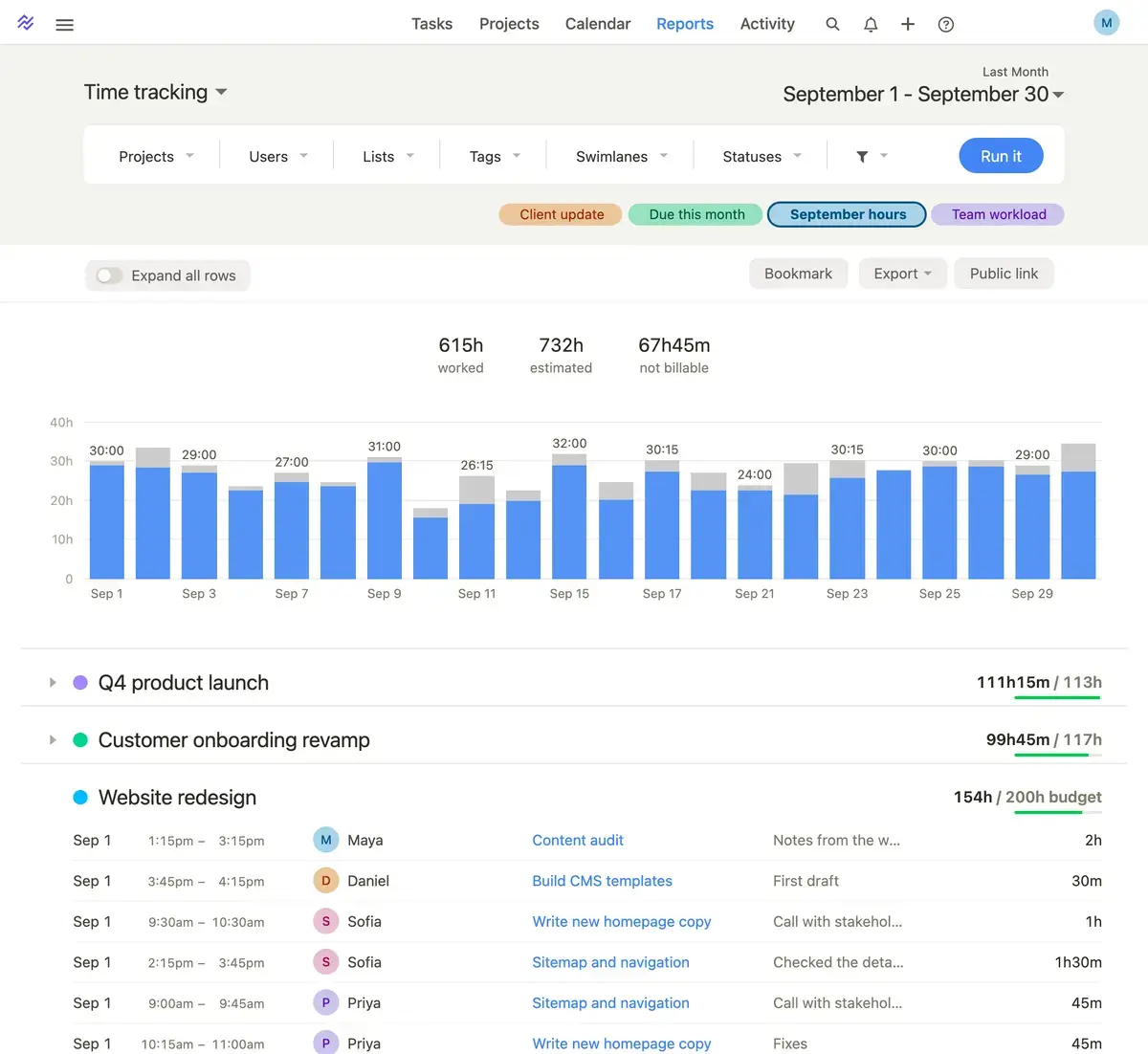
Tracking every minute across 12 categories almost always collapses within three weeks. It's a lot of admin to discover what most people already suspect: too much time on meetings, too much on email, not enough on deep work. For client billing, tracking is unavoidable and a simple in-task timer is fine. For personal "where did my week go" insight, the weekly 10 minute reset gives you 80 percent of the value at 5 percent of the cost.
Inbox zero as identity
The goal of email is not an empty inbox. The goal is to answer the things that matter and ignore the things that don't. A daily ritual of getting to zero, especially if it eats into a deep work block, is just busy work dressed up as discipline. Twice a day, ten minutes each time, is plenty for most roles.
Multitasking, in any form
Every credible study, including Nielsen Norman's focus research, lands in the same place: multitasking makes you slower and more error-prone. If you're proud of juggling ten threads, you're probably finishing each one worse than someone who finishes them one at a time. Passive parallel work like a long build running while you read doesn't count.
Saying yes to keep options open
Overcommitment doesn't come from one bad decision. It comes from a hundred small yeses, each of which felt small in the moment. The discipline that compounds is saying no to the meetings, calls, and "quick chats" that don't move anything. Give yourself permission to say "let me check my calendar" and come back the next day. The request usually looks smaller in the morning.
How should you pick which habits to actually try?
Don't try to adopt six new habits at once. That's the productivity equivalent of a crash diet, and it fails for the same reasons. Pick one or two that match your actual friction, and run them for a month before adding anything else.
If you can't find focus
Start with two protected deep work blocks. Put them on your calendar, tell your team, close Slack during those windows. Don't fiddle with timer apps or website blockers yet. Just the blocks. If after two weeks the work is still getting interrupted, then look at what's interrupting and fix that specifically.
If your inbox owns your day
Set two batched email windows, maybe 11am and 4pm. Combine that with the 2 minute rule. Anything bigger than two minutes becomes a task with a clear definition of done, not a half-answered email thread. Most teams find a sane email rhythm within a week of doing this.
If your team keeps re-doing work
This is almost always a definition-of-done problem. Add a "done means..." line to every task before it gets picked up - a single line at the top of the task is enough. The rework tax drops fast, and so does the volume of "is this what you meant?" Slack threads.
If meetings are eating the week
Default to async for anything that isn't a real-time decision. Move status updates into the project tool, and you can usually kill the standing meeting entirely. In Breeze, that's a comment on the task with the people who care subscribed. Only call a meeting when the async thread has stalled or a real decision needs everyone in the same room.
Pick one if you're not sure where to start. Run it for a month. If it sticks, add a second. If it doesn't, the habit wasn't matched to the actual friction - try a different one rather than blaming yourself.
Quick decision points
- How do I know if a habit is working?
- You're not thinking about it anymore. Real habits become invisible. If you're still talking about your morning routine after three months, it's a hobby, not a productivity gain.
- What if my team won't adopt any of this?
- Start with yourself for a month. Habits spread when people see them working, not when they're announced. If your week visibly opens up, two or three teammates will copy whatever you did.
- Do I really need a productivity app for any of this?
- You need somewhere to put commitments so they're not in your head, and somewhere decisions can live so they're not in chat. Whether that's a project tool, a notebook, or a doc matters less than picking one and using it.
What to actually do this week
Pick one habit from the "actually works" list, not three. Block two deep work windows on your calendar, or add a definition of done to every task you own, or switch your email to two batched windows. One change, one week, and see what happens.
If your team's project setup is making any of this harder than it should be, that's usually the lower-hanging fix. A smaller, honest board beats a beautiful one nobody trusts. Breeze is built around that idea if you want to see what a simpler setup looks like.