 Why choose Breeze
 Marketing
 Creative
 Sales
Sales Remote work
 Managers
 Product teams
 Project management
 Task management
 Kanban tool
 Time tracking
 Project reporting
 Project calendars
 Project timeline
 Team workload
 Project automation
 Project customization
 Chat
Chat Web forms
 Project roadmap
 AI
AI What's new
 Articles & guides
 Help center
 Mobile apps
 Integrations
 Developers & API
 Free tools
How do you actually overcome procrastination at work?

Most procrastination at work isn't a willpower problem, it's a friction problem. The task you keep avoiding usually has an unclear first step, a vague definition of done, or it's wedged behind a decision someone else hasn't made yet. Fix the structure of the work and the avoidance shrinks on its own. The rest of this post is a set of patterns that knowledge workers, team leads, and small business owners can use to get themselves and their teams unstuck without turning into productivity robots.

Why do you actually keep putting off the same task?
The honest answer is almost never 'I'm lazy'. When a single task sits on your list for three days, four days, a week, there's usually a hidden reason. The work isn't shaped in a way your brain can start on. Once you name the reason, the fix is mechanical.
The patterns repeat across teams. The task is too big, so any starting point feels arbitrary. The inputs are missing, so you'd have to chase someone before you can begin. The deliverable is fuzzy, so you can't tell when you're allowed to stop. Someone else owns a decision the task depends on, but no one has written that down. The task is genuinely unpleasant and there's nothing on the calendar forcing it. In a small team, the same five issues account for most of the stuck items on the board.
Compare two versions of the same line on a board. Version one: 'Update onboarding emails.' Version two: 'Rewrite the first three customer onboarding emails so they reference the new pricing page, draft in a shared doc, hand to Maria for review by Thursday.' The second one gets started. The first one gets carried to next week, then the week after.
What does the first two minutes actually look like?
The single highest-leverage trick for procrastination at work is what you might call the entry-point hack. Pick the task you're avoiding and write down only the first concrete action you'd take if you were starting right now. Not the goal, not the outcome, the literal first move. 'Open the doc.' 'Find the file Erik sent.' 'Reply to the supplier email asking which SKU.' That's the task you put on the board, at least for today.
This works because the part of avoidance you can actually feel is the activation cost. BJ Fogg's behavior model calls this out directly: the easier the first action, the more likely the behavior happens at all. Once you're three minutes in, you usually keep going. The mental hurdle is the empty first step, not the work itself. People who look productive aren't fighting harder, they're just spending less time in the doorway.
There's a related move for managers. When someone on the team keeps deferring a task, don't ask them why. Ask them what the first two minutes of doing it would look like. If they can't describe it, that's the actual problem. The task isn't ready to be done yet, regardless of whose name is on it.
How do you break a big task into chunks that move?
'Tiny task chunking' sounds like productivity-blog jargon, but it solves a real failure mode. Big, vague tasks like 'redesign the pricing page' or 'fix the reporting' sit on a board untouched for weeks because there's no way to be partly done with them. You either ship the redesign or you don't. So the task never makes visible progress, and after a while it becomes invisible. The team stops seeing it.
The fix is to split the work into chunks that each have their own definition of done. For a pricing page redesign that might be: collect the three competitor pages we want to react to, write the new headline and three sub-bullets, draft the new comparison table, get sign-off on the comparison table copy, hand visual design to Lena. Five items, each with a clear finish, each small enough that someone can pick it up at 2pm and close it before they leave.
This is where a workload board view earns its keep. In Breeze, dragging chunks across a board makes it obvious which sub-tasks are stuck and which are flowing. The big parent task no longer sits as a single brown lump on the list. You can see exactly which chunk is blocked, who's holding it, and what the next move is. The act of splitting the work usually surfaces the real blocker too, which is almost always 'we never decided what this is supposed to look like'.
What changes when every task has a clear definition of done?
Asking 'what does done look like?' is the cheapest project intervention there is. It costs one sentence and it eliminates a surprising amount of procrastination, both for individuals and for whole teams.
Before: a task on the board says 'improve the support docs'. It sits there. Three people glance at it each week and quietly think 'that's not really for me to start'. Even the person assigned doesn't open it, because they don't know what would count as having finished. Any work they do feels like it could be wrong.
After: the same task says 'update the five docs linked from the in-app help menu so they match the new dashboard, and send the diff to Anna for a quick read'. Now there's a clear start (open those five pages), a clear scope (only those five), and a clear endpoint (Anna has seen the diff). The same person closes it in an afternoon.
Most stuck tasks in Breeze workspaces aren't stuck because someone is avoiding them. They're stuck because the line on the board is a wish, not a task. Once teams adopt the habit of writing tasks as 'do X, hand to Y, by Z', avoidance drops on its own. Nobody decided to try harder, the work just became startable.
What do you do when the task is blocked by someone else?
A huge category of procrastination isn't real procrastination at all. The task can't move because it's waiting on a decision, an input, or a sign-off from someone else, and that fact is invisible. So it looks like you're avoiding it, when really the work is impossible to do as written.
The pattern that fixes this is to defer the decision to the async owner and get the task off your active list. Three things have to happen at once. Write down what you specifically need, from whom, by when. Move the task into a 'waiting' or 'blocked' state instead of leaving it in your 'today' column. Then schedule the next check or hand the decision to the actual owner with a deadline they've agreed to.
This sounds bureaucratic written out, but in practice it's the difference between a board you trust and a board that lies to you. When your 'in progress' column is full of items that are secretly waiting on other people, you stop believing the board and start procrastinating on looking at it. Then you procrastinate on the work the board was supposed to be tracking. The whole system collapses.
Decisions that aren't yours
If the task needs the founder to say yes or no, the founder owns the next move, not you. Send them the two options and a recommended choice with a deadline. Move on.
Inputs you don't have
If you need the numbers from finance before you can write the report, the report isn't a task yet. The task is 'ask finance for the numbers'. Treat them as two separate items on the board.
Reviews you're waiting on
If someone needs to review your draft before you ship, the task on your list should be the next thing you do after they review, not the review itself. Use a comment or mention to put it back in their court, then pick up the next item.
Meetings that should have been a Slack message
Some tasks are stuck because they're informally tied to a recurring meeting that keeps getting rescheduled. Pull the decision out of the meeting, write the question in a thread, and let async resolve it. The task starts moving the same day.
Which patterns actually help once you've cleaned up the friction?
Once the structural fixes are in place, the well-known personal techniques start working better, because they're applied to tasks that are actually ready. Without the structural work first, they tend to fail and people blame themselves.
Timeboxing in 25-minute blocks, or the Pomodoro method as it's usually called, works well for any task you've narrowed down to a specific first action. It doesn't work for 'improve the support docs', because you'll spend the 25 minutes deciding what to do. It works great for 'draft a new intro paragraph for the billing page'.
Time-of-day matching matters more than people admit. HBR research on energy management echoes this: people consistently mis-spend their peak hours. The hardest task of the week, the one you keep avoiding, almost always belongs in the first ninety minutes of your best day, before meetings start. Schedule it like a meeting. Most knowledge workers waste their best two hours of the week on email triage and then attempt the hard task at 4pm, which is exactly when their brain has the least patience for ambiguity.
Two-list discipline helps when your task list has grown into a graveyard. Keep one short list of the three to five items you actually plan to close today. Keep the long list separate. The short list is allowed to be honest. The long list is allowed to be long. Trying to make one list serve both purposes is why most people stop trusting their task list inside a month.
How do you stop a whole team from procrastinating on the same task?
When a task lingers on a shared board for two weeks, the issue is rarely individual. There's a pattern in how the team treats certain kinds of work, and it's worth naming out loud.
The most common one is 'nobody really owns this'. A task assigned to two people is usually a task assigned to nobody. Either pick one owner with the other person as the reviewer, or split the task in two with separate owners.
Another pattern is 'this is too important to start'. Some tasks become so symbolic, the redesign, the new policy, the rewrite, that everyone is afraid to put down a rough version. The fix is to ship the ugliest possible version inside the team first. A rough draft of a policy, a wireframe instead of a design, a one-paragraph version of the rewrite. Once something concrete exists, reactions appear, the work becomes editable, and the avoidance breaks.
The third one, and the one teams underestimate, is meeting overhead. Microsoft's Work Trend Index found that 57% of meetings are ad hoc, eating directly into focus time. If half your team's working day is meetings, the only time to do the hard tasks is the leftover scraps. People procrastinate on those tasks because there's no usable block of time to attempt them. Cutting one recurring meeting often does more for team output than any individual focus trick.
Where to start tomorrow
Pick the one task you've been avoiding longest. Don't try to do it. Just answer three questions on paper. What is the literal first two-minute action? What does done look like in one sentence? Who, if anyone, am I actually waiting on? Most of the time, one of those three answers reveals why the task hasn't moved, and the fix becomes obvious.
If you manage a team, do the same exercise once a week on the three oldest items on your board. Don't ask people to try harder. Ask whether the task is shaped in a way that someone could start it in the next ten minutes. The procrastination usually wasn't in the people. It was in the line on the board the whole time.
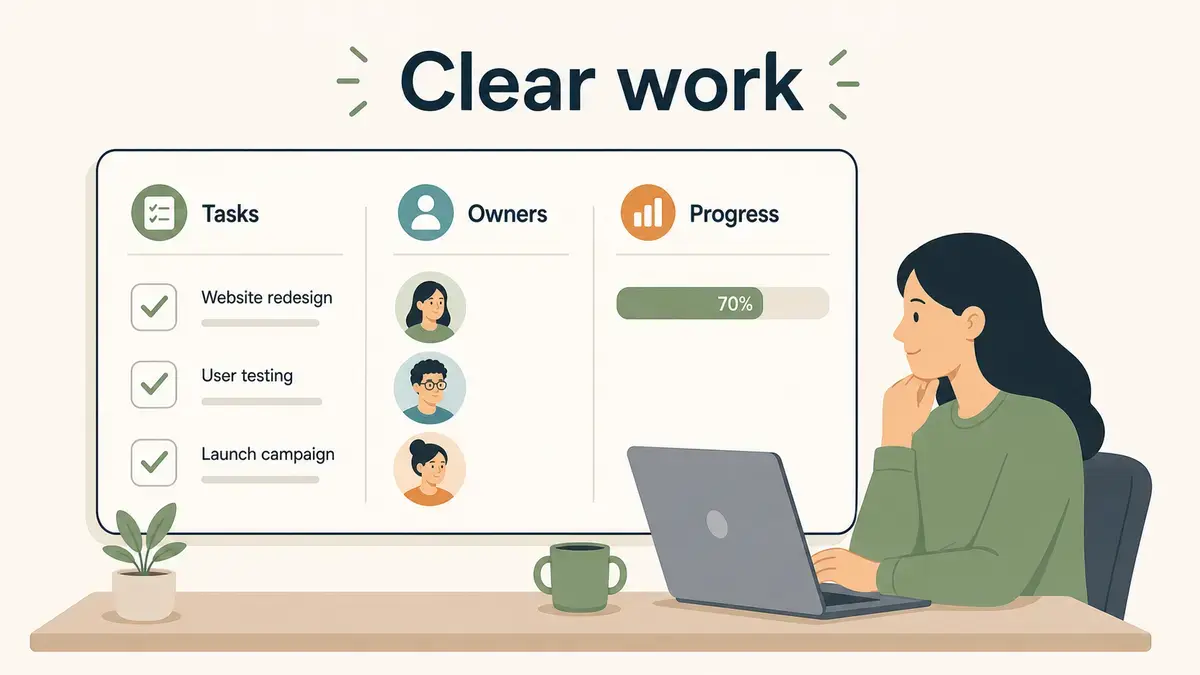
If your current task list is the thing you keep procrastinating on, that's a signal too. A board you trust is a board you'll actually open. Breeze is built around small, clear tasks with owners and visible status, which is most of what it takes to make work startable again.