 Why choose Breeze
 Marketing
 Creative
 Sales
Sales Remote work
 Managers
 Product teams
 Project management
 Task management
 Kanban tool
 Time tracking
 Project reporting
 Project calendars
 Project timeline
 Team workload
 Project automation
 Project customization
 Chat
Chat Web forms
 Project roadmap
 AI
AI What's new
 Articles & guides
 Help center
 Mobile apps
 Integrations
 Developers & API
 Free tools
Why do long to-do lists hurt productivity?

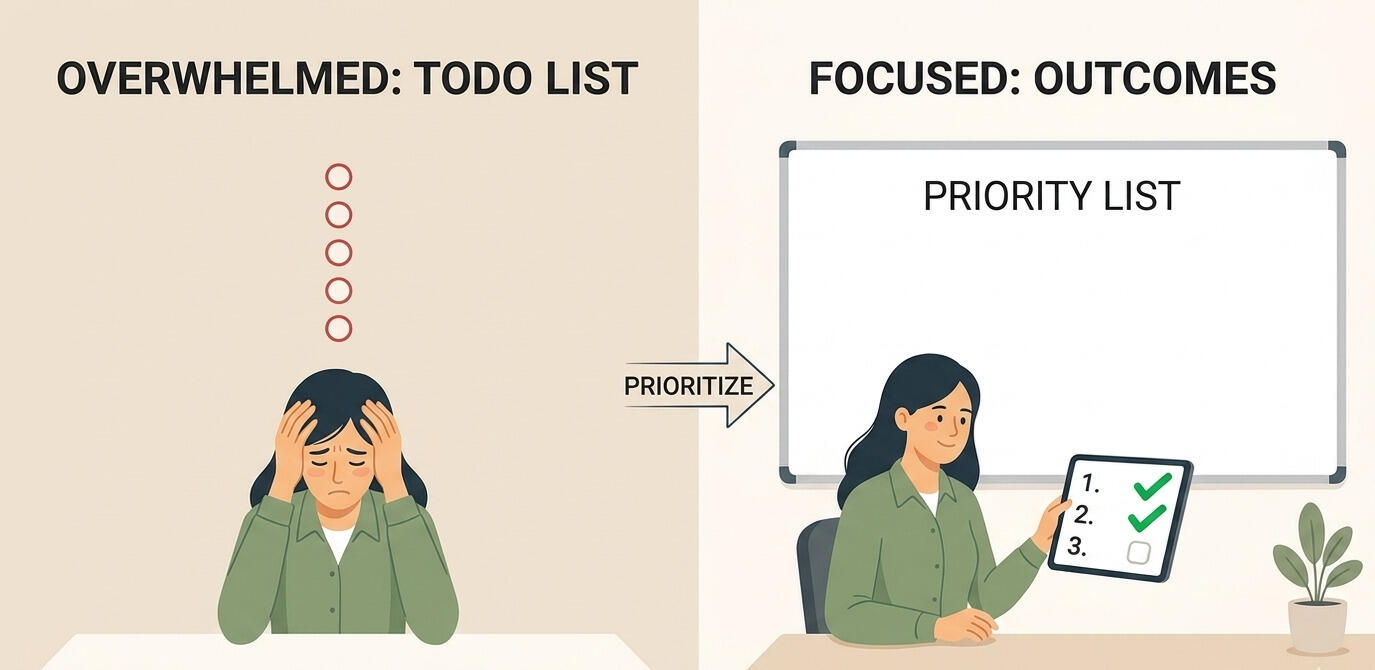
A long to-do list hurts productivity because it treats every task as equal and rewards you for finishing the easy ones. Crossing off "reply to that email" feels as good as shipping the thing that moves your business, so your attention drifts to whatever clears fastest. The result is a packed, satisfying day that leaves the important work untouched. The list itself is not the enemy - relying on it as your whole system is. The fix is not a better list, it is turning tasks into priorities, outcomes, and protected time.
What actually goes wrong with long to-do lists
The core problem is that a long to-do list rewards the wrong work. Checking off an item gives you a small but genuine hit of satisfaction, and your brain does not grade that reward by importance - clearing a two-minute task feels as good as finishing a two-week project. So you drift toward the easy, low-stakes items because they pay out fastest, and the hard, high-value work keeps getting pushed to tomorrow.
That drift is not laziness, it is the system working as designed. A flat list strips out context. "Send an invoice" sits on the same line as "finalize next quarter's strategy," with no signal that one is routine and the other could change your year. When everything looks equal, the urgent and the quick always crowd out the important.
The scale of this is not flattering to the format. According to research summarized by HuffPost, 41% of items on to-do lists are never completed. If nearly half of what you write down never gets done, the list is less a record of progress than a record of intentions, and the items that fall off are rarely the trivial ones. If you have ever looked back and thought "I was busy all day, but what did I actually achieve," you have met this firsthand.
Why busy is not the same as productive
Busy and productive feel identical from the inside, which is why they get confused. A packed schedule and a long row of crossed-off items look like hard work, and hard work is supposed to produce results. But being busy usually means reacting to whatever is loudest, not advancing what matters most. You spend the hours on emails, approvals, and quick fixes while the projects that would grow the business sit untouched.
Tim Ferriss, author of The 4-Hour Workweek, put it bluntly: "Being busy is a form of laziness - lazy thinking and indiscriminate action." That sounds harsh until you notice how often a full day was full of things you never decided to do. Busyness lets you dodge the harder question of what deserves your time, because answering it is uncomfortable and clearing the inbox is not.
The cost compounds. A team kept in constant motion without a sense of building anything real does not just move slowly, it burns out. People can tell the difference between a day that mattered and a day that merely filled up. The goal is not to do more things faster, it is to be more selective about which things get your best hours.
Why the list never ends, and why that matters
One quiet lie a to-do list tells is that you can eventually reach the bottom of it. Clear enough items and you will hit a clean slate: empty list, quiet mind, nothing hanging over you. In practice that day never arrives. New tasks land constantly - a client request, a last-minute change, an internal fire - and the list refills as fast as you empty it, or faster.
This sets up a frustrating loop. You finish a hard day, clear most of what you planned, and still feel behind, because three new things showed up while you worked. The problem is not your speed - a never-ending list is built to leave you feeling unfinished no matter how much you do.
Accepting that you will never "finish everything" is oddly freeing. Once you stop treating an empty list as the goal, you can stop trying to do everything and start choosing the right things. That shift - from completeness to selection - also changes what a tool is for. A board in Breeze, for instance, is most useful not as a place to pile every possible task, but as a place to see the few that move a project and watch them flow to done, rather than a backlog that only ever grows.
Tasks versus outcomes at a glance
The single most useful change is to shift from asking "what do I need to do today" to "what results do I need to create today." It sounds small, but it reframes everything. A task is something you get off your plate; an outcome is something that is true at the end of the day. Same email, different intent, very different priorities.
| Area | Task-focused thinking | Outcome-focused thinking |
|---|---|---|
| The framing | "Email the supplier." | "Confirm delivery dates for next month's launch." |
| Priority | Everything looks equal on the list. | Impact is obvious, so the right work rises. |
| What gets rewarded | Crossing items off, fast. | Moving a real result forward. |
| Effect on the day | Busy, scattered, reactive. | Focused, deliberate, fewer items. |
| Tie to bigger goals | Loose at best. | Direct - each day ladders up to something. |
This is not about throwing out structure. A list of tasks is still where outcomes turn into action. The point is to lead with the result and let the tasks fall out of it, rather than let a wall of tasks set your priorities by accident.
What to do instead of a long list
You do not need to abandon organization, you need a system that keeps you pointed at outcomes instead of small tasks. A handful of methods do this well, and most take an afternoon to adopt. Pick one or two rather than all.
Decide the day's priorities first
Before you touch the list, name the one to three outcomes that would make the day a success - real results, not tasks. This forces a judgment call about impact while you still have the energy to make it well. If choosing between competing priorities is the hard part, the Eisenhower matrix is a simple way to separate the genuinely important from the merely urgent, and to see how much of your day the urgent has been eating.
Do the hardest thing early
The high-value work usually feels heavier than the busywork, which is why it gets postponed. Flip the order. The eat the frog approach means tackling your most important, most-avoided task first, before email and meetings fragment your attention. Clear your biggest outcome before lunch and the small stuff stops being an excuse to avoid it.
Protect time, not just intentions
A priority with no time reserved for it loses to whatever is in front of you. Time blocking fixes that by giving each major outcome a protected slot on the calendar - strategy in the morning, follow-ups after lunch, deep work in a block you treat like a meeting you cannot move. The structure does the deciding for you, so you are not relying on willpower in the moment to choose the important task over the easy one.
Make the work visible, not just listed
A long list shows you a pile; a board shows you flow. Moving work through "to do," "in progress," and "done" gives you context a flat list cannot - what is stuck, what is waiting on someone, whether the things in motion are the things that matter. This is where a tool like Breeze earns its place: one card per real piece of work, an owner and due date on each, and a couple of the day's outcomes pinned where you cannot ignore them.
Redefine what "done" means
Finally, change the scoreboard. Measure the day not by how many items you crossed off but by whether you moved an outcome that matters. A day where you finished one major piece of strategic work is usually worth more than a day where you cleared ten small ones, even though the second feels more productive. That feeling is the habit you are unlearning.
Quick decision points
- Should I stop using to-do lists entirely?
- No. The problem is using a flat list as your whole system, not the act of writing things down. A short list of tasks that flows out of a clear daily outcome is genuinely useful. Building effective to-do lists is about making the list work for you instead of against you.
- How do I pick the day's priorities when everything feels urgent?
- Separate urgent from important before you start. Sort the list into what truly moves a goal versus what is just loud, do the most important thing first, and let the rest wait. Most days only one or two items actually deserve your best hours.
- Will focusing on fewer things make me look less productive to my team?
- In the short term, maybe, since visible busyness reads as effort. Over a few weeks the opposite happens - finished outcomes are more obvious than cleared tasks, and the work that moves the business is what people remember.
The short version
Long to-do lists are not evil, but as a main productivity system they reliably trap you in busyness instead of progress, because they reward easy work and treat every task as equal. The fix is to lead with outcomes, defend time for the few that matter, and stop scoring your day by how much you crossed off.
A good next step is small: tomorrow morning, before you open your list, write the one outcome that would make the day count, block an hour for it, and do that first. Keep the list if you like it - just make sure it serves that outcome rather than replacing it.