 Why choose Breeze
 Marketing
 Creative
 Sales
Sales Remote work
 Managers
 Product teams
 Project management
 Task management
 Kanban tool
 Time tracking
 Project reporting
 Project calendars
 Project timeline
 Team workload
 Project automation
 Project customization
 Chat
Chat Web forms
 Project roadmap
 AI
AI What's new
 Articles & guides
 Help center
 Mobile apps
 Integrations
 Developers & API
 Free tools
Airtable joins Bending Spoons: what customers should know

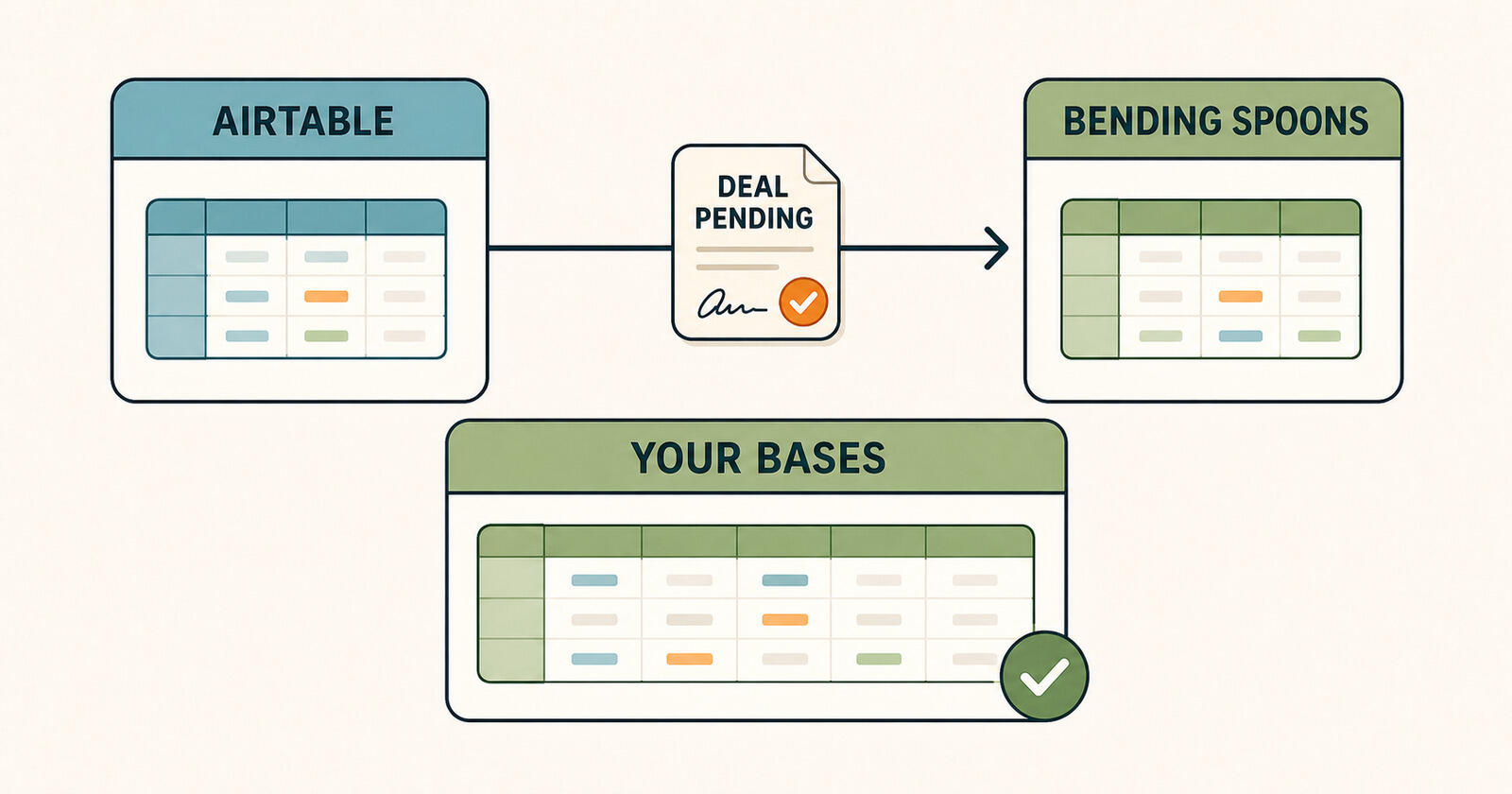
Bending Spoons completed its acquisition of Airtable on September 4, 2026. The ownership change is confirmed; a shutdown or future price increase is not. If your team depends on Airtable, the useful next step is to review your renewal terms and understand what moving your workflows would involve.
Disclosure: Breeze publishes this article and makes project management software. We compete with Airtable for some project-tracking uses.
What changed when the deal closed?
Bending Spoons acquired all of Airtable's outstanding shares. Its September 4 completion announcement confirms the transaction and says it plans to invest in Airtable's product, customer support and sales capabilities.
That statement describes the new owner's intentions. It does not guarantee future prices, free-plan limits or service levels. Nor does the ownership change itself establish that any particular feature or customer account has changed.
How much did Bending Spoons pay?
The August 4 deal announcement gave an enterprise value of $1.285 billion. Including Airtable's net cash, it put the equity value at approximately $2.25 billion. These are two measures of the same transaction, not competing estimates of the price.
The all-cash deal closed a month later. Bending Spoons reported Airtable's annual recurring revenue at approximately $480 million in June 2026, growing more than 20% year on year. Those figures describe the business at the time of the announcement; they do not tell customers what their next renewal will cost.
Who is Bending Spoons?
Bending Spoons is an Italian company that acquires and operates digital businesses. Its portfolio includes Evernote, WeTransfer and Vimeo. In its acquisition announcement, it describes a strategy that can involve reorganising teams, changing technology and interfaces, and adjusting how products earn revenue.
That makes product and plan changes worth watching. It does not establish which changes will happen at Airtable, or when.
What does Evernote's history tell Airtable customers?
Evernote offers a concrete example of how an acquired product's free plan can change. In late 2023, it announced a limit of 50 notes and one notebook for free accounts. Its free-plan limits announcement said users above those limits could still view, edit, export and delete existing notes, but could not create more without getting below the limits or upgrading.
That distinction matters. A restriction on creating content is different from losing access to existing content. Describing the free plan as simply unusable misses what customers could still do.
The lesson for Airtable customers is to watch the limits that affect their own workflows: records, storage, automations, permissions and billable seats. Evernote's history gives a reason to check those details, but it is not evidence that Airtable will adopt the same limits or pricing approach.
Is Airtable shutting down?
The acquisition announcements do not announce a shutdown. The closing statement instead describes investment in the product and customer support.
That is the confirmed position in the statements reviewed as of September 10, 2026. It is not a guarantee that every feature, plan or support arrangement will remain unchanged.
What should an Airtable customer check now?
Start with information you would need for any renewal or migration decision. You do not need to rebuild your setup just because ownership changed.
- Renewal terms. Record the renewal date, current seat count and total cost. Check the notice period and any agreed price protections in your own contract. Do not assume a longer commitment protects the price unless the terms say so.
- Data exports. Keep exports of important table data, but do not mistake CSV files for a complete backup of a working base. Document linked records, formulas, attachments, interfaces, automations and integrations separately, then check what a replacement system can actually restore.
- Workflow dependencies. List what would stop working if you moved. A simple task list may be straightforward to recreate; a base that runs approvals, reporting and customer operations needs a more detailed migration plan.
- Plan limits. Save the limits and features your team relies on so you can compare them with a future renewal offer or product notice.
Should you move off Airtable?
The acquisition alone is not a strong reason to migrate. If Airtable meets your needs at an acceptable cost, evaluate any announced changes when you have the details.
It makes sense to compare options if you were already unhappy with the cost, if your renewal is approaching, or if maintaining the setup takes more work than it saves. Estimate the cost of rebuilding linked records, rollups, interfaces and automations alongside the subscription price.
If you mainly use Airtable to assign tasks and track deadlines, a project management tool may cover the work with less setup. If you use it as a database behind custom workflows, look for that capability first. Our Airtable alternatives comparison covers several different replacement needs.
Before moving a critical workflow, test a representative base in the replacement tool. Check relationships, attachments, permissions and automation behaviour with the people who use it. A successful CSV import does not establish that the workflow has survived the move.
How would you compare staying with moving?
Take a small team using Airtable for client projects. Its base contains tasks, owners and deadlines, but also an approval interface, a weekly report and an automation that creates follow-up work. The table rows may move easily; the rest of the process needs to be mapped and tested.
Start by listing the work the team would have to do during a migration. Someone must clean the data, recreate relationships, set permissions, build replacement automations and check reports. The people using the system need time to learn the new workflow, and someone must answer questions during the transition.
Then compare that one-time effort with the recurring subscription difference. As an illustration, saving $100 a month produces $1,200 in annual subscription savings. If a move takes 40 hours of work valued at $50 an hour, that is $2,000 in migration effort before training or disruption. These are sample figures, not estimates of a typical Airtable migration, but they show why the monthly price alone is incomplete.
Include ongoing maintenance too. A cheaper replacement may need manual reporting that Airtable currently handles. Another tool may remove several steps and save time every month. Test those differences on your actual process before deciding which subscription offers better value.
Finally, choose a sensible point to switch if the comparison favours moving. A quiet period between projects may be easier than the middle of a launch. Keep a clear cutover date so people know where to enter new work and which system contains the final record.
What should you check in an export or migration test?
Use a representative sample, including records with linked data, attachments and unusual values. A clean table with a handful of text fields will not reveal problems in a base that depends on formulas and relationships.
- Record completeness: compare the exported row count with the intended source data. Check whether filters or views excluded anything you meant to keep.
- Relationships: confirm that linked records still identify the right customer, project or related item after import. A text label is not necessarily a working relationship.
- Attachments: check that the files can be accessed and retained in the replacement system. Do not assume a link in a spreadsheet is a durable copy of the file.
- Calculated values: distinguish exported results from formulas you need to recreate. Test a changed input to see whether the new system recalculates the result correctly.
- Permissions: test with the roles people will actually use. An administrator's successful import does not establish that clients or colleagues can access the right information.
Keep a record of what the test does not cover. If one automation still needs rebuilding, include it in the estimate instead of treating the migration as finished because the data imported successfully.
This preparation is useful even if you stay. It gives you a clearer account of what Airtable does for the business and what a future change would affect. You can then respond to a renewal offer with specific requirements instead of making a rushed decision from the acquisition headline.
What should you ask before renewing?
Ask for the price and included limits for the exact plan you intend to renew, including the number and type of billable users. If your team depends on a feature, have its availability confirmed in the offer rather than relying on a general product statement.
For a larger account, bring a short list of requirements to the renewal conversation: the workflows that must keep running, support expectations and any changes you are considering. Ask which commitments are contractual and which are roadmap intentions. A product investment announcement is useful context, but it is not the same as an agreed delivery date or a renewal term.
Which changes would affect that decision?
Watch for specific customer-facing changes: renewal notices, revised seat rules, lower plan limits, feature removals or changes to support commitments. Compare them with your recorded costs and requirements.
Product improvements matter too. If the new owner adds capabilities that solve a problem for your team, include that benefit in the comparison. Decide from the terms and product you can evaluate, rather than assuming either that everything will stay the same or that another acquisition's history will repeat.