 Why choose Breeze
 Marketing
 Creative
 Sales
Sales Remote work
 Managers
 Product teams
 Project management
 Task management
 Kanban tool
 Time tracking
 Project reporting
 Project calendars
 Project timeline
 Team workload
 Project automation
 Project customization
 Chat
Chat Web forms
 Project roadmap
 AI
AI What's new
 Articles & guides
 Help center
 Mobile apps
 Integrations
 Developers & API
 Free tools
How do you actually stay motivated working from home over the long haul?

The honest answer is that long-term motivation working from home is less about willpower and more about structure. The novelty wore off years ago. What actually sustains people who have been remote or hybrid for five plus years is a fixed start, a fixed shutdown, visible weekly outcomes, a small amount of real human contact, and a body of work they can point to. If you are still trying to white-knuckle your way through Wednesday afternoons, the problem is almost never discipline. It is that the day has no edges and the work has no audience.

This is written for people who already know what remote life is. You have done the standing desk, the noise-cancelling headphones, the four monitor setups. You are past the point where a new chair fixes anything. The question now is how to keep caring about the work month after month, year after year, in a job where nobody walks past your desk and nobody sees the thinking you do at 10am.
What is actually hard about staying motivated working from home over years?
The hard part is not the early adjustment. It is the slow erosion that happens once remote stops feeling new. Most articles still treat WFH like an emergency, with tips about setting up a dedicated desk and getting out of pajamas. That advice is fine for week two. It does almost nothing for year four. The longer-running Stanford remote work research from Nicholas Bloom confirms the same thing in numbers: the productivity story of remote is now about structure and management, not setup.
The deeper problems are quieter. Invisible work is the big one. In an office, people watch you think. They see you in the kitchen, on a whiteboard, in a hallway conversation. At home, all of that disappears. The only artifacts of your effort are messages, documents, and tickets. If you are not deliberate about producing visible work, it can feel like you spent eight hours and have nothing to show for it. That feeling, repeated for months, kills motivation more efficiently than any distraction.
Blurred boundaries are the second one. The laptop is always there. Slack is always there. Evenings collapse into half-checked messages, weekends pick up stray emails, and the day never really ends. People talk about overwork but the real damage is that you never get the dopamine of finishing. Nothing closes. Nothing resets. Monday feels like a continuation of Sunday, which felt like a continuation of Friday. Microsoft's Work Trend Index coined the term "infinite workday" to describe exactly this drift, and the numbers behind it are uncomfortable.
Then there is the shallowness problem. Most remote relationships are transactional. You meet someone in a 30 minute video call, you discuss a deliverable, you log off. After two years you have worked with someone closely and you still do not know what their kid is called or whether they hate their commute. That is fine for a quarter. Over years it leaves people feeling like contractors in their own jobs, even when they are full-time employees.
Finally, ambient energy. Offices have a low background hum that pulls you along. Other people typing, talking, laughing, arguing about a deploy. Working from a quiet flat strips that out. Some people love the silence. Many do not realise how much they were relying on other humans to keep their energy up until that input is gone for three years.
Where long-term remote work quietly falls apart
The failure mode is rarely dramatic. People do not quit because they hate remote. They drift. Output gets a bit thinner each month, then they wonder why they feel flat, then one day they realise they have not produced anything they care about in a year.
The first thing to go is usually the start of the day. In a healthy remote routine there is some kind of transition between not-working and working. A walk, a coffee made deliberately, a short planning pass. When motivation slips, that transition disappears. The day begins with opening the laptop in bed and answering a message. Within ten minutes you are reactive. You never get to choose what the day is about because someone else already chose for you.
The second thing to go is the shutdown. When the start vanishes, the end usually goes too. The work just bleeds out across the evening in twenty-minute checks. There is no clean point at which today is over, which means there is no clean point at which tomorrow begins. The brain never gets a break from low-grade work attention.
The third thing is the weekly arc. In an office, weeks have shape because other people give them shape. Monday standup, Wednesday review, Friday wrap. Remote weeks can flatten into one continuous Tuesday. Without a weekly outcome you commit to, time stops feeling like it is moving. A month vanishes and you cannot name what changed.
One realistic pattern: someone joins a remote-first company, has a strong first six months, gets praised, then slowly slides. Their work boards in Breeze stay green-ish but nothing big ships under their name. They are not slacking. They are responding to messages constantly. But they have no deep-work block they protect, no visible weekly outcome, and no shutdown. Eighteen months later they think they need a new job. What they actually need is two hours of uninterrupted morning work and a real Friday end.
Patterns that hold up over years, not weeks
The patterns that work long term are dull on the page and powerful in practice. They share a common shape: give the day edges, give the week an outcome, and give the work an audience.
A fixed start ritual
Pick a 15 to 30 minute thing you do every workday before opening any work app. A walk around the block, a coffee made without a screen, ten minutes of writing what the day is for. It does not matter what it is. It matters that it is consistent, that it is not on a screen, and that work does not begin until it ends. This single habit prevents more motivation loss than anything else on this list.
A real shutdown ritual
At the end of the day, write tomorrow's first task on a piece of paper or in a single note. Close the laptop. Physically move away from the desk. If you live in a studio, close the laptop and put it in a drawer. The point is to create a moment where today is officially done. Without it, the brain never files anything away.
Defended deep-work blocks
Two hours a day, ideally in the morning, with no meetings and no messages. Block it on the calendar, set status to do not disturb, and treat it as the most important thing on your week. This is where real work gets done. If you only have reactive time, you will have a reactive career. Tools like Breeze make this easier when you treat the work board as the canonical to-do list and stop trying to hold the week in your head. Pick the one or two cards that matter for the day, then close everything else. The same logic applies to anchoring a focused start with eating the frog or a tight time blocking habit so your morning hours are spent on real output rather than triage.
A visible weekly outcome
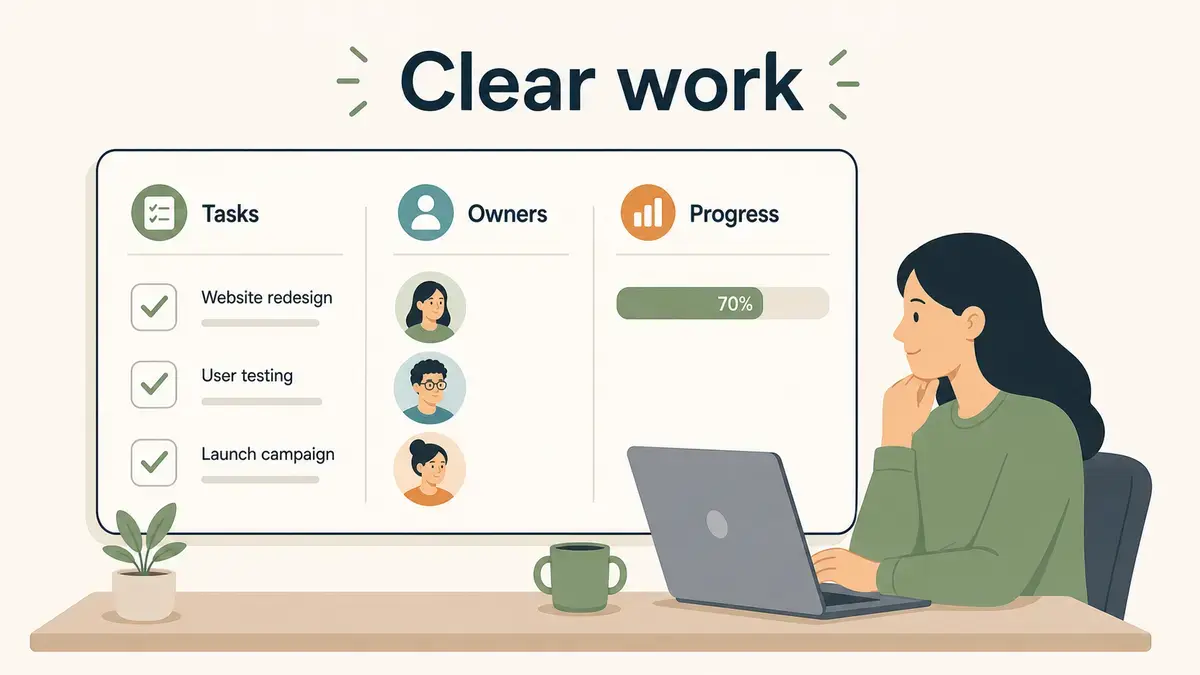
Each Monday, pick one thing you want to be able to point to on Friday. Not a checklist. One real outcome. Then on Friday, post a short async update somewhere your team will see it: the work board, a channel, a doc. This sounds trivial. It is the single biggest fix for the invisible-work problem. A short Friday update on Breeze or in a shared channel turns five days of effort into a thing other people can witness, which makes the work feel real again. The annual Buffer state of remote report has shown loneliness and lack of visibility hovering near the top of remote pain points for years now, and a weekly visible outcome is one of the few cheap fixes.
Regular movement during the day
Not a workout regime, just movement. A walk after lunch. Standing up every hour. A real break that is not scrolling on your phone in the kitchen. People who hold up over years tend to have one non-negotiable physical thing per day, even if it is a 20 minute walk. The ones who do not, burn out.
Async social moments that are not forced
The worst thing a remote company can do is mandate a virtual happy hour. The best thing is to make low-effort, opt-in social surface area part of how the team already works. A channel where people post what they cooked. A weekly async show-and-tell where someone shares something they learned. A quick voice note instead of a Loom. These work because they are not extra. They are folded into the existing rhythm.
A body of work you can point to
This is the long-term motivator nobody talks about. Over years, you need to be able to look back and see what you built. Keep a simple list, somewhere private, of what you shipped each quarter. When motivation dips, that list is the proof that the work matters. Without it, every quarter feels like the last one and you start to wonder what the point is.
Who actually thrives remote and who probably should not be?
This is the part that gets dodged in most WFH content. Remote is not universally good. After several years, it is clearer than ever that some people thrive in it, some get by, and some are quietly miserable in a way they will not admit because admitting it sounds like failure.
People who genuinely thrive remote
People with strong internal structure. They had routines before remote was a thing. They like long uninterrupted blocks. They get their social fill outside work, from family, friends, hobbies, or a city they actually use. They are usually good written communicators because that is the dominant medium. They tend to have hobbies that are not screen-based. They treat their home workspace seriously and they protect their calendar. Remote gives them more of what they were already good at.
People who get by but pay a quiet cost
A large middle group. They are productive enough, but the social shallowness wears on them. They miss the texture of in-person work. They are more anxious than they used to be and they cannot quite say why. They would benefit from a hybrid arrangement, even just a few days a month in a shared space with colleagues, but their company has gone fully remote and the option is not there. These people do not need to quit. They need to be more deliberate about meeting humans in person outside work.
People who probably should not be fully remote
People whose energy comes from other people. People early in their career who learn by being around more experienced colleagues. People in roles where messy, fast, in-person collaboration is the actual job. People who live alone in a small flat with no nearby community. People with a tendency to depression that gets worse in isolation. For these groups, fully remote is not a perk. It is a slow drain. Hybrid or office work is genuinely a better setup, and choosing it is not weakness.
A few questions to ask yourself
- Can you name one specific thing you shipped last week?
- If not, you are probably stuck in reactive mode. Pick one outcome for next week and protect time for it. A work board with a clear weekly focus, in Breeze or anything similar, helps make that visible.
- When was the last time you spent two hours on one task with no interruptions?
- If you cannot remember, your calendar is the problem, not your motivation. Block a deep-work window tomorrow morning before anything else lands. A short read on context switching costs is worth ten minutes if you are skeptical that this is the bottleneck.
- If your company offered a part-time office option, would you take it?
- If the answer is an instant yes, the issue might not be your routine. It might be that fully remote is the wrong shape for you, and that is worth being honest about.
The honest bottom line
Long-term motivation working from home comes from structure, visibility, and self-honesty. Give the day edges with a real start and shutdown, protect deep-work blocks, make your work visible at least once a week, and be willing to admit if fully remote is genuinely the wrong fit for you. Almost everything else is decoration.
If you want a practical next step, pick one thing from the patterns above and run it for two weeks. The fixed start ritual is usually the highest leverage. Then add a weekly outcome you post somewhere others can see, on your team's work board or in a shared channel. If you are setting up a remote rhythm from scratch, getting started remotely is mostly about the first ninety days. Two changes, two weeks, and you will know more about your remote setup than another year of tips ever taught you.