 Why choose Breeze
 Marketing
 Creative
 Sales
Sales Remote work
 Managers
 Product teams
 Project management
 Task management
 Kanban tool
 Time tracking
 Project reporting
 Project calendars
 Project timeline
 Team workload
 Project automation
 Project customization
 Chat
Chat Web forms
 Project roadmap
 AI
AI What's new
 Articles & guides
 Help center
 Mobile apps
 Integrations
 Developers & API
 Free tools
How do you actually manage a project effectively?

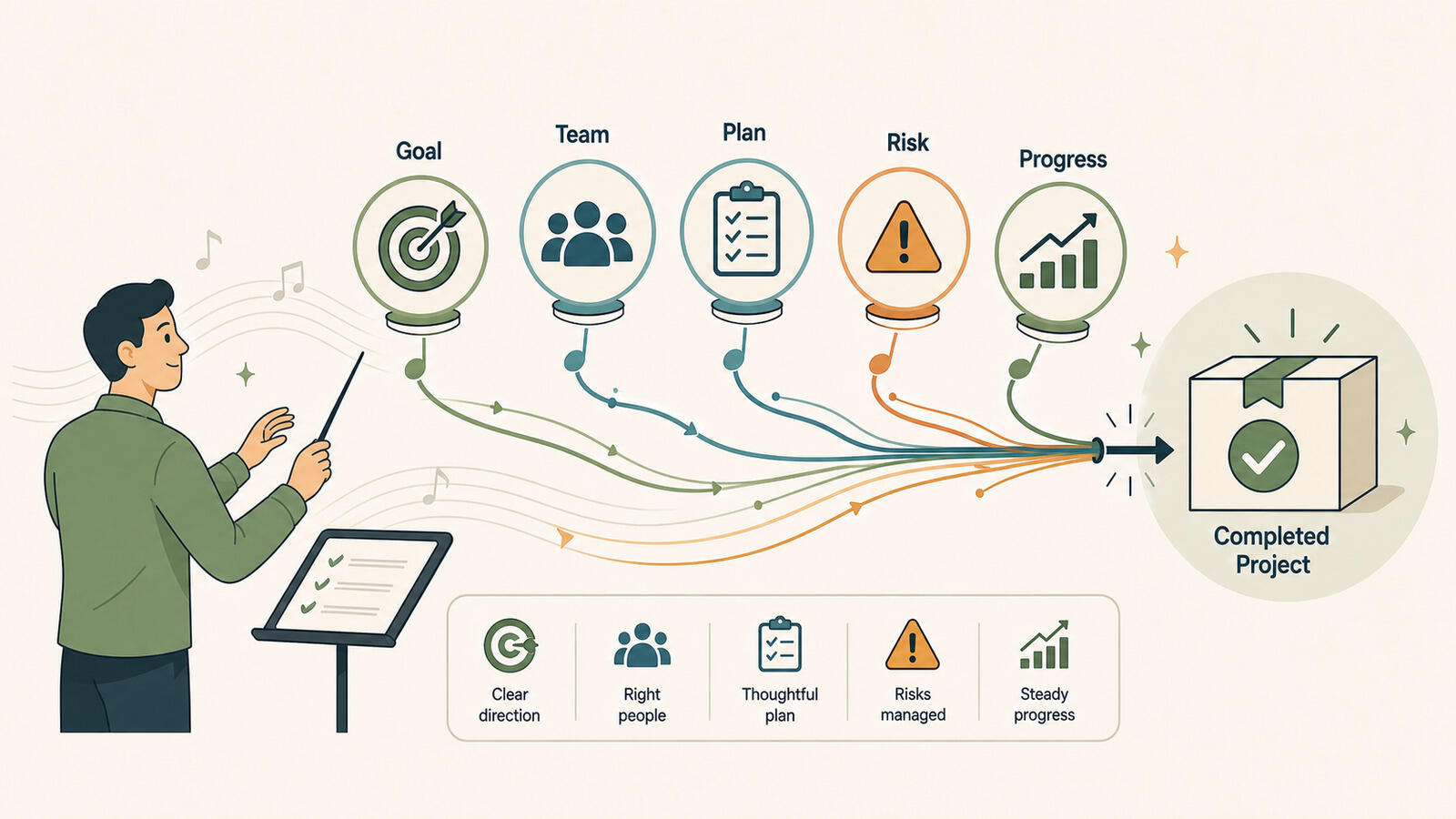
Managing a project effectively is not about knowing a framework, it is about doing five things reliably: planning the work, assigning it to real people, tracking what is happening, keeping everyone in the loop, and closing it out cleanly. That is the whole job. Most projects do not fail for lack of talent or effort, they fail because one of those five was skipped or kept in someone's head instead of out in the open. None of it requires a certification or a heavy process, only making the work visible and keeping it that way. The rest of this article walks through each of the five without turning your week into admin.
Start with a plan you can actually use
A plan is just the answer to three questions, written where the team can see them: what are we delivering, what are the steps, and by when. You do not need a hundred-row spreadsheet or a Gantt chart that takes a day to format. You need the goal stated clearly enough that everyone agrees what "done" looks like, the work broken into tasks small enough to assign, and a rough sequence so people know what comes first.
The biggest planning mistake is keeping it vague to "stay flexible." Vague plans do not stay flexible, they stay invisible, and invisible plans cannot be checked against reality. If you cannot point at a list and say which task is next, you do not have a plan, you have an intention. Break the work into concrete tasks first, even rough ones, because that breakdown is what everything else hangs off. A simple project plan captures that breakdown without overengineering it.
While you plan, name the points where the project could go wrong. Not a formal risk register, just a short honest list of what might slip - a dependency on another team, a slow-to-approve client, a piece of work nobody has done before. Spotting project risks early costs ten minutes and saves the late-stage scramble that wrecks deadlines. You are not predicting everything, just refusing to be surprised by the obvious.
Assign the work to real people
Every task needs exactly one owner. Not a team, not a department, one named person accountable for it moving. This sounds too basic to mention, and it is also the failure that quietly sinks more projects than any other. When a task belongs to "marketing" or "the devs," it sits untouched because each person reasonably assumes someone else has it. Give it a name and a due date and that ambiguity disappears.
One owner does not mean one person does all the work. It means one person is responsible for the outcome and for flagging when it is stuck. They can pull in help or hand off sub-tasks, but the buck stops with them. That is the difference between a task with a heartbeat and one that flatlines until it becomes a crisis on launch day.
Assign realistically, too. A common trap is loading the most reliable person with everything because they always deliver, which is how you burn them out and create a single point of failure. Spread the work against who has capacity, not who is easiest to ask. A shared board showing each person's open tasks makes this honest instead of guesswork. In Breeze, every card carries an owner and a due date, so "who has too much" answers itself instead of surfacing three weeks too late.
Track progress without nagging
Tracking effectively means status is something people glance at, not something you extract in a meeting. The moment you find yourself sending "any update on this?" messages, your tracking has failed - you have become the human progress bar, and that does not scale.
The fix is a board everyone can see, where work moves through visible stages. The simplest version is three columns - to do, doing, done - and it covers a surprising number of projects. Add columns only for a stage that truly matters, like "in review" or "blocked," because each extra column is a small tax on everyone reading the board. The point is that anyone, including you, can open it and know the state of the project in five seconds without asking a soul. Working this way with project boards is the lowest-effort tracking that holds up under pressure.
Track against milestones, not just tasks
Individual tasks tell you what is happening today. Milestones tell you whether the project as a whole is on schedule. A milestone is a meaningful checkpoint - "design approved," "beta shipped," "client signed off" - tied to a date. A slipping milestone shows up weeks early, while you still have room to react, instead of on the deadline when your only options are bad ones. Watching a few project milestones turns a busy board into a reliable read on whether you will finish on time.
The five moves at a glance
Here is the whole job in one place: what each move is for, and the most common way teams get it wrong. If a project is going sideways, it is almost always one of these.
| Move | What it is for | The usual failure |
|---|---|---|
| Plan | Agree what "done" looks like and the steps to get there. | Kept vague to stay flexible, so nobody can tell what is next. |
| Assign | Give every task one accountable owner and a date. | Work owned by "the team," so it belongs to no one. |
| Track | Make status visible without asking for it. | Progress lives in heads, surfaced only in status meetings. |
| Communicate | Keep the team and stakeholders current. | Silence until something breaks, then a panicked update. |
| Close | Finish cleanly and capture what you learned. | Project just trails off, lessons evaporate. |
Keep everyone in the loop
Communication is the move people think they are good at and usually are not. It is not about more messages, it is about the right people knowing the right thing at the right time, with as little effort from you as possible. The test: when something changes, does the person who needs to know find out without you having to remember to tell them?
The biggest lever is keeping the conversation attached to the work. When discussion about a task lives in the comments on that task - not scattered across email threads, chat channels, and hallway conversations - context never gets lost and nobody has to reconstruct "what did we decide?" later. A board where each task carries its own comments, files, and history puts almost any answer one click away instead of a search through six tools.
Stakeholders and clients are their own category. They do not want your task board, they want to know whether things are on track. The trick is a rhythm of short, predictable updates so they are never surprised. Surprises, even good ones, erode trust because they signal you were not in control. A weekly summary or a shared link to live status does more for the relationship than any amount of reassurance, because it shows rather than tells. Quiet projects make clients nervous, and nervous clients micromanage.
Close the project on purpose
Closing is the move almost everyone skips, and it is where most of the long-term value hides. A project that fizzles out - the last few tasks limp over the line and everyone drifts to the next thing - teaches you nothing. A project you close deliberately leaves you better at the next.
Closing well takes three steps and maybe half an hour. First, confirm the work is genuinely done against the goal you wrote at the start, not just "mostly there." Loose ends waved through at the finish are what come back as support requests and awkward client emails a month later. Second, tie off the admin: final approvals, the last invoice, archiving the board so it is out of the way but findable. Third, run a quick honest review: what went well, what went badly, what would you change. It need not be a formal retrospective - three bullet points your team sees next time is enough.
That review is what separates a team that gets steadily better from one that repeats the same mistakes. The estimate that was always too optimistic, the approval that always took twice as long, the handoff that always got dropped - you fix those only if you stop long enough to name them.
Common questions
- Do I need project management software to do this well?
- Not strictly, but it makes the five moves the path of least resistance. The point is keeping the plan, the owners, the status, and the conversation in one visible place. A tool stops that from scattering across email, chat, and memory once things get busy.
- How much planning is too much?
- If you spend more time formatting the plan than it saves you, you have overshot. For most small-team work, a list of tasks with owners and dates plus a couple of milestones is plenty. Add detail only when the work demands it, not to feel organized.
- What is the one habit to start with?
- One owner and a due date on every task. It is the smallest change with the biggest payoff, because it kills the "I thought you had it" failure that causes more slippage than anything.
The short version
Managing a project effectively is plan, assign, track, communicate, close - done consistently and out in the open, not in anyone's head. Match the structure to how much coordination the work needs, and resist the urge to add process that makes you feel organized without making the team faster.
If you want one place to start, take your current project, put every task on a single board with one owner and a date each, and add two milestones for the dates that really matter. That alone covers four of the five moves, and within a week it will tell you which one your team has been skipping.