 Why choose Breeze
 Marketing
 Creative
 Sales
Sales Remote work
 Managers
 Product teams
 Project management
 Task management
 Kanban tool
 Time tracking
 Project reporting
 Project calendars
 Project timeline
 Team workload
 Project automation
 Project customization
 Chat
Chat Web forms
 Project roadmap
 AI
AI What's new
 Articles & guides
 Help center
 Mobile apps
 Integrations
 Developers & API
 Free tools
How do you improve teamwork with team building games?

Team building games improve teamwork when they make a team practice a specific skill they are actually missing, then carry that skill back to real work. The eye-roll most people have at the phrase is earned, and a University of Central Florida study found the effect depends heavily on how the activity is designed and run, not on the game itself. So the useful question is not "what fun activity can we book," it is "what is broken on this team, and which exercise would force the opposite behavior." Get that match right and a one-hour game beats a year of generic offsites. Get it wrong and you confirm everyone's suspicion that this is a waste of time.
What actually makes a game work
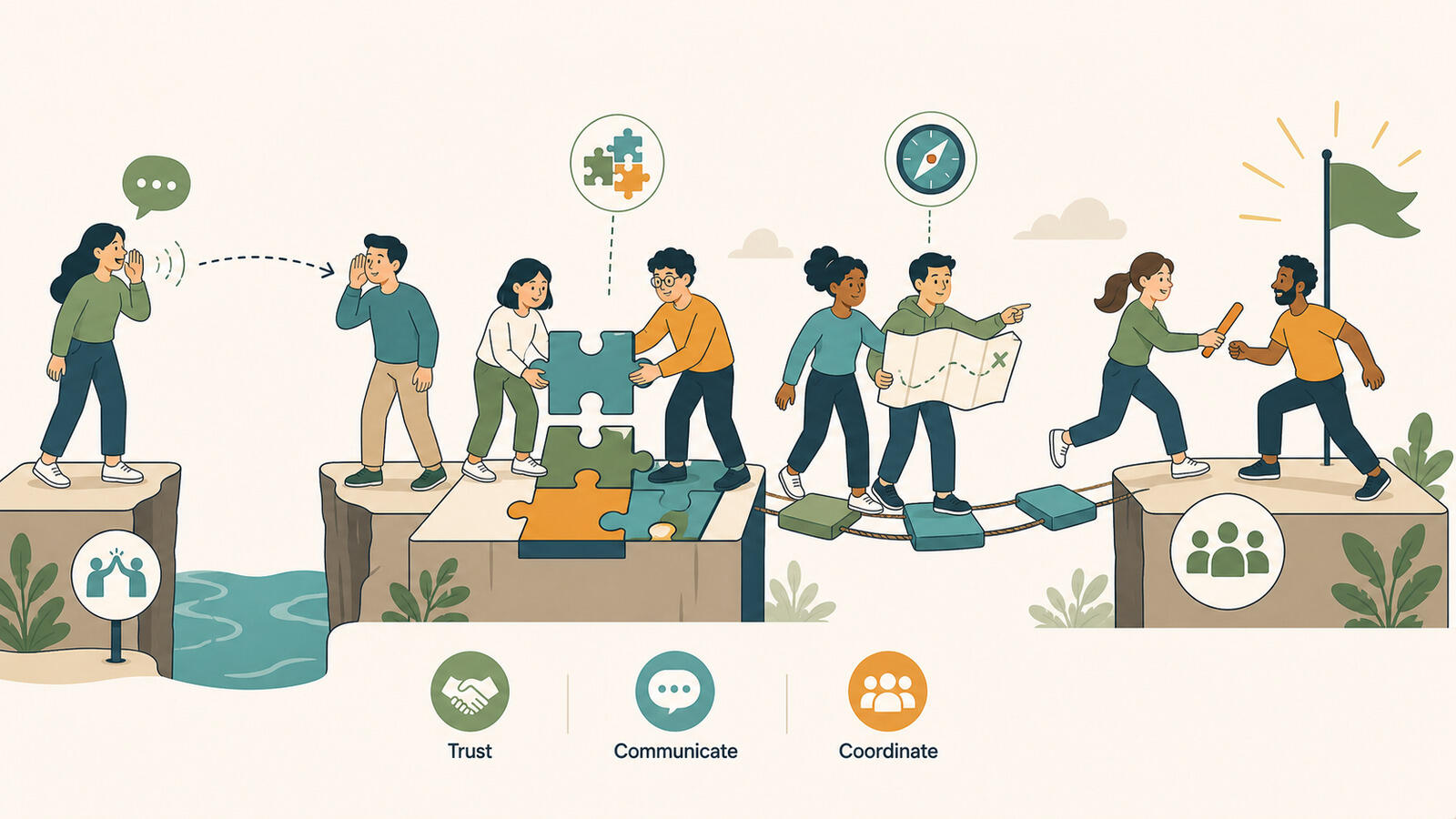
A team building game works when the only way through is to do the thing your team struggles with in real life. If your team talks past each other, the game should make them rely on words alone. If nobody trusts a new hire, it should make the group depend on that person to win. The activity is a controlled rehearsal, and the value is in the rehearsal, not the prize.
That is why the same exercise can be brilliant for one team and pointless for another. A scavenger hunt is great if people in different departments never talk, and a waste of an afternoon if two senior people refuse to share information. Before you book anything, name the gap. The research shows team building has positive effects on outcomes, but those effects come from goal-setting and clarifying roles, so the games that help are tied to a concrete goal.
There is also a quieter benefit. Workplaces throw together people who would never otherwise choose each other, and that social friction is real. A well-run game lowers the stakes of a first interaction, so getting to know a colleague happens over a silly puzzle instead of a high-pressure project. That alone can make the next real handoff smoother.
Which games for which goal
Start from the weakness, then pick the format. Here is a quick map of common goals to the activities that target them, with a note on what each is really training. None of these need a budget or a facilitator - the cheap ones often work better because nobody feels they have to perform.
| Goal | Game that fits | What it actually trains |
|---|---|---|
| Communication | Back-to-back drawing: one person describes an image, the other draws it without seeing it. | Giving clear instructions and asking questions instead of assuming. Exposes how much your team fills gaps with guesses. |
| Trust | Minefield: blindfolded teammates cross a room of obstacles guided only by a partner's voice. | Relying on someone else's judgment and learning to give usable, calm guidance under pressure. |
| Problem-solving | Escape room or a build challenge like the marshmallow-and-spaghetti tower. | Dividing a problem, testing ideas fast, and deciding as a group when the clock is running. |
| Getting to know each other | Two truths and a lie, or a structured "show and tell" of something personal. | Lowering social barriers so the first real conversation is not also a high-stakes one. |
| Remote and hybrid teams | Online trivia, a shared "guess the desk" photo game, or a virtual escape room. | Building the casual rapport that office teams get for free, and practicing turn-taking on a call. |
A note on the remote row, since that is where most teams get it wrong. Distributed teams need this more than office teams, because they miss the hallway conversations that build trust by accident. But the forced-fun problem is worse on a video call, so keep remote games short, default to optional cameras, and lean on activities with a clear structure so nobody is left staring into the silence. The skills you practice there - taking turns, being generous with words - are exactly what a remote team needs every day anyway.
How to run them without the cringe
The biggest predictor of whether a session lands is how you frame and schedule it, not which game you chose. A mediocre game run with respect for people's time beats a clever one that feels like an ambush. Four things matter.
Run it on company time
Almost nobody wants to give up an evening or weekend for a work event, however good it is. If it is worth doing, it is worth an hour of the working day, and hosting it over a provided lunch is a fair compromise. Scheduling it on the clock also signals that you take it seriously enough to pay for it, which makes people take it seriously too.
Be honest about why
People dread these sessions when the real purpose is hidden behind forced fun. Disguising "we need you to communicate better" as a surprise game reads as condescending. You do not have to over-explain, but name the goal: we want new hires to feel part of the team, or design and engineering to talk earlier. When people know the point, they stop bracing.
Collaboration, not competition
The moment a game becomes about winning, people stop learning and start protecting their score. Worse, pitting colleagues against each other can breed exactly the resentment you wanted to dissolve. Pick activities where the whole group succeeds or fails together, so the natural move is to help the person next to you, not beat them.
Always debrief, then keep it going
This is the part most teams skip, and the part that does the work. Spend ten minutes afterward asking what happened: who took charge, where communication broke down, what you would do differently on a real project. That conversation is where a game becomes a lesson. Do not let it be a once-a-year event either - a light, regular rhythm reinforces what people learned. Ask for honest feedback too, since these sessions are for your team, and use it to shape the next one.
What to avoid
Most team building disasters come from a short list of avoidable mistakes, and people have genuinely had enough of the bad version. Skip these and you are most of the way to a session nobody dreads.
Avoid anything mandatory outside work hours, anything risky enough to make someone opt out in front of colleagues, and anything that singles out individuals for public failure. Trust exercises that require touching strangers, drinking-based bonding, and games that reward the loudest person all backfire for the quieter half of your team. Be careful with competition that has real stakes, because it pulls people toward self-interest. And avoid the cardinal sin: running a great session, then never connecting it to anything. If the lesson never reaches Monday's work, you have bought an afternoon of mild fun and called it development.
One more trap is treating games as a fix for a structural problem. If your team is dysfunctional because ownership is unclear, deadlines live in one person's head, or one manager is the issue, no scavenger hunt will touch that. If people are overloaded and stepping on each other, the fix is to manage the team's workload so the work is visible and evenly shared, not to add a Friday game on top.
When games help and when they fall flat
Games help most when the problem is relational: people who do not know each other, departments that do not communicate, a new team that has not formed habits, or a remote group with no shared history. A good exercise then creates a shortcut to familiarity that would otherwise take months. They also help when you want to surface how a team behaves under mild pressure, since people show their real collaboration style faster in a puzzle than in a status meeting.
They fall flat when the problem is structural or when nothing carries over. A team that communicates badly because there is no single place to see who owns what will keep communicating badly the day after the game. To make the gains stick, build a small action plan out of each session and wire the lesson into how you work. If handoffs are where things break, the follow-up is a clear handoff step in your real workflow.
That is where day-to-day tooling matters. In Breeze, the things a good game teaches - clear ownership, visible progress, talking before something is blocked - become permanent when every task has one named owner and a due date on a shared board, so "who has this" is never a mystery. And if the gap a game exposed was remote communication, the durable fix is to run better virtual meetings every week. The game starts the change; the system makes it last.
Quick decision points
- How often should we do team building games?
- Light and regular beats one big annual event. A short activity every month or two keeps momentum and reinforces what stuck. Quality and a real debrief matter far more than frequency.
- What if my team hates these activities?
- Usually that means past sessions were forced, off-hours, or pointless. Ask them what they would enjoy, keep the first one short and optional, run it on work time, and be honest about why. Their own preferences are the best place to start.
- Do remote teams really benefit, or is it just awkward on a call?
- They benefit more than office teams, because they miss the casual contact that builds trust for free. The trick is keeping it short and structured, and not forcing cameras or participation.
The short version
Team building games improve teamwork only when you pick them to close a specific gap, run them with respect for people's time, and connect the lesson back to real work the next day. The game is the easy part; the diagnosis and the follow-through make it worth doing. A good next step is to name the one teamwork problem that costs you most, choose a single exercise that forces the opposite behavior, and plan the ten-minute debrief before you plan the game.