 Why choose Breeze
 Marketing
 Creative
 Sales
Sales Remote work
 Managers
 Product teams
 Project management
 Task management
 Kanban tool
 Time tracking
 Project reporting
 Project calendars
 Project timeline
 Team workload
 Project automation
 Project customization
 Chat
Chat Web forms
 Project roadmap
 AI
AI What's new
 Articles & guides
 Help center
 Mobile apps
 Integrations
 Developers & API
 Free tools
How do you run a brainstorming session that actually works?

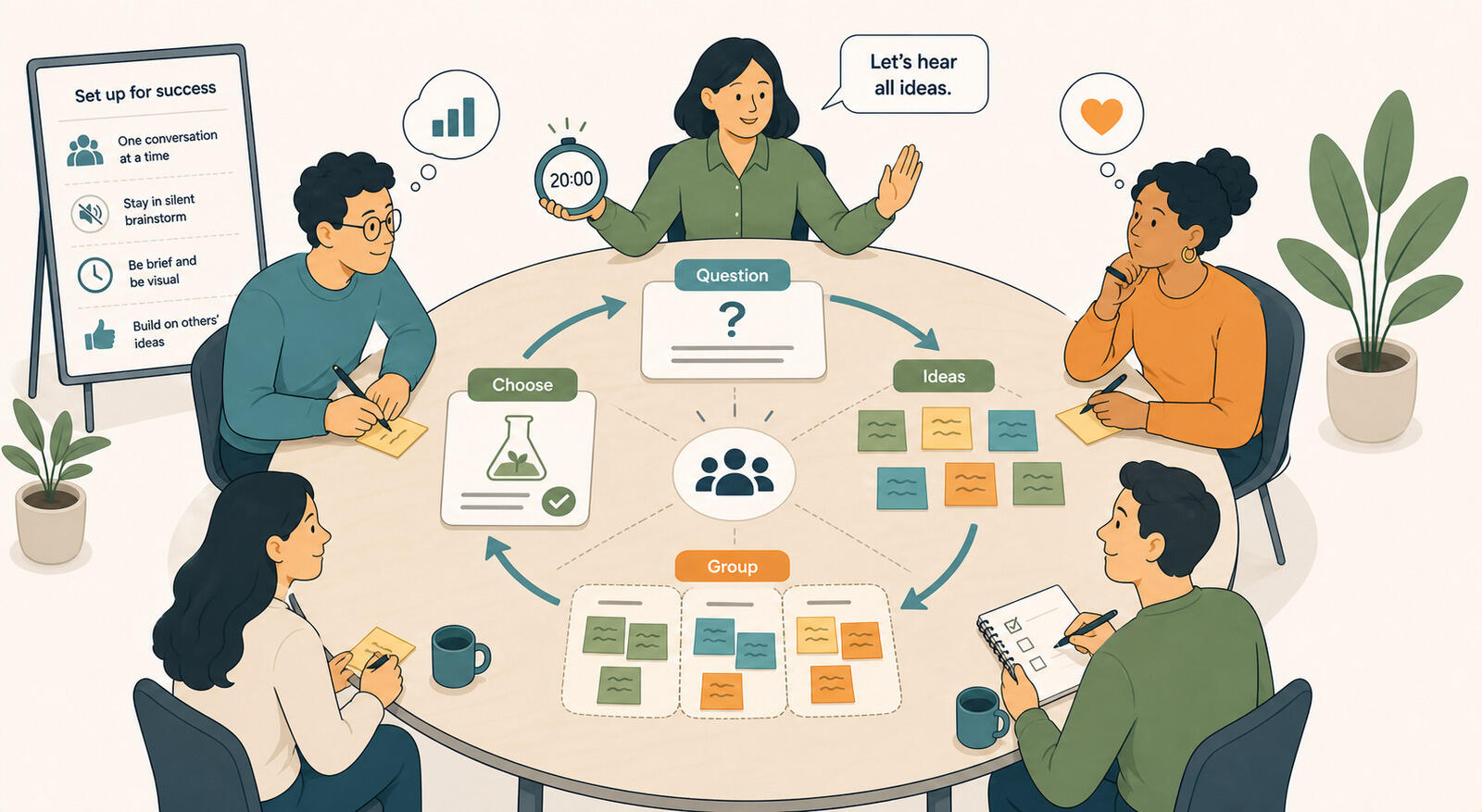
A productive brainstorming session does three things in order: it gets a lot of ideas out of people's heads, captures them so nothing is lost, and ends with named next steps and dates. Miss any one of those and you have held a meeting that felt creative and changed nothing. Most brainstorms fail at the first or the last step - either the same two confident people do all the talking, or a wall of sticky notes gets photographed and never looked at again. The good news is that both failures are structural, not a matter of having a more "creative" team. Fix the structure and an ordinary group will out-produce a brilliant one that is winging it.
Why most brainstorms fail
The classic brainstorm fails for a reason that has nothing to do with creativity: it rewards confidence over ideas. Ask a room to call out thoughts, and what you actually measure is who is comfortable speaking first. There is a natural pull in most workers to hang back, for familiar reasons - fear of looking silly, of contradicting a senior person, of getting shot down. So the same two or three people dominate, everyone else nods along, and you walk out convinced you "got the team's input" when you heard from a quarter of it.
Three specific traps do most of the damage. The first is groupthink, where junior people quietly defer to whoever outranks them and the room converges on the safe answer. The second is premature problem-solving, the instinct to name a solution the second a problem is mentioned, which kills the next ten ideas before they are spoken. The third is blockers and divers - the person who shoots down every idea with "we can't because," and the person who derails the session by diving three levels deep into one tangent. None of them announce themselves, which is why a good facilitator earns their keep.
How to set up before anyone walks in
Half the outcome is decided before the session starts. The biggest lever is making sure everyone is solving the same problem, because a vaguely framed topic produces vaguely useless ideas. Write down the exact issue or question and send it out ahead of time, along with whatever context people need - relevant facts and figures, what has already been tried, and what a good idea would look like.
Give people homework
Ask everyone to come with a few ideas already written down. This is not busywork. People who think out loud are fine in any room, but people who think best with time to prepare are silenced by a cold-start session, and those are often the ones with the most considered ideas. A short worksheet, or just "bring three thoughts on this," levels the field before anyone speaks. It is the same principle as a good meeting agenda: people contribute more when they know what is coming.
Change the room and set the rules
If you can, get out of the usual conference room. A different setting loosens people up and breaks the meeting-as-usual mindset, and seating people in small clusters of three to five makes it easier for quieter folks to talk. Then agree on ground rules out loud: no criticism during idea generation, no interrupting, questions welcome, all ideas on the table. Let the group suggest a couple of their own - the rules they ask for are the conditions they need to feel safe speaking. Finally, give the session a moderator, ideally someone who is not personally invested in the outcome. Their job is to hold the time, keep the rules, draw out the quiet people, and stop the blockers and divers before they take over.
Which techniques actually surface ideas
There is no single best method, but the good ones share a trait: they separate generating ideas from judging them, and most of the strongest ones have people write before they speak. Pick one or two that fit your problem rather than running all of them. Here are the ones worth knowing.
Methods for getting volume
A mind map puts the central topic in the middle of the board and branches every related idea and sub-idea off it, so you can see how thoughts connect without worrying about order. A word storm is the lighter cousin: someone says a word, the next person says the first word it triggers, and so on, with everything written down for review. The "yes, and" rule, borrowed from improv, has people build on each statement instead of blocking it, which keeps momentum and stops the reflexive "but we can't." A decision tree, popular with consulting firms, maps out a choice and every branch that follows from it, which works well when you are weighing options rather than inventing them.
Methods that beat the loud-voice problem
These are the ones to reach for when a couple of people always dominate. Brainswarming is essentially silent brainstorming - everyone writes ideas on sticky notes and posts them to a wall until clusters form, with no one having to perform out loud. The research behind brainswarming is blunt about why ordinary brainstorming underperforms. The step ladder forces breadth: two people start in the room, then you add one at a time, and each newcomer shares their idea before hearing what the group discussed, so no one is anchored to the first answer. Stream of consciousness gives everyone a timer and tells them to write without stopping until a new idea arrives. Across all of these, break the day into individual, small-group, and full-room time, and let people move around.
What works versus what kills a session
Most of running a good brainstorm is doing a handful of things and avoiding their opposites. Here is the contrast, stage by stage.
| Stage | What kills the session | What makes it productive |
|---|---|---|
| The topic | A vague theme announced in the room. | A specific question sent out in advance with context. |
| Who talks | Open call-outs, so the loudest win. | Write first, then share, so everyone contributes. |
| Judging ideas | Critiquing each idea as it lands. | Generate everything first, evaluate later. |
| Running it | No facilitator, so tangents take over. | A neutral moderator holding time and rules. |
| The output | A photo of sticky notes nobody revisits. | Captured ideas with owners and dates. |
| After the day | Silence, so people stop bothering next time. | A summary and visible follow-through. |
How to capture and act on the output
A brainstorm is not finished when the ideas stop. It is finished when someone owns the next step. This is the part most teams skip, and it decides whether people show up engaged next time or treat the session as a box-ticking exercise. If contributions go nowhere, the lesson everyone quietly learns is that their input does not matter.
Save real time at the end for a wrap-up while the room is still together. Review what came up, highlight the ideas the group agreed are worth pursuing, and turn those into concrete next steps with names and dates attached. Do not let "we should explore that" stand on its own - it needs an owner and a deadline or it evaporates. Good meeting notes matter here because the raw ideas are easy to lose; assign someone to capture them as the session runs, not from memory afterward.
Then follow up fast, within a day or two, with a short summary: the key ideas, the decisions, the next steps, and the timeline. This is where the output stops being a pile of notes and becomes work. The cleanest way to do it is to drop each agreed action straight onto a shared board as its own task. In Breeze, that looks like a card per next step, an owner and a due date on each, and a couple of milestones for the dates that matter, so the ideas live alongside the rest of the team's work instead of in a document nobody opens. You will not action every idea, and that is fine - but when you drop one, tell the person who suggested it why, so the silence does not read as indifference.
If your sessions run remotely, the capture problem gets harder, not easier, because the casual "I'll grab a photo of the board" fallback is gone. It pays to be deliberate about who is writing things down and where. The right setup for running virtual meetings is what keeps a distributed brainstorm from turning into three people on mute.
Common questions
- How long should a brainstorming session be?
- Long enough to generate and cluster ideas, short enough to keep energy up. Most productive sessions run in focused blocks with breaks rather than one long open-ended stretch. Put a clear time limit on each exercise so there is always an endpoint to push toward.
- How many people should be in the room?
- Small enough that everyone speaks, which usually means seating people in clusters of three to five even within a larger group. Big rooms favor the confident few, so if the group is large, lean on silent or step-ladder methods that force broader input.
- What if the team barely knows each other?
- Cold groups self-censor more, so a little warm-up helps. A short round of team building games before the real work lowers the social cost of saying something half-formed, which is exactly what you want people doing.
The short version
A brainstorm is productive when it gets a lot of ideas out, captures them, and ends with owners and dates - and it fails when the loudest voices crowd everyone else out or when nothing happens afterward. The fix is structure, not talent: frame the question in advance, have people write before they speak, use a method that breaks the loud-voice problem, and turn the output into owned tasks the same day. Pick one technique from this list, run your next session that way, and put the next steps on a board before the room empties.