
 Why choose Breeze
 Marketing
 Creative
 Sales
Sales Remote work
 Managers
 Product teams
 Project management
 Task management
 Kanban tool
 Time tracking
 Project reporting
 Project calendars
 Project timeline
 Team workload
 Project automation
 Project customization
 Chat
Chat Web forms
 Project roadmap
 AI
AI What's new
 Articles & guides
 Help center
 Mobile apps
 Integrations
 Developers & API
 Free tools
Notion vs Asana

Disclosure: Breeze publishes this comparison and is one of the tools discussed here. We try to be candid about where Breeze isn't the right fit; weigh that bias when reading our recommendations.
Review process: We compared current vendor documentation, pricing pages, published product interfaces, and independent user reviews. Pricing and plan names were checked against vendor sites on July 16, 2026; vendors change packaging often, so confirm the current total for your team before buying.
Project management isn't one-size-fits-all. Some teams love structure and step-by-step workflows, while others need a blank canvas to organize their way. That's where Notion and Asana come in. Two tools that take different approaches to project management. But how do you choose which is right for your team? In this article, we'll break down the unique strengths of each and help you decide. And if neither feels like the perfect fit, we'll introduce Breeze. An alternative that gives you the essential project management features. Whether you're managing a small team or a large project, you'll find something here to guide your decision.
Notion vs Asana at a glance
| Feature | Notion | Asana |
|---|---|---|
| Best for | Teams that combine documentation, planning, and lightweight project management | Teams that need structured project management across departments |
| Pricing | Free for personal use, with team plans starting at $10 per user per month | Free for basic use, with premium features starting at $10.99 per user per month |
| Rating | 4.7/5 on Capterra | 4.5/5 on Capterra |
| Standout strengths | Create workflows for unique projects, with flexibility that suits your team needs; Combine task management, documentation, and databases into one platform, reducing reliance on multiple tools | Asana is easier for non-technical team members to use, while Notion's flexible setup often requires more effort to learn and configure; Designed specifically for managing projects across teams like marketing, HR, and operations, Asana delivers built-in tools, unlike Notion, which relies heavily on user customization |
| Main tradeoff | A blank canvas that needs real setup to become a reliable project system; task management is lightweight | Purpose-built depth that can feel heavy for small teams, with no native time tracking |
Quick verdict: Notion vs Asana
Choose Notion if:
- Create workflows for unique projects, with flexibility that suits your team needs
- Combine task management, documentation, and databases into one platform, reducing reliance on multiple tools
- Go beyond traditional task tracking by using Notion as a team wiki or resource hub for better organization
Choose Asana if:
- Asana is easier for non-technical team members to use, while Notion's flexible setup often requires more effort to learn and configure
- Designed specifically for managing projects across teams like marketing, HR, and operations, Asana delivers built-in tools, unlike Notion, which relies heavily on user customization
- Asana's portfolio feature gives teams a clear, high-level view of multiple projects, a functionality Notion doesn't natively include without additional configuration
Choose Breeze if:
- Getting started is effortless with intuitive design. It eliminates the need for complex configurations, the opposite of Notion, which often requires significant setup, or Asana, whose feature depth can slow down onboarding
- Monitor productivity using the built-in time tracking tool
- With workflow automation and real-time chat , teams have all the tools they need to stay organized. While Notion's customization options can feel overwhelming, and Asana's layered features can be more than small teams need, this platform provides clarity and functionality in one place
Key differences between Notion and Asana
Notion is a better fit for teams that combine documentation, planning, and lightweight project management. Asana is a better fit for teams that need structured project management across departments.
The main difference comes down to how much structure, setup, and reporting your team needs. Both have a moderate learning curve, but Notion's comes from building your own structure on a blank canvas, while Asana's comes from its feature depth — eased by templates and a guided setup.
Is Notion better than Asana?
Notion is better than Asana for teams that combine documentation, planning, and lightweight project management.
Asana is better than Notion for teams that need structured project management across departments.
Breeze is a good alternative if you want boards, timelines, time tracking, and automation in one simpler workspace.
If you are early in the search, other Notion alternatives and Asana alternatives will widen your options.
It can be clarifying to see a parallel case like Notion vs Basecamp.
What is Notion?

- Pricing: Free for personal use, with team plans starting at $10 per user per month
- Rating: 4.7/5 on Capterra
Notion's open-ended design makes it a standout for teams that want full control over their workspace. Contrary to Asana's structured task management, Notion allows you to create wikis, project hubs, or collaborative dashboards that suit your team's needs. Think of it as a modular system where you're free to build workflows that align with how your team operates.
For teams looking to integrate project management with documentation, Notion offers an all-in-one platform. While its flexibility can be a major strength, it does demand a higher initial investment of time to configure, especially compared to Asana's ready-to-use templates and predefined workflows. However, this trade-off results in a workspace tailored to your needs. It is also a good option for creative teams managing projects.
What users say about Notion
"We chose Notion as it supports the documentation of different types of the design information."
Source: Capterra
What is Asana?

- Pricing: Free for basic use, with premium features starting at $10.99 per user per month
- Rating: 4.5/5 on Capterra
Asana stands out for its structured approach. Unlike Notion's open-ended framework, Asana offers ready-made workflows, templates, and a user-friendly interface that help teams get started quickly. This focus on simplicity and clarity ensures that even new users can easily manage tasks and collaborate effectively.
With tools like Timeline and Calendar views, Asana enables teams to track deadlines and progress visually. Features such as task assignments, real-time updates, and a portfolio view make it easy to manage multiple projects simultaneously. For teams looking to centralize communication, Asana integrates seamlessly with Slack, Google Drive, and Zoom, keeping resources and conversations in one place. Its combination of usability and features makes it a good choice for teams aiming to stay organized and productive.
What users say about Asana
"Running an online business requires a lot of different types of tasks from product creation to social media."
Source: Capterra
Notion vs Asana features
Notion and Asana overlap on core project management, but they emphasize different strengths. The main differences usually come down to workflow depth, visibility, setup effort, and how much structure the team needs day to day.
| Area | Notion | Asana |
|---|---|---|
| Workflow style | Teams that combine documentation, planning, and lightweight project management | Teams that need structured project management across departments |
| Top strengths | Create workflows for unique projects, with flexibility that suits your team needs; Combine task management, documentation, and databases into one platform, reducing reliance on multiple tools | Asana is easier for non-technical team members to use, while Notion's flexible setup often requires more effort to learn and configure; Designed specifically for managing projects across teams like marketing, HR, and operations, Asana delivers built-in tools, unlike Notion, which relies heavily on user customization |
| Ease of use | Moderate — flexibility means you build your own structure | Moderate — depth eased by templates and guided setup |
| Main tradeoff | A blank canvas that needs real setup to become a reliable project system; task management is lightweight | Purpose-built depth that can feel heavy for small teams, with no native time tracking |
Notion stands out for its flexibility: teams can build workflows for unusual projects and combine task management, documentation, and databases in one platform, cutting reliance on multiple tools.
Asana stands out for structured, out-of-the-box project management: it's easier for non-technical members to pick up, and it ships with built-in tools for running work across marketing, HR, and operations rather than leaning on user customization.
Notion vs Asana pricing
Pricing changes over time, so confirm the latest details on each vendor site before you commit.
| Plan detail | Notion | Asana |
|---|---|---|
| Pricing | Free for personal use, with team plans starting at $10 per user per month | Free for basic use, with premium features starting at $10.99 per user per month |
| Rating | 4.7/5 on Capterra | 4.5/5 on Capterra |
Notion pricing: Free for personal use, with team plans starting at $10 per user per month.
Asana pricing: Free for basic use, with premium features starting at $10.99 per user per month.
The better value depends on team size, feature needs, and how much workflow depth or reporting your team actually needs.
Notion vs Asana ease of use
Notion has a moderate learning curve that comes from its open-ended design — you have to build the structure before it becomes a project system.
Asana also has a moderate learning curve, driven by its feature depth, but ready-made templates and a guided setup mean most teams are productive quickly.
If your team values fast adoption and lower overhead, choose the simpler option. If you need more control, customization, or reporting, a steeper learning curve can still be worth it.
Notion pros and cons
Notion pros
- Create workflows for unique projects, with flexibility that suits your team needs
- Combine task management, documentation, and databases into one platform, reducing reliance on multiple tools
- Go beyond traditional task tracking by using Notion as a team wiki or resource hub for better organization
- Collaborate easily with real-time editing, ensuring all team members stay updated and aligned
- Connect with external tools like Google Calendar, Slack, or GitHub to improve overall efficiency
- Use pre-built templates for project planning, eliminating the need to start from scratch and saving time
Notion cons
- A blank canvas that takes real setup to become a consistent project system
- Project features are lightweight — no true dependencies, timeline, or native time tracking
- Reporting and cross-project dashboards need manual database work to replicate
- Its flexibility can lead to messy, inconsistent workspaces across a team
Asana pros and cons
Asana pros
- Asana is easier for non-technical team members to use, while Notion's flexible setup often requires more effort to learn and configure
- Designed specifically for managing projects across teams like marketing, HR, and operations, Asana delivers built-in tools, unlike Notion, which relies heavily on user customization
- Asana's portfolio feature gives teams a clear, high-level view of multiple projects, a functionality Notion doesn't natively include without additional configuration
- Asana's layout avoids clutter, helping teams stay organized, whereas Notion's broad flexibility can lead to visual and functional complexity
- Asana's 30-day trial and free plan offer more time to explore its features compared to Notion's shorter evaluation options
Asana cons
- No native time tracking — you need an integration or third-party add-on
- The depth of features can feel heavy for small teams or simple task lists
- No built-in docs or wiki, so you still need a separate tool for knowledge
- Timeline, dashboards, and other views are locked behind paid tiers, and per-user pricing adds up
When Notion is the better choice
- Create workflows for unique projects, with flexibility that suits your team needs
- Combine task management, documentation, and databases into one platform, reducing reliance on multiple tools
- Go beyond traditional task tracking by using Notion as a team wiki or resource hub for better organization
When Asana is the better choice
- Asana is easier for non-technical team members to use, while Notion's flexible setup often requires more effort to learn and configure
- Designed specifically for managing projects across teams like marketing, HR, and operations, Asana delivers built-in tools, unlike Notion, which relies heavily on user customization
- Asana's portfolio feature gives teams a clear, high-level view of multiple projects, a functionality Notion doesn't natively include without additional configuration
Breeze as an alternative
Notion and Asana are great choices, but they can be overkill for teams that want to keep things simple. Are you considering Breeze and, wondering why should you make the switch? Breeze is a practical alternative, intended for users who require basic project management tools without additional convolutions. Whether it's managing tasks, tracking progress, or setting deadlines, Breeze keeps everything organized in a distraction-free manner.
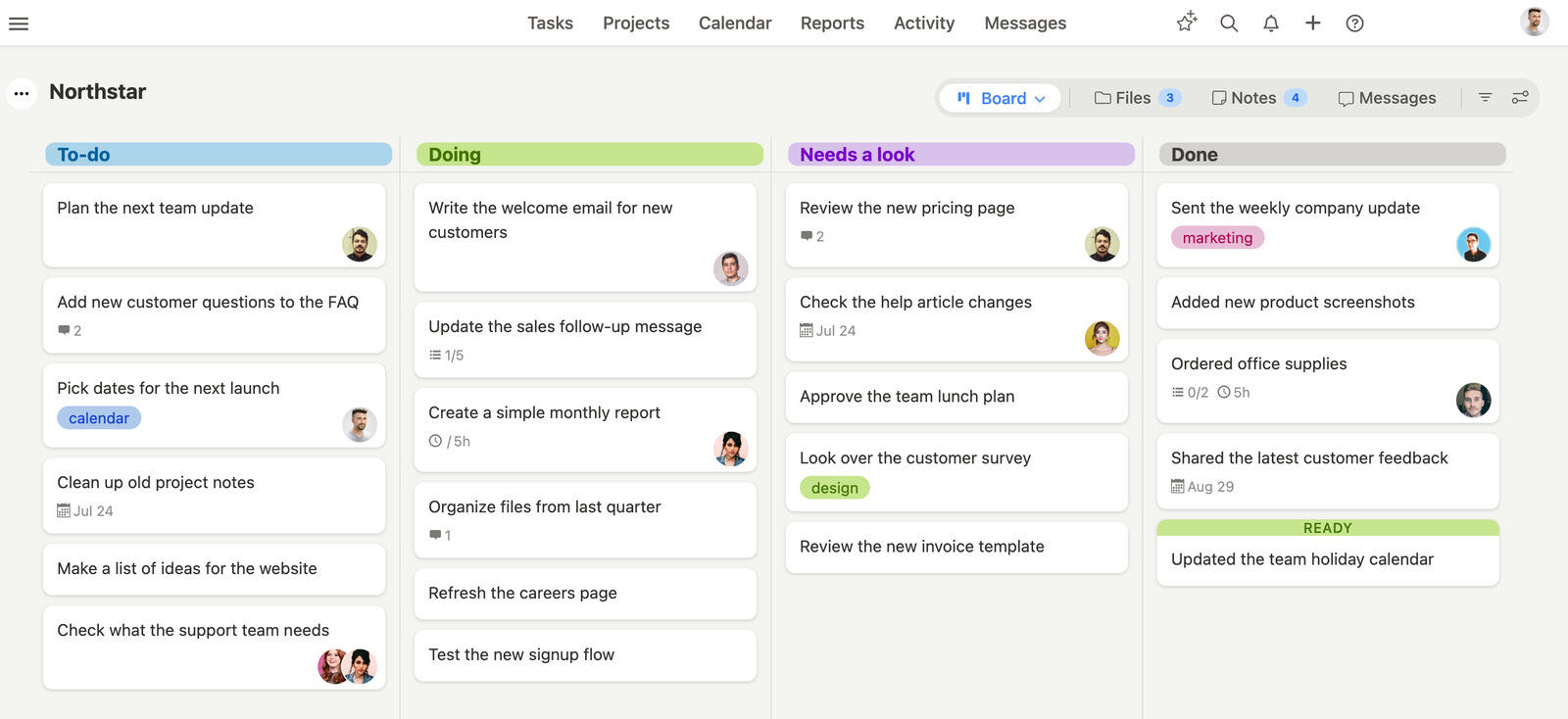
Contrary to Notion's broad flexibility or Asana's detailed workflows, Breeze focuses on delivering just what teams need to stay productive. Features like customizable task boards, built-in time tracking, and workflow automation make it easy for teams to stay on top of their work without unnecessary clutter. Its straightforward design means you can spend less time onboarding and more time hitting those deadlines.
For teams that value usability and efficiency, Breeze is the best option. Also, it works great for those who want powerful tools without getting bogged down by steep learning curves or unnecessary features.
For the version with specifics attached, our Notion comparison covers the setup a flexible workspace demands, and putting Breeze beside Asana covers the point where its workflow depth starts to feel like admin.
What users say about Breeze
"I like that I can have multiple cards, columns and swimlanes inside one project and customize them however I like."
Source: Capterra
Which tool should you choose?
The honest split is that these tools solve different problems. Notion is a documentation-first workspace that can also track tasks; Asana is a project tracker with no real documentation side. If your team's center of gravity is knowledge — wikis, notes, specs — and projects are secondary, Notion wins, and its databases can flex into light project management. If you're coordinating deadlines, dependencies, and hand-offs across departments, Asana's built-in structure saves you the weeks of setup Notion would demand. Many teams end up running both, which is a fair signal that neither fully replaces the other — and if that overlap feels like too much tooling, a focused project app with boards, timelines, and time tracking may be the simpler answer.
Choose Notion if:
- Create workflows for unique projects, with flexibility that suits your team needs
- Combine task management, documentation, and databases into one platform, reducing reliance on multiple tools
- Go beyond traditional task tracking by using Notion as a team wiki or resource hub for better organization
Choose Asana if:
- Asana is easier for non-technical team members to use, while Notion's flexible setup often requires more effort to learn and configure
- Designed specifically for managing projects across teams like marketing, HR, and operations, Asana delivers built-in tools, unlike Notion, which relies heavily on user customization
- Asana's portfolio feature gives teams a clear, high-level view of multiple projects, a functionality Notion doesn't natively include without additional configuration
Choose Breeze if:
- Getting started is effortless with intuitive design. It eliminates the need for complex configurations, the opposite of Notion, which often requires significant setup, or Asana, whose feature depth can slow down onboarding
- Monitor productivity using the built-in time tracking tool
- With workflow automation and real-time chat , teams have all the tools they need to stay organized. While Notion's customization options can feel overwhelming, and Asana's layered features can be more than small teams need, this platform provides clarity and functionality in one place
Managing projects should be simple and not like other tasks to manage. Notion's endless customization options might appeal to highly technical users, but they can overwhelm teams that need a practical and consistent workflow. Similarly, Asana's complex features, designed for intricate project structures, often introduce unnecessary steps for teams that just want to get things done.
Breeze takes a different approach to task tracking. Its intuitive design eliminates the need for extensive setup or training. With built-in time tracking, your team can monitor progress without jumping between tools. The simple Kanban boards provide a clear overview of tasks, helping everyone stay on track and prioritize what's important. Breeze ensures your team can focus on completing projects efficiently without getting lost in unnecessary complexity.
FAQ
- Is Notion better than Asana?
- Notion is better than Asana for teams that combine documentation, planning, and lightweight project management. Asana is better than Notion for teams that need structured project management across departments.
- Which tool is easier to use, Notion or Asana?
- Both take some ramp-up. Notion's learning curve comes from its blank-canvas flexibility — you build your own structure — while Asana's comes from its feature depth, offset by ready-made templates and a more guided setup.
- How do Notion and Asana compare on pricing?
- Notion pricing: Free for personal use, with team plans starting at $10 per user per month. Asana pricing: Free plan; Starter costs $10.99 per user per month, billed annually.
- What is a good alternative to Notion and Asana?
- Breeze is a strong alternative if you want boards, timelines, time tracking, and automation in one simpler workspace.