 Why choose Breeze
 Marketing
 Creative
 Sales
Sales Remote work
 Managers
 Product teams
 Project management
 Task management
 Kanban tool
 Time tracking
 Project reporting
 Project calendars
 Project timeline
 Team workload
 Project automation
 Project customization
 Chat
Chat Web forms
 Project roadmap
 AI
AI What's new
 Articles & guides
 Help center
 Mobile apps
 Integrations
 Developers & API
 Free tools
How do you set team goals that the team actually hits?

You set team goals the team actually hits by picking 3 to 5 outcomes for the quarter, giving every goal one owner, defining what "done" looks like before anyone starts, and reviewing them on a short weekly cadence. Most teams do not miss goals because the framework is wrong. They miss them because the list is too long, ownership is fuzzy, and nobody agreed up front on what success looks like. The rest of this piece is a working playbook for small teams that want goals to drive real work, not fill a slide.

What actually makes a team goal hit-able?
A hit-able team goal has four traits. It is specific enough that two people on the team would describe it the same way. It is measurable, meaning you can tell at a glance whether you are at zero, halfway, or done. It has exactly one owner. And it has a real deadline, not "this quarter" with no review point.
Most of the messy goals you see in small teams fail at least one of these. "Improve onboarding" is not a goal, it is a topic. "Cut new-user time-to-first-action from 9 minutes to under 3 by end of Q2, owned by Sara" is a goal. The second version tells you exactly what you are tracking, who is responsible, and when you will know whether it worked. HBR's research on the power of small wins shows the same effect at the individual level: clarity about what counts as progress is itself a motivator.
The simplest test: if a goal was hit yesterday, could the team agree on that without arguing? If the answer is "we would need to talk about it", the goal is not specific enough yet. Tighten the wording before you put it on the board.
Short-term goals, long-term goals, and OKRs at a glance
Most teams get tangled in the framework debate before they have even agreed what they are trying to do. Here is the practical shape of the three things people usually mean when they say "team goals".
| Type | Timeframe | Best for | Where it breaks |
|---|---|---|---|
| Short-term goal | 1 to 12 weeks | The 3 to 5 things this quarter actually depends on | Becomes a glorified to-do list if every task gets one |
| Long-term goal | 1 to 3 years | Direction, hiring decisions, what to say no to | Demotivating without short-term goals underneath it |
| OKRs | Usually a quarter | Larger orgs that need vertical alignment | Bureaucratic overhead for teams of 3 to 25 |
For a team of 3 to 25 people, the useful mental model is: pick a long-term direction once a year, then chunk it into 3 to 5 short-term goals each quarter. The OKR machinery (separate objectives, three key results each, scoring 0.0 to 1.0) is optional and usually overkill at this size. The detailed tradeoff between SMART goals and OKRs is worth a look if you are choosing a framework.
Why do team goals usually fail?
Team goals fail in a small number of recognisable ways, and they are almost never about the framework. The four big ones are: too many goals, vague goals, no owner, and no review cadence. If you fix those four, you do not need much else.
Too many goals
If a team of 8 people has 14 goals for the quarter, none of them are real. Pick the 3 to 5 outcomes that matter most. Everything else becomes "we may also do this, but we will not be measured on it". The team needs to know which goals get prioritised when something has to give, and a long list makes that impossible. Gallup's workplace research finds that when employees can name a small set of priorities, engagement and follow-through both rise.
Vague goals
"Improve marketing" or "be more responsive to customers" cannot be hit because they cannot be checked. The fix is mechanical: write the goal, then ask "how would we know it was done". If you cannot answer, rewrite the goal until you can. The SMART criteria are a decent checklist for this, even if you do not adopt SMART formally.
No owner, or shared ownership
"The marketing team owns this" sounds reasonable and usually fails. When a goal has three owners, it has none in practice. Pick one person, by name, who is accountable for the outcome. They do not have to do all the work themselves. They are the person you ask when you want to know where the goal stands.
No review cadence
A goal set in January and looked at again in March is not a goal, it is a wish. Most teams need a 15 to 20 minute weekly check-in where every goal owner says: where the goal stands, what moved this week, and what is blocking it. No slides. No status colors invented on the spot. Just the number and the blocker.
What changes when ownership and "done" are defined up front?
The single biggest shift in how a team handles goals comes from doing two boring things at the start: naming one owner and writing down what "done" means. The change is not subtle.
Before: the goal sits on a shared doc, three people mention it occasionally, work happens that vaguely relates to it, and at the end of the quarter someone tries to argue it was 70% done because they did "a lot of things in that area". Whether the goal was hit becomes a negotiation, not a fact.
After: one person owns the goal. The "done" criteria are written down in the same place the goal lives, ideally on the team's project board next to the work that supports it. At the weekly check-in, the owner says "we are at 4,200 of 6,000" or "we are blocked on the vendor responding". There is no ambiguity, and the conversation can be about the blocker instead of about the metric.
This is also where a tool earns its keep. Tracking 3 to 5 quarterly goals in a spreadsheet works, barely. Tracking them next to the actual tasks on a Breeze board, with milestones for the checkpoints and one assignee per goal, removes most of the "where do we stand" friction. The goal sits in the same place as the work that delivers it, which is the whole point.
Short-term goals vs long-term goals: different cadences for different things
Short-term goals and long-term goals are not just different sizes of the same thing. They serve different jobs and need different review rhythms. Conflating them is one of the most common mistakes small teams make.
Short-term goals are this quarter's bets
A short-term goal is something you can finish in 1 to 12 weeks with the people and resources you already have. The marketing team shipping a new landing page and getting it to a target conversion rate by end of Q2 is a short-term goal. So is the product team reducing checkout drop-off by a measurable amount. These get weekly check-ins because a week is a meaningful slice of the timeline.
Short-term goals work well when they map cleanly to a project board. The goal at the top, the work underneath, one owner, a date. Most small teams should have 3 to 5 of these in flight at any time. More than that and the team starts thrashing between them, one of the recurring project success factors.
Long-term goals are 1 to 3 year direction
A long-term goal answers "where is this team trying to get to over the next year or two". Becoming the default tool for marketing teams of 10 to 50 people. Growing recurring revenue by 3x. Hiring and integrating a 4-person engineering team without breaking shipping cadence. These are not weekly conversations. They are quarterly conversations, and they exist mostly to inform which short-term goals you pick.
The biggest failure mode for long-term goals is treating them like short-term goals. You cannot have a useful weekly check-in on "become the default tool for marketing teams". You can have a useful quarterly review on whether the short-term goals you picked over the last 3 to 6 months are pointing in that direction.
A good rhythm for a small team: long-term goals get revisited once a quarter. Short-term goals get picked at the start of the quarter, checked weekly, and reviewed honestly at the end. The long-term direction informs the quarterly picks. That is the whole connection.
How to actually run goals through a quarter
Setting goals is the easy part. Running them through 12 weeks without losing focus is where most teams fall over. Here is a workflow that holds up for teams of 3 to 25 people without becoming process theatre.
Start from the outcome, not the activity
Write the goal as a change in the world. "Reduce average support response time from 14 hours to under 4" not "answer support tickets faster". "Get 200 paying customers on the new plan" not "launch the new plan". The outcome version forces clarity. The activity version lets the team do the activity, miss the outcome, and still claim the goal was met.
Define "done" before starting
Write the success criteria in the same line as the goal. A number, a date, and the thing being measured. If the goal is qualitative, define what evidence would count. "Done means we have shipped the redesign and at least 60% of weekly active users have used the new flow by July 1." Now you can argue about how to get there instead of whether you got there.
Put the goals where the work lives
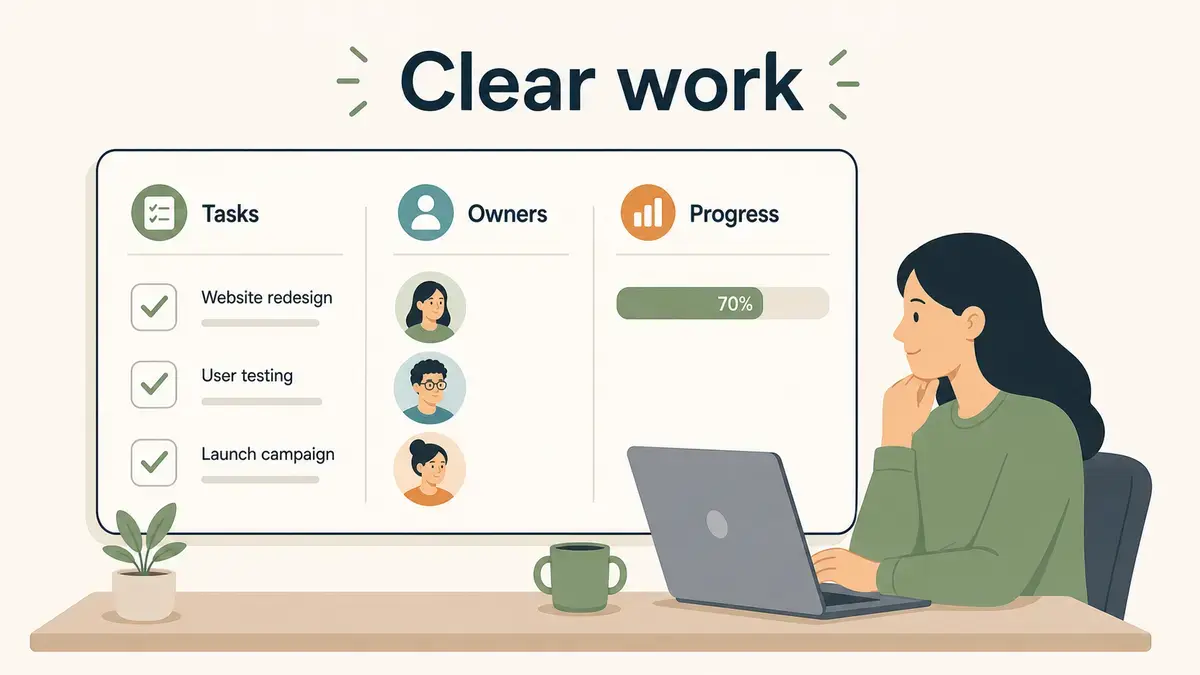
If goals live in one doc and work lives in another, the connection breaks within 2 weeks. Keep them together. Inside Breeze, a quarterly goal sits as a project or a parent task with milestones for the checkpoints, and the supporting work lives underneath as tasks on the same board. Anyone can open the board view and see both the goal and the work pointing at it without context-switching tools.
Weekly check-in, not weekly status
A 15-minute weekly check-in covers all 3 to 5 goals. Each owner says: the current number, what moved this week, what is blocking it. No slides. The point is to catch a goal going sideways early enough to do something about it, not to perform progress for management. Atlassian's guidance on team meeting hygiene suggests the same trim. If a goal needs more than 3 minutes to discuss, take that conversation out of the check-in and into a separate call with just the people involved.
Know when to drop a goal
This is the part most teams skip. If a goal is clearly not going to hit by week 6 of the quarter and the reason is a real change in priorities or constraints, drop it explicitly. Do not let it limp to the finish line at 30% complete. Dropping a goal mid-quarter and saying why is a sign the team is paying attention. Pretending a dead goal is still alive is how teams lose trust in the goal-setting process.
Push through when the goal is right but the work is hard
The flip side: if the goal still matters and the team is just behind, do not drop it. Re-scope the path, move resources, or extend the date by a few weeks and say so. The judgment call is whether the goal itself still matters. If yes, push. If no, drop. Avoid the middle ground where it stays on the list but nobody works on it.
A few questions to ask before you commit to the list
- If I had to cut this list in half, which goals would survive?
- Whatever the team would protect is the real list. Everything else is probably noise dressed up as a goal. Cutting it now is cheaper than cutting it in week 8.
- For every goal, can I name one person who will be embarrassed if it misses?
- If you cannot, the goal does not really have an owner. Either name one or remove the goal.
- What happens at the weekly check-in?
- If the answer is "we have not figured that out yet", figure it out before the quarter starts. A goal without a review rhythm is a memo.
The short version
Pick 3 to 5 short-term goals that map to a clear outcome, give each one a single owner, write down what "done" means before you start, and check in weekly without making it a status performance. Keep the long-term direction in view at a quarterly cadence and let it inform which short-term goals you pick. Drop goals that stop making sense instead of letting them rot on the list.
The next practical step is to write your current quarter's goals in one place, next to the work that delivers them. Most teams that try this with a project tool like Breeze find the change in clarity does more than any new framework ever did. The goal is not to pick the right methodology. The goal is to pick 3 to 5 things the team can actually finish, then finish them.