 Why choose Breeze
 Marketing
 Creative
 Sales
Sales Remote work
 Managers
 Product teams
 Project management
 Task management
 Kanban tool
 Time tracking
 Project reporting
 Project calendars
 Project timeline
 Team workload
 Project automation
 Project customization
 Chat
Chat Web forms
 Project roadmap
 AI
AI What's new
 Articles & guides
 Help center
 Mobile apps
 Integrations
 Developers & API
 Free tools
How do you run a meeting that doesn't waste everyone's time?

A meeting wastes time for one of three reasons: it should have been an email, it has no clear purpose, or it has a purpose but nobody is steering it back to that purpose. Fix those three things and almost every other complaint about meetings disappears. The good news is that the fixes are cheap and boring. You do not need a new framework or a workshop. You need a reason for the meeting, a short list of what you will decide, and one person willing to cut a tangent off mid-sentence. Most "meeting culture" advice overcomplicates this. The hard part is not knowing what to do, it is having the nerve to keep the meeting short when everyone has settled in for an hour.
Why do most meetings fail?
They fail because they were never designed to succeed. Someone felt a vague need to "sync," booked an hour because that is the default slot, invited everyone to be safe, and arrived without a clear question to answer. An hour later the group has talked, nobody has decided anything, and the same topic gets re-booked for next week. The meeting did not go wrong in the room. It was already lost the moment it was scheduled without a purpose.
This is not a small problem. Harvard Business Review has written about how the steady creep of meetings eats into focused work and dents productivity and creativity, especially when they interrupt the deep work people are actually paid to do. Fortune has reported on companies that found improving internal communication, tracking productivity with data, and protecting employee wellbeing were more useful than holding more meetings. The problem is rarely a single dreadful meeting. It is the slow accumulation of mediocre ones that each seemed reasonable to book.
So the useful question is not "how do I make this meeting good." It is "should this meeting exist, and if so, what is the one thing it needs to produce."
What should you settle before sending the invite?
Three things, and they take about two minutes to think through. Get them right and the meeting almost runs itself. Get them wrong and no amount of in-room skill will save it.
The decision, not the topic
A topic is "the new onboarding flow." A decision is "choose between the two onboarding flows and pick a launch date." Topics invite open-ended talk. Decisions force the conversation toward an outcome. If you cannot name the decision the meeting will produce, or the specific thing the group needs to align on, you have found your first warning sign that this should not be a meeting at all.
The smallest possible guest list
Inviting everyone "to keep them in the loop" is how a four-person decision becomes a twelve-person debate. Invite the people who will actually decide or who own a piece of the work. Some meetings need only the leads, others need one specific department. Everyone else can read the notes. A smaller room moves faster, and people stop treating meetings as background noise they can half-attend.
An agenda you will actually follow
An agenda is not bureaucracy, it is the spine of the meeting. List the items to cover, who owns each one, and roughly how long each gets. Send it ahead of time so people arrive prepared rather than thinking out loud. The act of writing the agenda often reveals that two of the three items are status updates that belong in a message, which is a useful thing to discover before you have gathered eight people in a room. A reusable meeting agenda template makes this quick to repeat.
How do you keep a meeting tight once it starts?
Preparation gets you most of the way, but meetings still drift in the room. A few habits keep them on the rails without turning you into the fun police.
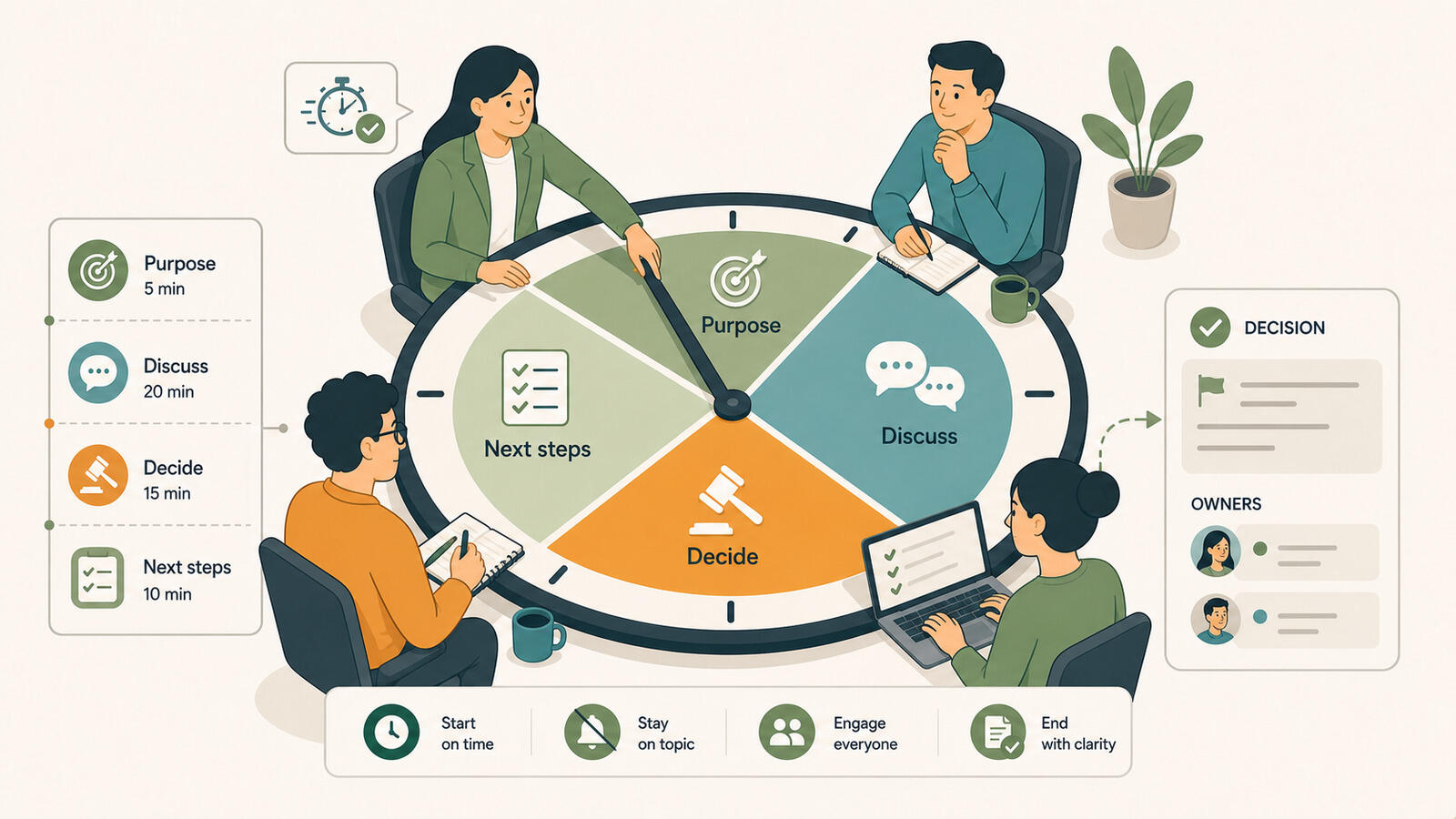
Start by stating the objective out loud in the first thirty seconds. "We are here to decide X by the end of this call." That single sentence reorients everyone and gives you something to point back to when the conversation wanders. When a topic does get its conclusion, close it before opening the next one. A clean handoff like "we have settled the budget, let's move to timeline" stops half-finished threads from piling up.
Watch the clock on purpose. Meetings expand to fill whatever slot you booked, so book less. There is real evidence that tighter scheduling changes behavior, not just the calendar. Microsoft's Work Trend Index data showed meetings of 30 minutes or less rising while hour-plus meetings fell, and the company found that shorter default slots made people more deliberate about whether a meeting was worth booking at all. A 25-minute meeting is not a worse 60-minute meeting. It is often a better one, because the constraint forces the group to skip the throat-clearing.
For recurring meetings, consider whether a standing daily standup would serve better than a long weekly session. A 10-minute stand-up where people share blockers and move on can replace an hour of status theater. And if you are running things remotely, the failure modes shift. Audio problems, people talking over each other, and the temptation to multitask all get worse on a screen, which is why running virtual meetings well deserves its own playbook rather than treating a video call as an in-person meeting with worse sound.
One more thing that quietly raises quality: make participation a stated expectation, not a hopeful one. Tell people up front that you want input and that the call is not a lecture. Leave deliberate gaps for questions. A meeting where two people talk and six people stay muted is usually a sign the other six did not need to be there.
When should you skip the meeting entirely?
This is the tactic that saves the most time, and the one people use least. Before you book anything, run the request through a simple filter. If it does not need real-time back-and-forth, it does not need a meeting. The table below is the test I actually use.
| The situation | Hold a meeting | Skip it, do this instead |
|---|---|---|
| Sharing an update | Only if people need to react live. | Post a written update and let people read it. |
| Making a decision | When trade-offs need discussion and buy-in. | If it's clear-cut, decide and announce it. |
| Solving a problem | When it crosses people or teams. | If one or two people can fix it, let them. |
| Brainstorming | When live energy and build-on matters. | Collect ideas async first, meet only to choose. |
| Status check-in | A short standup if blockers need surfacing. | A shared board everyone can glance at anytime. |
That last row matters more than it looks. Most recurring status meetings exist only because nobody can see the current state of the work. If the work lives on a shared board, the status is always visible and the meeting becomes optional. In Breeze, a project board with one card per task, an owner, and a due date means anyone can check progress in ten seconds, which removes the entire reason for the weekly "where are we" call. The meeting you never have to hold is the most efficient one of all.
What happens after the meeting ends?
A meeting that produces a decision and then evaporates was still a partial waste, because the decision did not travel. The fix is two minutes of discipline at the end. Restate what was decided, name the action items, and say who owns each one and by when. If that sounds obvious, notice how many meetings end with a vague "great, thanks everyone" and no record of what anyone agreed to do.
Capture it in writing so the decisions survive the room. You do not need a verbatim transcript. You need the decisions, the owners, and the next steps, written somewhere the people who could not attend will actually find them. Designating one notetaker beats hoping everyone remembers the same thing, and it frees the rest of the group to listen instead of scribbling. The trick to taking meeting notes is keeping it fast rather than turning it into a second job.
Then close the loop. Turn the action items into real tasks with owners and dates wherever your team tracks work, so the meeting feeds into the doing rather than dead-ending in a doc nobody reopens. And occasionally ask whether the meeting was worth it. A one-line "was this a good use of your time" survey, taken seriously, will tell you which recurring meetings to shorten, merge, or cancel before they quietly stop earning their place on the calendar.
Common questions
- How long should a meeting be?
- As short as the decision allows. Default to 25 or 50 minutes instead of 30 or 60 so you build in a buffer and avoid back-to-back fatigue. If you cannot fill 25 minutes with real discussion, the meeting probably did not need to happen.
- Who should own running the meeting?
- One named facilitator, not the most senior person by default. Their job is to keep time, move between agenda items, and close topics. It is genuinely a role, and meetings without it drift no matter how good the agenda is.
- How do I cancel a recurring meeting without offending people?
- Frame it as protecting their time, not removing a ritual. Propose replacing it with a written update or a shared board, and offer to bring it back if something breaks. Most people are relieved to get the hour back.
The short version
A meeting earns its place when it needs live discussion to reach a decision, and only then, and even then it should be short, owned, and written down afterward. Everything else is a habit dressed up as a necessity. Before your next invite, ask the one question that does most of the work: what decision will this produce, and could that decision be reached without gathering anyone at all? If the honest answer is no decision, send the message instead and give everyone their afternoon back.