
 Why choose Breeze
 Marketing
 Creative
 Sales
Sales Remote work
 Managers
 Product teams
 Project management
 Task management
 Kanban tool
 Time tracking
 Project reporting
 Project calendars
 Project timeline
 Team workload
 Project automation
 Project customization
 Chat
Chat Web forms
 Project roadmap
 AI
AI What's new
 Articles & guides
 Help center
 Mobile apps
 Integrations
 Developers & API
 Free tools
ClickUp vs Notion

Disclosure: Breeze publishes this comparison and is one of the tools discussed here. We try to be candid about where Breeze isn't the right fit; weigh that bias when reading our recommendations.
Review process: We compared current vendor documentation, pricing pages, published product interfaces, and independent user reviews. Pricing and plan names were checked against vendor sites on July 16, 2026; vendors change packaging often, so confirm the current total for your team before buying.
ClickUp and Notion are two of the top productivity tools out there. Each has its own strengths. ClickUp is loaded with project management features like time tracking, task hierarchies and detailed dashboards so it's great for teams managing complex workflows. Notion is a flexible workspace where you can organize tasks, notes and projects however you want. The choice between these two comes down to whether you want structure or adaptability.
We'll compare ClickUp and Notion, exploring their core strengths and limitations. We'll also check Breeze, a great alternative for teams choosing a project management tool that offers an easy-to-use platform with essential features. Breeze strikes the perfect balance between functionality and simplicity.
ClickUp vs Notion at a glance
| Feature | ClickUp | Notion |
|---|---|---|
| Best for | Teams that want deep customization in one workspace | Teams that combine documentation, planning, and lightweight project management |
| Pricing | Free Forever, with paid plans from $7 per user per month (Unlimited, annual) | Free for personal use, with the Plus plan from $10 per user per month (annual) |
| Rating | 4.6/5 on Capterra | 4.7/5 on Capterra |
| Standout strengths | Extensive feature set with tools like time tracking, screen recording, and Gantt charts for detailed project management; Custom dashboards to track KPIs, performance metrics, and project progress, offering a high-level view of work | Highly flexible workspace customization, giving you the freedom to design workflows tailored to your specific needs; Simplicity allows anyone to dive in without training, making it ideal for personal projects or small teams |
| Main tradeoff | Dense feature set takes time to configure and can overwhelm small teams | Not a dedicated PM tool; project tracking, dependencies, and reporting are thin |
Quick verdict: ClickUp vs Notion
Choose ClickUp if:
- Extensive feature set with tools like time tracking, screen recording, and Gantt charts for detailed project management
- Custom dashboards to track KPIs, performance metrics, and project progress, offering a high-level view of work
- Granular permissions allow better control over team access compared to Notion's limited options
Choose Notion if:
- Highly flexible workspace customization, giving you the freedom to design workflows tailored to your specific needs
- Simplicity allows anyone to dive in without training, making it ideal for personal projects or small teams
- A robust library of templates for tasks like project planning, note-taking, and database creation, helping you save setup time
Choose Breeze if:
- Breeze is designed to minimize the time spent onboarding, unlike ClickUp's feature-dense interface, which can overwhelm new users, or Notion's open-ended structure that often requires time to configure effectively
- Breeze integrates built-in time tracking directly into the platform, a feature ClickUp includes at higher tiers and Notion lacks entirely without third-party integrations
- While ClickUp's extensive options and Notion's flexibility can feel cluttered, Breeze prioritizes clarity by focusing on core project management essentials, helping teams stay productive without distractions
Key differences between ClickUp and Notion
ClickUp is a better fit for teams that want deep customization in one workspace. Notion is a better fit for teams that combine documentation, planning, and lightweight project management.
The main difference comes down to whether you want a purpose-built project manager or an all-purpose workspace. ClickUp is opinionated and feature-rich for managing projects, with a steeper learning curve, while Notion is a flexible blank canvas that's simple to start but takes deliberate setup to behave like a real project system.
Is ClickUp better than Notion?
ClickUp is better than Notion for teams that want deep customization in one workspace.
Notion is better than ClickUp for teams that combine documentation, planning, and lightweight project management.
Breeze is a good alternative if you want boards, timelines, time tracking, and automation in one simpler workspace.
Depending on what is missing for you, other ClickUp alternatives or other Notion alternatives may point to a better fit.
If your shortlist is still moving, Notion vs Jira is a natural one to read next.
What is ClickUp?

- Pricing: Free Forever, with paid plans starting at $7 per user per month (Unlimited, billed annually)
- Rating: 4.6/5 on Capterra
ClickUp is more than a task manager. it's a productivity platform designed to improve workflows and help teams stay organized. Its features include project tracking, team collaboration, and time management. All this makes it a good option for teams aiming to meet deadlines efficiently. With integrations for tools like Gmail, Slack, and Dropbox, ClickUp consolidates workflows in one place, reducing the need to switch between apps and keeping teams focused.
ClickUp's extensive library of templates further streamlines project setup. Whether launching a product or organizing daily tasks, these templates save time and provide structure. Combined with automation for repetitive tasks and reminders, with ClickUp teams can maintain efficiency and concentrate on high-priority work.
What users say about ClickUp
"ClickUp is great, we've tried numerous other project management platforms and it's a top-tier product."
Source: Capterra
What is Notion?

- Pricing: Free for personal use, with the Plus plan starting at $10 per user per month (billed annually)
- Rating: 4.7/5 on Capterra
Notion has a unique, flexible approach to organizing workspaces. Unlike ClickUp's structured setup, Notion allows you to create customized workflows that adapt to your style. Think of it as a blank canvas for your ideas, where you can build anything from a simple to-do list to a full-scale project database.
Its intuitive interface makes it easy for new users to get started. Whether you're jotting down notes, organizing a team project, or designing a content calendar, Notion provides the tools without overwhelming you. Additionally, Notion's collaborative features enable real-time edits, so teams can work together seamlessly, no matter where they are.
What users say about Notion
"We chose Notion as it supports the documentation of different types of the design information."
Source: Capterra
ClickUp vs Notion features
ClickUp and Notion overlap on core project management, but they emphasize different strengths. The main differences usually come down to workflow depth, visibility, setup effort, and how much structure the team needs day to day.
| Area | ClickUp | Notion |
|---|---|---|
| Workflow style | Teams that want deep customization in one workspace | Teams that combine documentation, planning, and lightweight project management |
| Top strengths | Extensive feature set with tools like time tracking, screen recording, and Gantt charts for detailed project management; Custom dashboards to track KPIs, performance metrics, and project progress, offering a high-level view of work | Highly flexible workspace customization, giving you the freedom to design workflows tailored to your specific needs; Simplicity allows anyone to dive in without training, making it ideal for personal projects or small teams |
| Ease of use | Steeper learning curve; more to configure | Simple to start; harder to structure as a project system |
| Main tradeoff | Dense feature set can overwhelm small teams | Thin native project tracking, dependencies, and reporting |
ClickUp stands out for its extensive project-management toolkit — time tracking, screen recording, and Gantt charts for detailed planning — plus custom dashboards that track KPIs, performance metrics, and progress from a high-level view.
Notion stands out for its highly flexible, blank-canvas workspace that lets you design workflows exactly how you want, and for a simplicity that lets anyone dive in without training, which makes it ideal for docs, wikis, personal projects, and small teams.
ClickUp vs Notion pricing
Pricing changes over time, so confirm the latest details on each vendor site before you commit.
| Plan detail | ClickUp | Notion |
|---|---|---|
| Pricing | Free Forever, with paid plans from $7 per user per month (Unlimited, annual); Business $12 | Free for personal use, with Plus from $10 per user per month (annual); Business $20 |
| Rating | 4.6/5 on Capterra | 4.7/5 on Capterra |
ClickUp pricing: a Free Forever plan, with paid plans starting at $7 per user per month (Unlimited, billed annually) and Business at $12.
Notion pricing: Free for personal use, with the Plus plan starting at $10 per user per month (billed annually) and Business at $20.
The better value depends on team size, feature needs, and how much workflow depth or reporting your team actually needs.
ClickUp vs Notion ease of use
ClickUp has a steeper learning curve. It ships with a lot of project-management structure — many views, custom fields, and automations — so there's more to learn before it feels dialed in.
Notion is simple to start but deceptively deep. Writing docs and pages is effortless, yet building a reliable project system out of its databases and relations takes real setup.
If your team values fast adoption and lower overhead, choose the simpler option. If you need more control, customization, or reporting, a steeper learning curve can still be worth it.
ClickUp pros and cons
ClickUp pros
- Extensive feature set with tools like time tracking, screen recording, and Gantt charts for detailed project management
- Custom dashboards to track KPIs, performance metrics, and project progress, offering a high-level view of work
- Granular permissions allow better control over team access compared to Notion's limited options
- Built-in automation to handle repetitive tasks such as reminders, assignments, and status updates
- More affordable pricing for small teams, with plans starting at $7 per user per month
- Diverse project views, including timelines, calendars, and Kanban boards, for flexible workflow visualization
- Robust collaboration tools like in-app chat, task comments, and file sharing for real-time teamwork
ClickUp cons
- The volume of features and settings can overwhelm new or small teams
- Performance can lag in large workspaces with many tasks and automations
- Docs and wikis are weaker than Notion's for knowledge management
- So much configurability means teams need to standardize how they use it
Notion pros and cons
Notion pros
- Highly flexible workspace customization, giving you the freedom to design workflows tailored to your specific needs
- Simplicity allows anyone to dive in without training, making it ideal for personal projects or small teams
- A robust library of templates for tasks like project planning, note-taking, and database creation, helping you save setup time
- Seamless integrations with apps like Google Calendar, Slack, and GitHub to keep all your tools connected in one place
- Real-time collaboration capabilities that let multiple users edit and contribute to the same page simultaneously
- Multi-purpose functionality, allowing Notion to double as a personal organizer, content management system, or team wiki
- Free tier for personal use, making it an accessible option for individual users and small-scale projects
Notion cons
- No native time tracking, and project features like dependencies and Gantt views are limited
- Turning its flexible blank canvas into a consistent project system takes real setup
- Reporting and dashboards are shallow compared with dedicated PM tools
- Large databases can feel sluggish, and offline support is unreliable
When ClickUp is the better choice
- Extensive feature set with tools like time tracking, screen recording, and Gantt charts for detailed project management
- Custom dashboards to track KPIs, performance metrics, and project progress, offering a high-level view of work
- Granular permissions allow better control over team access compared to Notion's limited options
When Notion is the better choice
- Highly flexible workspace customization, giving you the freedom to design workflows tailored to your specific needs
- Simplicity allows anyone to dive in without training, making it ideal for personal projects or small teams
- A robust library of templates for tasks like project planning, note-taking, and database creation, helping you save setup time
Breeze as an alternative
Beyond ClickUp and Notion, other productivity tools like Breeze are worth exploring. Breeze features a simple yet powerful project management platform. It's great for organizing tasks, tracking time, and managing your team's flow.
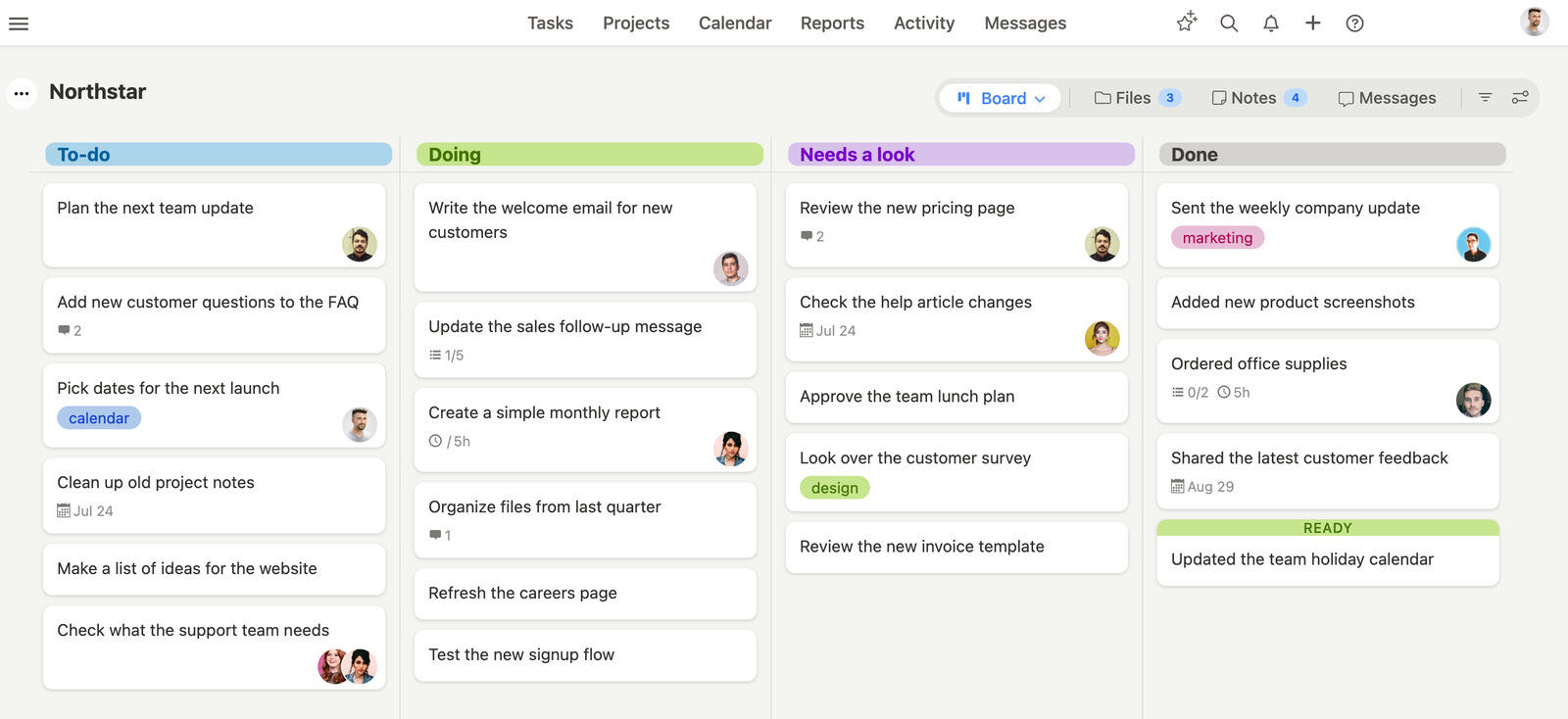
Breeze makes project management easy by focusing on essential tools without burdening users with excessive features. Unlike ClickUp and Notion, which can sometimes feel overly complicated, Breeze keeps processes simple while delivering robust capabilities. Teams can track time directly within the platform, automate repetitive tasks, and generate detailed reports to stay on top of progress and deadlines.
Breeze prioritizes ease of use. Its clean interface reduces distractions, allowing teams to focus on tasks and collaborate effectively. Features like Kanban boards, task prioritization, and integrated calendars make organizing work effortless. For teams seeking an alternative that balances simplicity with essential functionality, Breeze's single pricing plan and approachable design stand out as an excellent choice.
Feature by feature the picture gets clearer: Breeze stacked against ClickUp works through the depth-versus-setup trade-off, and Notion on the same criteria covers what a custom workspace costs to maintain.
What users say about Breeze
"This is and has always been the most appropriate commercial task management system for small teams available today in my experience."
Source: Capterra
Which tool should you choose?
Our honest take: these tools solve different problems, and the best answer is often "both." Notion is unbeatable as a docs, wiki, and knowledge hub, and it handles light task lists well — but if deadlines, dependencies, time tracking, and reporting are core to your work, it will fight you. ClickUp is the stronger dedicated project manager and scales better for teams that live in tasks. Many teams keep Notion for documentation and pair it with a real PM tool rather than forcing one to do both. Migrating a project database out of Notion is a manual rebuild, so decide early which system owns your tasks — and if you want project management without ClickUp's overhead or Notion's setup, a focused tool like Breeze may be the simpler fit.
Choose ClickUp if:
- Extensive feature set with tools like time tracking, screen recording, and Gantt charts for detailed project management
- Custom dashboards to track KPIs, performance metrics, and project progress, offering a high-level view of work
- Granular permissions allow better control over team access compared to Notion's limited options
Choose Notion if:
- Highly flexible workspace customization, giving you the freedom to design workflows tailored to your specific needs
- Simplicity allows anyone to dive in without training, making it ideal for personal projects or small teams
- A robust library of templates for tasks like project planning, note-taking, and database creation, helping you save setup time
Choose Breeze if:
- Breeze is designed to minimize the time spent onboarding, unlike ClickUp's feature-dense interface, which can overwhelm new users, or Notion's open-ended structure that often requires time to configure effectively
- Breeze integrates built-in time tracking directly into the platform, a feature ClickUp includes at higher tiers and Notion lacks entirely without third-party integrations
- While ClickUp's extensive options and Notion's flexibility can feel cluttered, Breeze prioritizes clarity by focusing on core project management essentials, helping teams stay productive without distractions
Ultimately, the right tool depends on what your team values most. ClickUp excels in team collaboration and detailed project management, offering robust features for those who need structure and scalability. Notion, with its adaptability and focus on personal organization, is a strong choice for users who prefer flexibility and customization.
If simplicity and essential features without the clutter are what you're after, don't overlook Breeze. Its design and balanced functionality make it a great alternative for teams that want to stay productive without being overwhelmed. Learn more about why Breeze could be the perfect fit for your team's needs. Evaluate your options, test them with your team, and choose the one that aligns with your goals—and makes your work feel effortless.
FAQ
- Is ClickUp better than Notion?
- ClickUp is better than Notion for teams that want deep customization in one workspace. Notion is better than ClickUp for teams that combine documentation, planning, and lightweight project management.
- Which tool is easier to use, ClickUp or Notion?
- Notion is easier to start with for docs and notes thanks to its blank-canvas simplicity, but turning it into a structured project system takes effort. ClickUp is more powerful out of the box for project management, at the cost of a steeper learning curve.
- How do ClickUp and Notion compare on pricing?
- ClickUp pricing: a free plan, with paid plans starting at $7 per user per month (Unlimited, billed annually). Notion pricing: Free for personal use, with the Plus plan starting at $10 per user per month (billed annually).
- What is a good alternative to ClickUp and Notion?
- Breeze is a strong alternative if you want boards, timelines, time tracking, and automation in one simpler workspace.