
 Why choose Breeze
 Marketing
 Creative
 Sales
Sales Remote work
 Managers
 Product teams
 Project management
 Task management
 Kanban tool
 Time tracking
 Project reporting
 Project calendars
 Project timeline
 Team workload
 Project automation
 Project customization
 Chat
Chat Web forms
 Project roadmap
 AI
AI What's new
 Articles & guides
 Help center
 Mobile apps
 Integrations
 Developers & API
 Free tools
Redmine vs OpenProject

Disclosure: Breeze publishes this comparison and is one of the tools discussed here. Breeze cannot be self-hosted at all, so a self-hosting requirement disqualifies it outright — which covers most people reading this page. We say so rather than working around it.
Review process: Written in late July 2026 from redmine.org's download and installation wikis for version and support status, and from OpenProject's pricing page including its per-plan feature grid, which is where the Enterprise gating list below comes from. Ratings and reviewer comments are from Capterra.
Short answer: OpenProject if you are starting fresh on self-hosted in 2026 and would rather pay for SSO than build it — it ships packaged installers, a supported release line and a modern interface. Redmine if you already have working plugins, a sysadmin who knows Rails, and a hard requirement that the licence stays at zero forever. The catch to know first: OpenProject's cheapest paid plan has a 25-user minimum.
OpenProject started life as a Redmine fork, and the concepts still line up — work packages are issues, and versions, roles and trackers carry the same meaning. That shared ancestry is why this comparison is unusually tractable: the question is not which feature set you prefer, it is who maintains the thing and what the vendor charges for.
Redmine vs OpenProject at a glance
| Feature | Redmine | OpenProject |
|---|---|---|
| Best for | Teams with in-house Rails ops | Teams wanting a supported release line |
| Licence | Free, GPL, no tiers | Community free, Enterprise paid |
| Cheapest paid plan | None exists | EUR 5.95/user/mo, 25 user minimum |
| Installation | Source tarball | Packaged installers and Docker |
| Boards and agile | Plugin required | Enterprise add-on |
| Single sign-on | Multiple LDAP built in | Above the Basic plan |
| Hosted option | None | Enterprise cloud |
| Rating | 4.1/5 on Capterra (177 reviews) | 4.6/5 on Capterra (188 reviews) |
Quick verdict: Redmine vs OpenProject
Choose Redmine if:
- A plugin already runs a business process you cannot rebuild
- Zero licence cost is a policy, not a preference, and will stay that way at any headcount
- You have someone who genuinely enjoys running a Rails application
Choose OpenProject if:
- You are starting fresh and want an installer rather than a build
- Someone should be accountable for security patches other than you
- You would rather buy SSO and boards than assemble and maintain them
Choose Breeze if:
- The self-hosting requirement has quietly expired and nobody has revisited it
- The instance is now holding non-engineering work with deadlines and hours
- Nobody should own upgrades, backups or a database again
What the Community edition does not include
This is the section people wish they had read before installing. OpenProject's Community edition is free with no minimum users, and a substantial list of features is not in it. Discovering that after a rollout is the single most common complaint in its reviews — one puts it bluntly: "Not so open. Need to purchase the enterprise edition to use even the basic productivity features like boards."
From OpenProject's own plan grid, these are Enterprise add-ons rather than Community features:
| Feature | Community | Basic, EUR 5.95 |
|---|---|---|
| Baseline comparisons | No | Yes |
| Custom action buttons | No | Yes |
| Hierarchy custom fields | No | Yes |
| Date alerts | No | Yes |
| Custom theme and logo | No | Yes |
| Team planner | No | Yes |
| Gantt chart PDF export | No | Yes |
| Single sign-on | No | No — higher tier |
| Portfolio management | No | No — higher tier |
Two things to take from that. First, the free edition is a real project management tool but a plain one — work packages, Gantt, wiki, time tracking — and the polish lives behind the licence. Second, even the entry Basic plan does not include everything: single sign-on, portfolio management, SharePoint and OneDrive integration, external sharing of work packages and Model Context Protocol support all require a higher tier.
Redmine has no equivalent structure because it has no vendor. Everything in core is in core, and everything else is a plugin — free, paid or unmaintained, and yours to evaluate.
Key differences between Redmine and OpenProject
The first difference is who is accountable. OpenProject is a product from a company with a release line, packaged installers, Docker images and support contracts. Redmine is a project that publishes tarballs; if a security release lands, applying it is entirely your problem.
The second is how you acquire capability. Redmine's answer is plugins from a twenty-year community — flexible, occasionally excellent, and a liability at every upgrade. OpenProject's answer is a licence key that switches features on. Both are ways of paying; one is in money and one is in attention.
Is Redmine better than OpenProject?
Redmine is better than OpenProject when a plugin already does something specific to your business, when the licence must stay free at any size, and when the people running it are comfortable in the Rails ecosystem.
OpenProject is better than Redmine for teams starting fresh: the installation is packaged, the interface is modern, and the features Redmine expects you to assemble are a purchase rather than a project.
For the wider field, Redmine alternatives covers both self-hosted and hosted options, and YouTrack alternatives is worth a look if a commercial tracker you can still self-host would satisfy the requirement.
If you have not ruled out commercial trackers, Redmine vs Jira covers the hosted side of the same decision.
What is Redmine?

- Pricing: free and open source under the GPL; there is no paid edition
- Rating: 4.1/5 on Capterra from 177 reviews
Redmine is the upstream project OpenProject forked from, and it is still actively released: 7.0.0 arrived on 30 June 2026. Against OpenProject's tiered editions, its distinguishing quality is that there are no tiers — everything in the product is in the product, and there is nothing to unlock.
What that costs is upkeep, and the release policy makes the deadline concrete. Version 7.0.x is fully supported, 6.1.x receives bug fixes and security updates, 6.0.x receives important security updates only, and 5.1.x and older are unsupported. Staying current means moving with a stack that moves: Redmine 7.0 runs on Rails 8.1 and Ruby 3.2 through 4.0, and the project specifically recommends Ruby 4.0.4 or later because of an upstream regression in earlier 4.0 releases. Every plugin has to survive each of those jumps.
What users say about Redmine
"It's open source, so it is easy to customize. The UI is ugly, even with the different themes, it's not fun to have to stare at all day for an engineering team."
Source: Capterra
What is OpenProject?
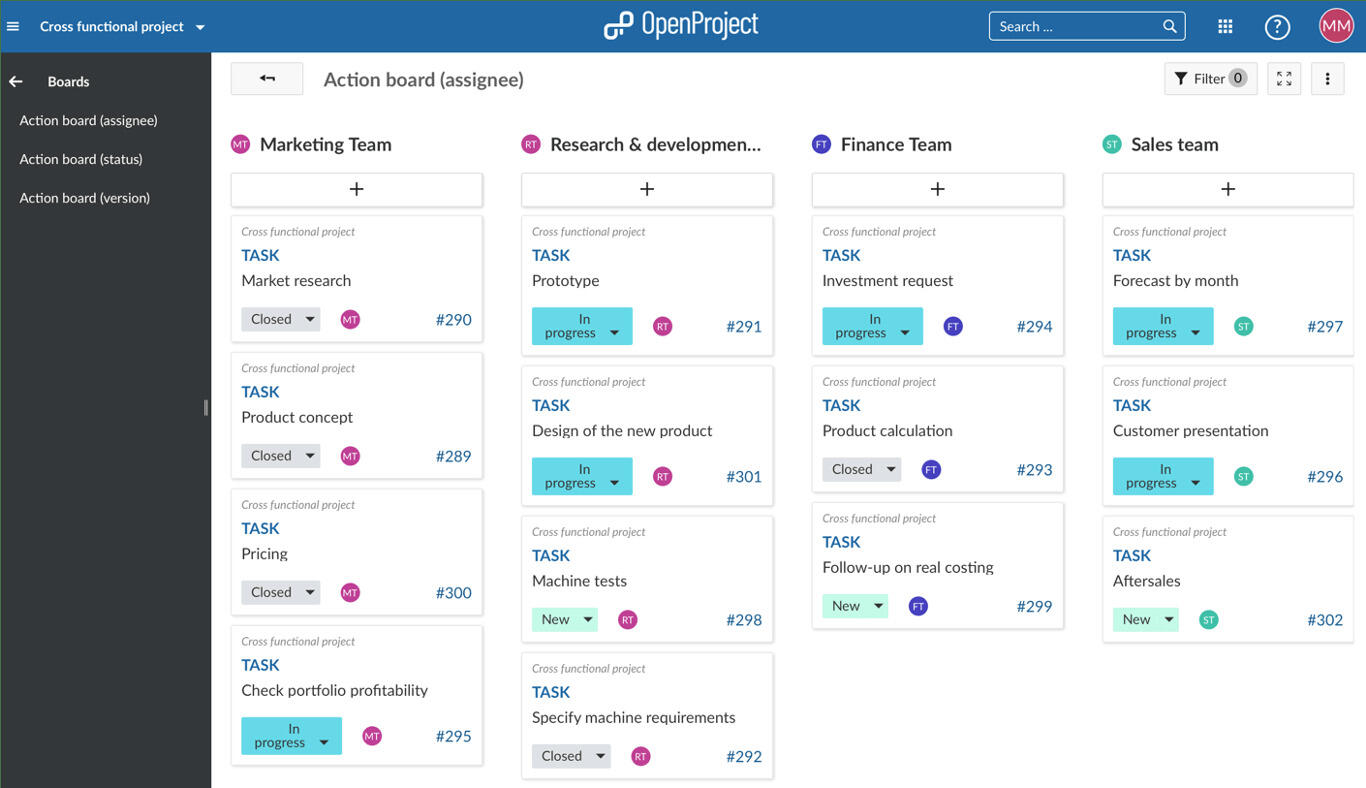
- Pricing: Community free with no minimum; Basic EUR 5.95, Professional EUR 10.95, Premium EUR 15.95 per user per month
- Rating: 4.6/5 on Capterra from 188 reviews
OpenProject is the fork that became a product. Where Redmine hands you source, OpenProject hands you a packaged installation — DEB and RPM packages, Docker images — and a company that publishes releases on a schedule. Reviewers who like it tend to cite exactly that: "Docker image, easy to setup, open, free, simple."
The commercial structure is the thing to understand before installing. Community is free with no user minimum. Basic is EUR 5.95 per user per month but carries a 25-user minimum, so a ten-person team cannot buy it — they pay for 25 seats or stay on Community. Professional at EUR 10.95 also requires 25 users; Premium at EUR 15.95 requires 100; Corporate is quoted and requires 250. Multi-year terms cut the cost significantly, up to fifteen months free on a five-year commitment.
What users say about OpenProject
"Not so open. Need to purchase the enterprise edition to use even the basic productivity features like boards."
Source: Capterra
Redmine vs OpenProject features
The shared ancestry means the core overlaps heavily — projects, work packages or issues, versions, roles, wikis, time tracking. Below is where they differ.
| Area | Redmine | OpenProject |
|---|---|---|
| Agile boards | Third-party plugin | Enterprise add-on |
| Gantt chart | Core feature | Core, PDF export is paid |
| Time tracking | Core feature | Core feature |
| Repository browsing | Git, SVN, Mercurial, CVS, Bazaar | Git and SVN |
| Directory authentication | Multiple LDAP, free | LDAP free, SSO paid |
| Installation | Source tarball | Packages and Docker |
| Vendor support | Community forums | Paid support tiers |
| Industry modules | Plugins | BIM edition, +EUR 1/user |
The repository row is Redmine's genuine and under-appreciated advantage. Browsing Mercurial, CVS and Bazaar alongside Git and Subversion is rare in 2026, and if any of your history lives in one of those, OpenProject does not cover it.
The authentication row is where the money shows up. Redmine authenticates against multiple LDAP directories in core at no cost; OpenProject includes LDAP but puts single sign-on above its entry paid plan, which for a company with an identity provider is a meaningful gap.
Redmine vs OpenProject pricing
Redmine has no price list. OpenProject's is unusual because of the seat minimums, so the table shows what you would actually pay rather than the rate card.
| Team size | Redmine | OpenProject Community | OpenProject Basic | OpenProject Professional |
|---|---|---|---|---|
| 10 users | EUR 0 | EUR 0 | EUR 1,785 — billed for 25 | EUR 3,285 — billed for 25 |
| 25 users | EUR 0 | EUR 0 | EUR 1,785 | EUR 3,285 |
| 100 users | EUR 0 | EUR 0 | EUR 7,140 | EUR 13,140 |
The ten-user row is the one that catches teams out. A small team wanting boards, date alerts or a custom logo has to buy 25 seats to get them, which turns a EUR 714 expectation into EUR 1,785. Below 25 people the practical choice is Community or nothing.
Against those figures, Redmine's zero is real but incomplete. Neither column includes the server, the database or the person applying security releases — and with Redmine that person is definitely you, whereas OpenProject's paid tiers come with someone to call.
Redmine vs OpenProject ease of use and upkeep
For everyday users, OpenProject wins comfortably. Its interface is a decade newer, and its Capterra rating of 4.6 against Redmine's 4.1 mostly reflects that. Redmine's own reviewers are blunt about the look — "not fun to have to stare at all day for an engineering team" is representative.
For whoever runs it, the gap is wider still. Redmine means preparing a Ruby environment, installing gems, and re-testing every plugin whenever the pinned Rails version moves. OpenProject means running a package or a container, with a vendor's release notes telling you what changed.
The honest counterweight: Redmine's plugin ecosystem is why some organisations cannot leave. Twenty years of community work has produced integrations for things no vendor would prioritise, and OpenProject's answer to a missing feature is to wait for it or pay for it.
Redmine pros and cons
Redmine pros
- Everything in the product is free — no Enterprise edition gating boards, themes or alerts
- Multiple LDAP directories in core, where OpenProject charges for single sign-on
- Browses Mercurial, CVS and Bazaar as well as Git and Subversion, which OpenProject does not
- Twenty years of plugins covering processes no vendor would build
- No seat minimums of any kind, unlike OpenProject's 25-user floor
Redmine cons
- Source tarball only — no packaged installer or Docker image of the kind OpenProject ships
- No agile board in core, where OpenProject at least sells one
- Pinned to specific Ruby and Rails versions, with every plugin at risk each upgrade
- Releases older than 6.0 get no security updates, so falling behind has a hard deadline
- Interface looks its age, and reviewers score it a full half-point below OpenProject
OpenProject pros and cons
OpenProject pros
- Packaged installers and Docker images, against Redmine's build-it-yourself tarball
- A vendor accountable for the release line, where Redmine leaves patching entirely to you
- Modern interface — 4.6 on Capterra against Redmine's 4.1
- Migration from Redmine is a supported path thanks to the shared data model
- Hosted Enterprise cloud available, which Redmine has no equivalent of
OpenProject cons
- Boards, baselines, date alerts, team planner and custom branding are all Enterprise add-ons Redmine users would expect free
- Basic and Professional carry a 25-user minimum, so small teams cannot buy them
- Single sign-on and portfolio management sit above the entry paid plan
- Repository support is narrower than Redmine's
- Reviewers feel the "open" branding oversells what the free edition includes
When Redmine is the better choice
An organisation whose Redmine has become the system of record for change requests or IT tickets through custom fields and plugins. Rebuilding that in OpenProject means rebuilding a process, and the Enterprise licence would only replace part of what the plugins do.
It is also the better choice for a team under 25 people who want more than Community offers, because OpenProject's seat minimum makes the upgrade disproportionately expensive at that size.
When OpenProject is the better choice
Any team starting self-hosted project management in 2026 without an existing plugin dependency. The installer works, the interface is current, and the migration path from Redmine exists if you ever inherit one.
It is also the better choice where somebody external has to be accountable — for a security patch, for an SLA, for an audit question — because Redmine has no vendor to be accountable at all.
Breeze as an alternative
If self-hosting is a genuine requirement, Breeze is disqualified. There is no on-premise edition, there is no plan to add one, and no feature comparison changes that. For most people reading this page, that is the end of the matter.

There is one case worth naming, because it is more common than it sounds: the requirement expired and nobody revisited it. Plenty of self-hosted instances were stood up years ago for a policy that has since changed, and are now maintained out of habit by someone who would rather be doing something else. If that describes your instance — and if the work in it is projects with deadlines rather than issues against code — a hosted tool removes the upgrade, the backup and the database entirely.
If you want to test whether the requirement is real, what Breeze sets out to do is a short read that will tell you quickly whether hosted is even on the table for you.
What users say about Breeze
"Our team manages 100+ clients. We use Breeze to assign tasks to ourselves and other teammates and set due dates to keep all of our projects completed on time."
Source: Capterra
Which tool should you choose?
| Choose Redmine | Choose OpenProject | Choose Breeze |
|---|---|---|
| A plugin runs your process | You are starting fresh | Self-hosting is no longer required |
| Licence must stay at zero | Someone must be accountable | The work is not engineering work |
| Fewer than 25 users, needing more | You would rather buy than build | Nobody should own upgrades |
The clean rule for most teams: if you have no plugin dependency, choose OpenProject and pay for what you need. If you have one, the cost of leaving is the cost of rebuilding a process, and that is almost always higher than another year of maintaining Redmine.
The other thing worth deciding deliberately is what "open source" is buying you. If it means auditability and the certainty that nobody can take the software away, Redmine delivers that completely and OpenProject only partly — its Community edition is real, but the features people actually want are licensed. If it just means "free", both qualify, and the honest comparison is between OpenProject's licence fee and the hours Redmine will ask of somebody every quarter.
FAQ
- Is OpenProject a fork of Redmine?
- Yes. OpenProject began as a Redmine fork and kept the underlying concepts — work packages correspond to issues, and versions, roles and trackers carry over. It has diverged a long way since, with its own release line, packaged installers and a commercial Enterprise edition, but the shared lineage is why migrating between them is a supported path rather than a guess.
- Can you migrate Redmine data to OpenProject?
- Yes, and OpenProject documents the route because of the shared data model. Expect the core objects — projects, issues as work packages, users, roles, time entries and wiki pages — to carry across, and expect to reconcile anything that came from Redmine plugins, since those have no OpenProject equivalent. Budget the plugin audit rather than the migration itself.
- Is OpenProject free, and what is missing from the Community edition?
- The Community edition is free with no minimum users, but a long list of features is Enterprise-only: baseline comparisons, custom action buttons, hierarchy custom fields, date alerts, custom theme and logo, configurable work-package forms, Gantt PDF export, placeholder users, team planner and reusable meeting templates. Single sign-on and portfolio management sit higher still, above the entry Basic plan.
- Which is less maintenance to self-host, Redmine or OpenProject?
- OpenProject, for most teams. It ships packaged installers and Docker images against Redmine's source tarball, and one vendor is accountable for the release line. Redmine pins you to a specific Ruby and Rails combination — 7.0 requires Rails 8.1 — and every plugin has to survive each upgrade, with releases older than 6.0 no longer receiving security updates.