 Why choose Breeze
 Marketing
 Creative
 Sales
Sales Remote work
 Managers
 Product teams
 Project management
 Task management
 Kanban tool
 Time tracking
 Project reporting
 Project calendars
 Project timeline
 Team workload
 Project automation
 Project customization
 Chat
Chat Web forms
 Project roadmap
 AI
AI What's new
 Articles & guides
 Help center
 Mobile apps
 Integrations
 Developers & API
 Free tools
Remote work statistics you need to know (2026)

Remote work continues to evolve rapidly, shaped by return-to-office mandates, employee preferences, and productivity debates. Understanding the latest statistics helps you make informed decisions about work arrangements, policies, and tools. This comprehensive guide presents the most current data on remote work trends, adoption rates, and workforce insights for 2026.
Key remote work statistics (2026)
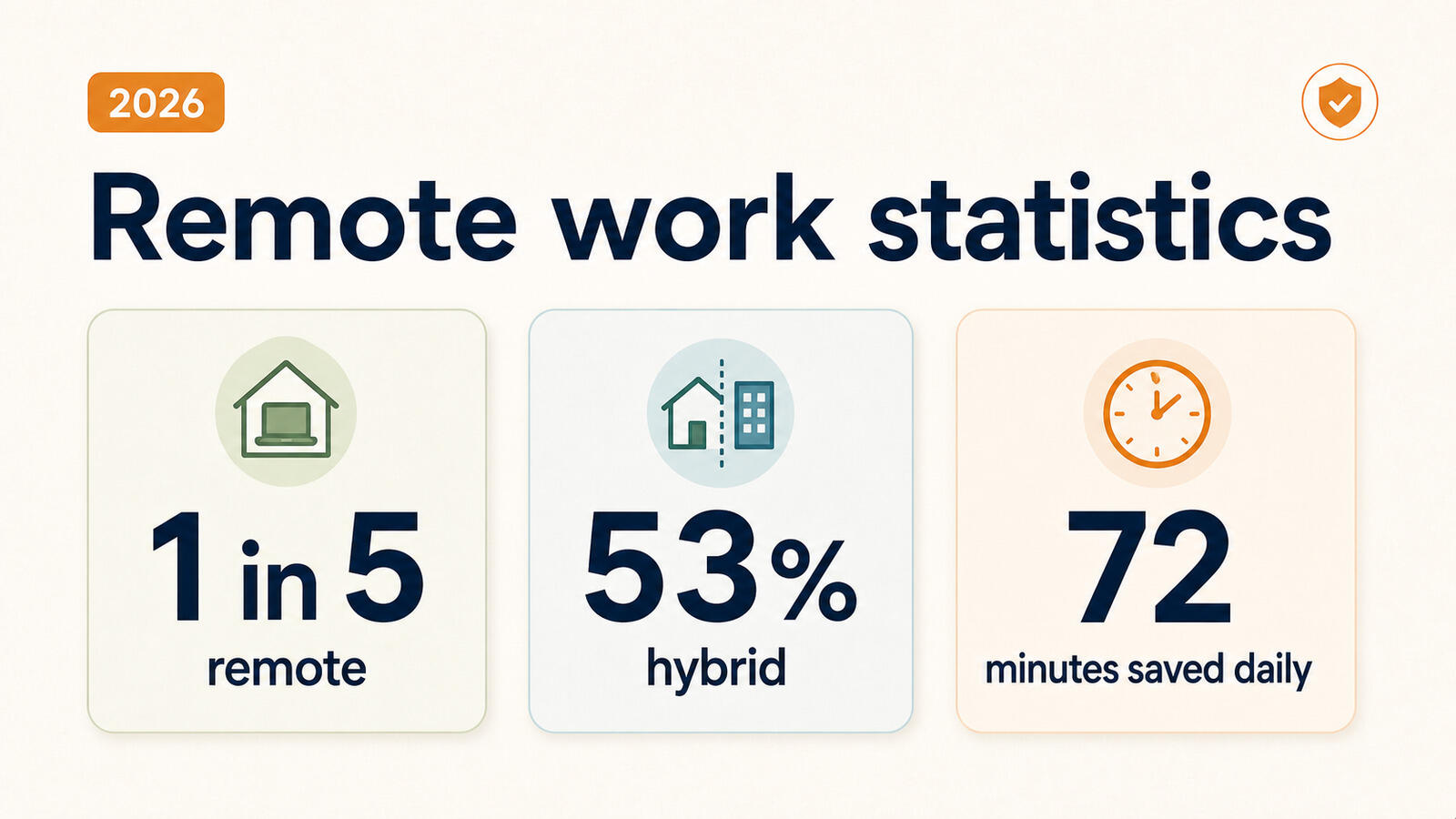
- About 1 in 5 US workers (roughly 21.6%) did some remote work in 2025.
- Globally, 27% of remote-capable employees are fully remote and 53% are hybrid.
- Hybrid employees average about 2.3 work-from-home days a week.
- Skipping the commute frees up roughly 72 minutes a day.
- The remote workplace services market is projected to reach $58.5 billion by 2027.
Prevalence and growth of remote work
What percentage of US workers currently work remotely at least some of the time?
As of March 2025, approximately 22.8% of U.S. employees worked remotely at least part of the time, equating to about 36 million individuals. This percentage has remained stable between 21% and 23% since early 2024, indicating that remote work has become a consistent component of the workforce.
What this means: Remote work has stabilized at about one-fifth of the US workforce - this isn't a temporary trend but a permanent shift in how work gets done.
Source: WFH Research
Globally, what percentage of workers work remotely at least once a week?
As of 2026, approximately 27% of full-time employees worldwide work remotely, while an additional 52% engage in hybrid roles. This represents a significant increase from 28% in 2023, with remote work now encompassing nearly half of the global workforce.
What this means: Remote and hybrid work combined represent the majority of the global workforce - fully in-office work is becoming the exception.
What percentage of knowledge workers primarily work remotely?
Among "knowledge workers" (those whose main capital is knowledge), estimates suggest over 50% work either fully remotely or in a hybrid model in developed economies. In the technology sector specifically, 67% of employees work primarily from home.
What this means: Knowledge work is increasingly location-independent - the majority of knowledge workers now have flexibility in where they work.
Source: Gallup
How many days a week do hybrid workers typically work remotely?
The most common hybrid arrangements involve working remotely 2-3 days per week, with employees often preferring flexibility to choose which days they come into the office.
What this means: Hybrid work typically means 2-3 days remote - this balance allows for both focused work at home and collaboration in the office.
Source: WFH Research
Are small businesses or large enterprises more likely to offer remote work?
Large enterprises were initially quicker to mandate returns to the office, but both small and large businesses now show significant adoption of hybrid/remote options, often driven by talent demands. Prevalence varies greatly by industry and company culture.
What this means: Company size matters less than industry and culture - both small and large companies offer remote work when it makes business sense.
Return-to-office trends and mandates
How have federal and state governments approached remote work?
In January 2025, an executive order ended remote work for all federal employees, affecting thousands across the country. States like California and Texas have also mandated returns to the office for state employees, reflecting a broader trend of reducing remote work in the public sector.
What this means: Government mandates are creating a split between public and private sector remote work policies - private companies have more flexibility.
Productivity and performance
How does remote work impact measured productivity according to companies?
Studies show mixed results, but many indicate neutral or slightly positive impacts. For example, a Stanford study showed a 13% performance increase in remote call center workers. Productivity often depends on the role, setup, and management approach.
What this means: Measured productivity generally improves with remote work - but success depends heavily on how remote work is implemented and managed.
Source: Stanford WFH Research
What are the biggest productivity boosters for remote workers?
Top reported productivity boosters include fewer interruptions, a quieter work environment, and more focused time. Remote workers save approximately 72 minutes daily by avoiding commutes, with about 40% of this time allocated to productive work activities.
What this means: The commute time savings alone contribute significantly to productivity - nearly 30 minutes of additional productive work daily.
How does autonomy impact remote worker productivity?
Higher levels of autonomy are strongly correlated with increased productivity and job satisfaction among remote workers. Organizations that focus on outcomes rather than presence see better results.
What this means: Trust drives productivity - remote workers with more autonomy perform better than those under constant surveillance.
Does hybrid work offer a productivity balance?
Many organizations find hybrid models offer a good balance, leveraging focused work time at home and collaborative time in the office, though optimal balance varies. Productivity data specifically for hybrid is still evolving but generally positive.
What this means: Hybrid work can offer the best of both worlds - focused productivity at home and collaboration in the office.
Source: McKinsey & Company
Employee satisfaction, well-being, and retention
How many employees would consider quitting if forced to return to the office full-time?
Around 76% of current remote/hybrid workers indicate they would consider looking for a new job if required to return to the office five days a week. This represents a significant retention risk for companies mandating full-time office returns.
What this means: Mandating office returns creates massive retention risk - three-quarters of remote workers would consider leaving.
What's the impact of remote work on employee burnout rates?
Results are mixed. While flexibility can reduce burnout triggers like commuting, the inability to disconnect (a common remote work challenge) can increase it. Overall impact depends heavily on company culture and individual habits. Some studies show slightly lower burnout for hybrid workers compared to fully remote or fully in-office.
What this means: Remote work can reduce or increase burnout depending on implementation - boundary-setting and culture matter more than location.
Source: Gallup (Analysis on Hybrid)
Demographics and equity
How does remote work prevalence vary by education level?
Remote work is significantly more prevalent among individuals with higher education levels. In March 2025, 42.8% of U.S. employees with advanced degrees worked remotely, compared to 37.6% of those with a bachelor's degree, and only 9.1% of high school graduates without college education.
What this means: Remote work creates an education divide - those with more education have far more access to remote work opportunities.
How does remote work adoption differ by gender?
Women are more likely to work remotely than men. Between October 2023 and September 2024, 24.5% of women reported working remotely, compared to 20.1% of men. In April 2025, nearly 25% of employed women teleworked compared to around 20% of men.
What this means: Women are more likely to work remotely - this may reflect caregiving responsibilities, industry distribution, or preference for flexibility.
Source: StartFleet – Remote Work Statistics
White House Economic Report 2025
How does remote work adoption vary by age?
Remote work is most common among mid-career professionals. In April 2025, 27.4% of workers aged 35-44 worked remotely, 24% of those aged 25-54 worked remotely, while only 6.2% of those aged 16-24 did the same.
What this means: Mid-career professionals have the highest remote work rates - younger workers may have fewer remote-capable roles or prefer in-person learning.
How has remote work affected women in the workforce?
Since January 2025, over 212,000 women aged 20 and up have exited the U.S. workforce, a trend partially attributed to the reduction of remote work options and increased return-to-office mandates.
What this means: Reducing remote work options is pushing women out of the workforce - flexibility is critical for many women's ability to work.
Source: Time – Women Leaving Workforce
Employer perspective and benefits
How much can companies save on real estate costs with remote work?
Companies can save significantly on real estate, potentially thousands of dollars per employee per year. Estimates range widely, but average savings can be around $10,000-$11,000 per employee annually for full-time remote positions.
What this means: Remote work delivers massive cost savings - $10,000+ per employee annually makes remote work financially compelling for employers.
Source: Global Workplace Analytics
Global Workplace Analytics
How has remote work impacted manager roles?
Managers report needing new skills, focusing more on outcomes than presence, and increased effort in team communication and cohesion (reported by over 60% of managers).
What this means: Remote work requires managers to evolve - from presence-based to outcome-based management, with stronger communication skills.
Communication and collaboration
Is video conferencing fatigue a significant issue?
Yes, studies indicate that around 60% of remote workers experience "Zoom fatigue" or general exhaustion from frequent video calls.
What this means: Video fatigue is widespread - organizations need to balance video calls with async communication and meeting-free time.
Challenges and downsides
Do remote workers report feeling increased pressure to be "always on"?
Yes, a significant portion (around 45%) feel the need to be constantly available or respond quickly to prove they are working.
What this means: Many remote workers feel pressure to prove they're working - this creates stress and blurs work-life boundaries.
Source: HBR (Remote Work Pressure)
How is technological surveillance affecting remote workers?
There is an increasing trend of technological surveillance in remote work settings, particularly in the U.S., leading to concerns about privacy and trust between employers and employees. This surveillance can impact employee morale and productivity.
What this means: Surveillance is increasing - but it erodes trust and can reduce productivity, creating a counterproductive dynamic.
Hybrid work specifics
What is the most preferred hybrid work schedule among employees?
Employees often prefer having the flexibility to choose which days they come into the office, but structured models often involve 2-3 fixed days in the office per week.
What this means: Employees prefer flexibility in hybrid schedules - but structured 2-3 day models are common and often work well.
Source: WFH Research
What percentage of companies use a hybrid model?
Hybrid is the dominant model for companies offering flexibility. Estimates suggest 60-70% of companies with remote-capable jobs offer some form of hybrid arrangement. In 2025, 55% of U.S. employees in remote-capable jobs worked in a hybrid setting.
What this means: Hybrid work is the most common flexible arrangement - most companies offering flexibility use hybrid models.
Source: Owl Labs State of Remote Work
Britopian – Post-Pandemic Remote Work Policies 2025
Do hybrid workers feel more or less engaged than fully remote or fully in-office workers?
Some studies suggest hybrid workers report slightly higher engagement levels, potentially benefiting from both flexibility and in-person connection. However, poorly managed hybrid models can decrease engagement.
What this means: Well-managed hybrid work can offer the best engagement - but poor implementation can make it worse than fully remote or in-office.
What percentage of office space is typically vacant on remote days in hybrid models?
Office occupancy rates on typical "remote" days for hybrid companies can be very low, sometimes below 30%, leading companies to rethink their real estate footprint.
What this means: Hybrid work creates low office occupancy - companies are rethinking real estate needs and space utilization.
Source: Kastle Systems Back-to-Work Barometer (Office Occupancy Data)
Market and industry growth
How big is the remote workplace services market?
The market for remote workplace services is expected to grow from $20.1 billion in 2022 to $58.5 billion by 2027, reflecting a compound annual growth rate (CAGR) of 23.8%. This growth reflects increasing investment in remote work infrastructure, tools, and services.
What this means: The remote work services market is nearly tripling in five years - massive investment reflects the permanence of remote work.
Source: Wow Remote Teams – Market Growth
Key takeaways for 2026
The data paints a clear picture of remote work in 2026:
- Remote work has settled in: about 1 in 5 US workers still do some remote work, and globally 27% of remote-capable employees are fully remote with another 53% hybrid.
- Mandates collide with preferences: some employers are pushing a full return to office, but most remote-capable employees want hybrid, and many would look for another job if flexibility disappeared.
- Productivity fears have not held up: controlled studies find hybrid work does not reduce output and improves retention, and the clearest gain is the roughly 72 minutes a day people get back from the commute.
- Hybrid is the default: a slim majority of remote-capable employees now work hybrid rather than fully remote or fully in-office.
- Adoption is uneven: remote work is far more common in higher-education, higher-paid roles, rises with age, and is slightly more common among women.
- The market keeps growing: the remote workplace services market is projected to reach about $58.5 billion by 2027.
Use these statistics to evaluate your own remote work practices. Organizations that balance employee preferences with business needs, invest in proper tools and processes, and address challenges like proximity bias and isolation will consistently outperform those that mandate rigid policies or ignore employee feedback.