 Why choose Breeze
 Marketing
 Creative
 Sales
Sales Remote work
 Managers
 Product teams
 Project management
 Task management
 Kanban tool
 Time tracking
 Project reporting
 Project calendars
 Project timeline
 Team workload
 Project automation
 Project customization
 Chat
Chat Web forms
 Project roadmap
 AI
AI What's new
 Articles & guides
 Help center
 Mobile apps
 Integrations
 Developers & API
 Free tools
What is the difference between program and project management?

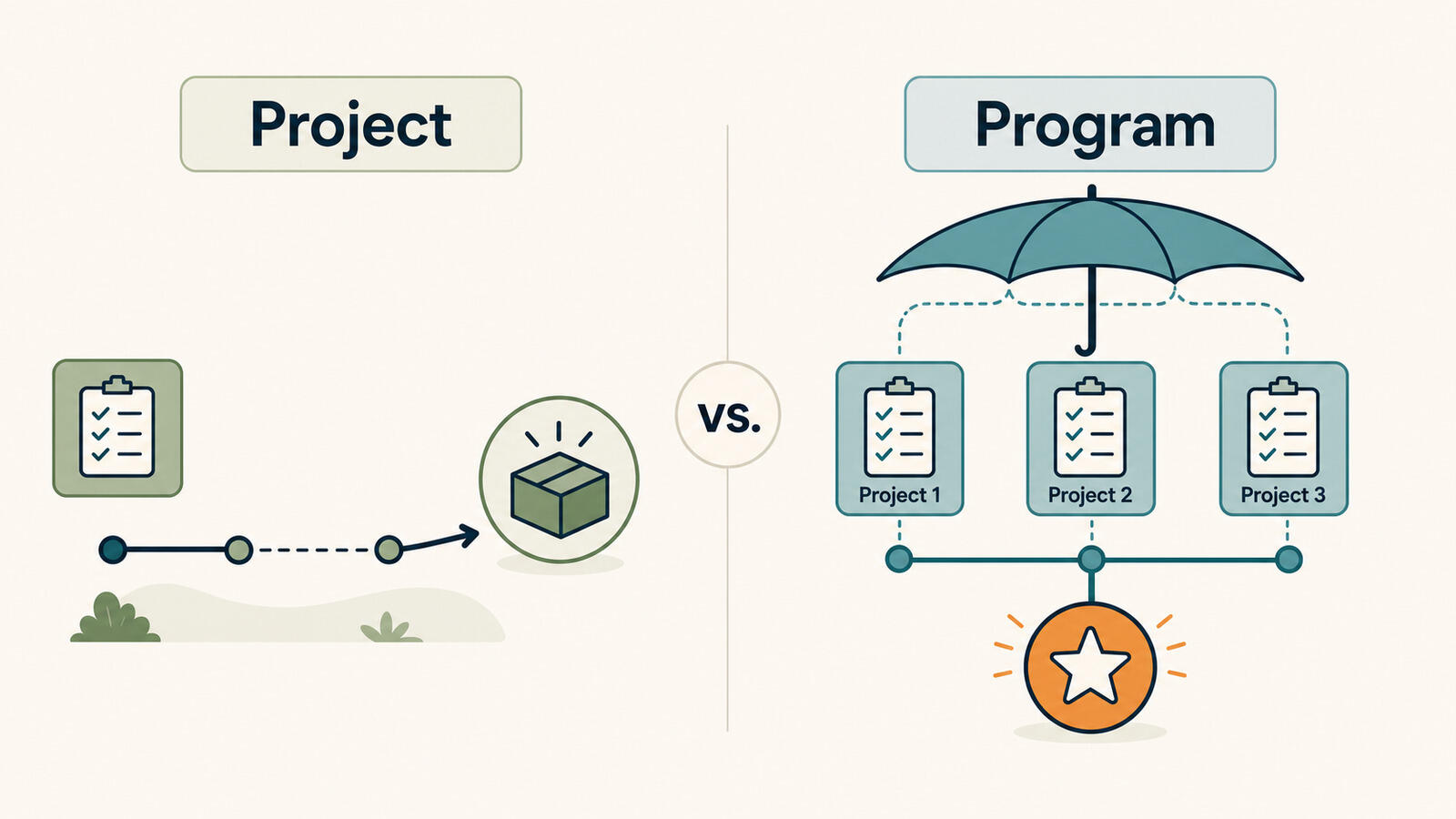
The short version: a project delivers one defined thing by a deadline, and a program coordinates a group of related projects toward a bigger strategic change that has no single finish line. So project management is about getting a specific output shipped on time and on budget, while program management is about steering several projects so they add up to lasting value. People use the words interchangeably because a big project and a small program look similar from outside, but the difference is real, and it decides who you hire, how you measure success, and what "done" even means. One website redesign is a project. Modernizing how the whole company works online over two years is a program made of many projects.
What is a project, exactly?
A project is a temporary effort to deliver one defined outcome. You know its goal up front, list the tasks, assign a team, set a deadline and a budget, and the project is finished the moment that output exists. Build a new mobile app, run a product launch, redesign a landing page - each has a clear endpoint and is complete once delivered. The defining traits are a fixed scope, a definite end date, and success measured against quality, cost, and time.
The project manager owns the day to day. They turn the goal into a plan, line up the resources, and keep the team moving against dates agreed before anything started. Their job is execution: making sure tasks, dependencies, and milestones all land so the deliverable ships on time without blowing the budget. Because the target is fixed, the work is fairly straightforward to manage compared to a program. You wrote down what you are building, you have a roadmap to follow, and you correct course when reality drifts from the plan.
That does not make it easy. A project manager juggles task and time management, puts the right people on the right work, monitors workloads, and renegotiates timelines when something slips. They are the link between the people doing the work and the stakeholders waiting on the result, which is why communication and conflict resolution sit near the top of the skill list. The craft is making the obvious things explicit so the team coordinates on purpose instead of by accident.
What is a program, then?
A program is a group of related projects, run together, that contribute to one strategic objective. The projects share a direction, and the program is usually resourced as a single package even though it has many moving parts. The signature difference is that a program does not chase one tidy deliverable. It chases a new capability, a transformation, an ongoing benefit, and its timeline is flexible, sometimes open ended. Some programs have no hard end date at all.
Picture a company deciding to "become a digital-first business." Nobody can hand you that as a single task list. Underneath it sit a website rebuild, a new mobile app, a CRM migration, and staff training, each a real project with its own manager and deadline. Bundle them so they pull the same direction and you have a program. The website might ship in three months while the cultural change takes three years, and that mismatch is the point: programs hold short, finishable projects inside a long arc of value.
The program manager owns that arc. They design a broad plan that works across projects, take end-to-end responsibility for cost, milestones, and outcomes, and make sure each project meets the standard expected. They are not in the weeds of any one project's tasks. Their day is spent monitoring several projects at once, working with project managers, leadership, and sponsors, and deciding what to adjust when the market shifts. Over a multi-year horizon, embracing change and steering toward value matters more than hitting any single date.
Program vs project, side by side
The cleanest way to see the difference is side by side. Neither is better - they answer different questions.
| Dimension | Project | Program |
|---|---|---|
| Goal | One well-defined target the team must hit. | A broad, sometimes shifting strategic outcome. |
| Scope | Several tasks and activities, fixed up front. | A set of related projects run in parallel. |
| Timeline | Short term, with a definite end date. | Long, flexible, sometimes with no fixed end. |
| What "done" means | The deliverable ships, on time and on budget. | The organization gains a lasting capability or benefit. |
| Focus | Quality, deadlines, cost, client satisfaction. | Long-term value, new capabilities, strategic change. |
| Uncertainty | Low - scope and roadmap are defined. | High - scope can move with external factors. |
How do the two manager roles differ?
They share a few skills - both need to communicate clearly, manage risk, and keep people aligned - but they point in opposite directions. A project manager looks down and in, at tasks, milestones, and a single team. A program manager looks up and out, at outcomes, budgets across projects, and the executives the program answers to. One is an execution role; the other is closer to senior management.
What each one actually does
A project manager tracks the tasks, activities, and milestones inside one project, builds plans specific to that project's resources, spend, and timeline, and works closely with the team and its stakeholders. A program manager oversees a cluster of projects, writes broader plans meant to be reused across them, and spends much of their time with project managers, leadership, and sponsors because they answer for strategic value, not a single output. The financial scope differs too: a project manager protects one budget, while a program manager watches every project budget at once.
Why the management styles diverge
The difference in scope forces a difference in style. Project management is about controlling known elements - you defined the scope, so you track what was planned. Program management is about managing uncertainty on top of that. A program can run for years before benefits appear, scope can change with market conditions and competitor moves, and the risk framework is open rather than bounded. Hitting deadlines and staying on budget defines a good project, but a good program can run longer and cost a little more if the value delivered is higher. Maintaining relationships with sponsors and leadership over that long horizon is its own discipline, which is why critical thinking and decision-making sit at the center of the program role.
When does an organization actually need program management?
Most teams never need a formal program. They need projects run well, and bolting a program layer onto work that does not require it just adds overhead. Program management earns its keep only when several projects genuinely depend on one another to reach a shared goal too big, too long, or too uncertain for a single project to carry.
Program management fits when you want to drive significant change behind a strategic objective, when you will deliver multiple outcomes over months or years, and when your focus is on value to the point where you stay flexible on timeline and budget. It also fits when there is real uncertainty about the process or outcome, when scope has room to move with external factors, and when several departments must invest effort together. Those conditions describe a transformation, not a task list.
A project is the right call when the opposite is true. You have specific goals to hit within a timeframe, you know the processes and skills you will need, and you can write the scope down without it shifting underneath you. If you can answer "what are we building, by when, and how will we know it is done" with confidence, you are looking at a project. The practical skill is noticing the moment work crosses from one to the other, which usually happens when separate efforts start depending on each other.
The tooling is the same at the base. Whether you run one project or coordinate five inside a program, the work still lives as tasks with owners and dates on a board. In Breeze, a single project gets its own board, and a program is just several of those projects tracked together, so a program manager sees all of them at once. If you are starting fresh, a simple project plan is the project layer, and breaking work against milestones is what lets a program manager see a slipping project weeks before it becomes a crisis.
Quick decision points
- Is a big project the same as a small program?
- No, and size is not the test. A project of any size has one defined deliverable and a finish line; a program is several related projects with no single deliverable. If you cannot name the one thing you are shipping, it is probably a program.
- Do I need to hire a program manager?
- Only when coordinating the projects has become a job in itself. If your work is one initiative with a clear end, a project manager is enough. The program role pays off when several projects share a goal and someone must steer the budget, sponsors, and trade-offs across all of them.
- Can the same person do both?
- For a while, yes, but the mindsets pull apart. Project management rewards tight control of known work; program management rewards comfort with uncertainty and a strong grip on stakeholder relationships. The skills a strong project manager needs overlap with the program role, but the program job leans harder on strategy and senior communication.
The short version
A project delivers one defined thing on a deadline, and a program coordinates many related projects toward a strategic change with no single finish line - so use the project lens when you know exactly what you are building, and the program lens when you are steering several efforts toward a bigger, fuzzier outcome. The next step is simple: ask whether the work in front of you has one clear deliverable or several that only matter together. That answer tells you which discipline, and which kind of manager, you actually need.