 Why choose Breeze
 Marketing
 Creative
 Sales
Sales Remote work
 Managers
 Product teams
 Project management
 Task management
 Kanban tool
 Time tracking
 Project reporting
 Project calendars
 Project timeline
 Team workload
 Project automation
 Project customization
 Chat
Chat Web forms
 Project roadmap
 AI
AI What's new
 Articles & guides
 Help center
 Mobile apps
 Integrations
 Developers & API
 Free tools
Does a 4-day work week actually improve productivity?

A four-day work week can improve productivity, but not for the reason most headlines suggest. The day off is not magic. What actually moves the needle is the forced redesign that comes with it: fewer meetings, sharper priorities, and the simple pressure of having less time to do the same work. When Microsoft Japan closed every Friday in August 2019, it reported a 40% jump in productivity compared with the same month a year earlier. That is a real result. It is also a result that depends entirely on what you change to get there, which is why the four-day week works beautifully for some teams and falls apart for others.

What the evidence actually shows
The strongest single data point is still Microsoft Japan. The company ran the four-day week as an experiment at its Japanese subsidiary, closing the office every Friday in August 2019, and measured a 40% productivity gain against August 2018. The win was not just on output. Costs dropped too: the office printed 58.7% fewer pages and cut electricity use by 23%. Employees were paid for the day off, and the company quietly demonstrated that they could afford to be, because the overhead of running the place a fifth day had largely disappeared.
Worker sentiment lines up with that result. Research by the Workforce Institute found that 78% of full-time workers believe they could do their job in under seven hours a day if they were left uninterrupted, and 45% said the work would take less than five hours without distractions. Some said they would even accept a pay cut for an extra day off. None of this is shocking once you look at how the average day really runs.
That is the honest case. It is also worth saying what the evidence does not prove. A single company in a single month is a promising signal, not a guarantee, and the productivity number reflects the changes Microsoft made as much as the day it removed. Treat the 40% as proof that the model can work, not that it works automatically.
Why a shorter week can raise output
The mechanism is less about rest and more about constraint. Start with a sobering fact: in a standard eight-hour day, the average worker is genuinely productive for only about three hours. The rest leaks away into meetings, context switching, and busywork. Remove a day and you do not lose much of the real output, because there was never five days of real output to begin with. You lose the slack.
This is Parkinson's Law in plain sight: work expands to fill the time available for its completion. Give a task two days and it takes two days. Give it one and it usually gets done in one. A four-day week compresses the available time, and that compression forces teams to ask which work actually matters. Microsoft's people responded by reducing meeting time and leaning on asynchronous channels such as Slack, so the day they kept was denser than the days they used to spread out.
There is a deeper reason it holds up. Most knowledge workers are at least sometimes burned out, and tired people are not productive people. A rested team working four focused days will often beat an exhausted one grinding through five. The four-day week, done right, trades low-value hours for recovery, and recovery shows up as sharper work.
Where it fits and where it does not
The blunt answer is that the four-day week suits some kinds of work far better than others, and pretending otherwise is how it fails. The deciding factor is whether your output is measured by results or by coverage. Results-based work can compress. Coverage-based work, where someone simply has to be present, cannot, at least not without staggering.
| Factor | Good fit for a four-day week | Poor fit, or needs adapting |
|---|---|---|
| Type of work | Project and knowledge work judged by output. | Roles judged by hours of availability. |
| Team size | Small, lean teams that can move fast. | Large teams with heavy interdependencies. |
| Customer demands | Clients fine with async, next-day replies. | Support lines expected open Monday to Friday. |
| Existing process | Clear priorities and visible workflows. | Ad hoc work that lives in people's heads. |
| Meeting culture | Few meetings, lots of focused time. | Calendar packed wall to wall. |
Customer support is the classic edge case. If clients expect someone reachable five days a week, a blanket Friday close is off the table. The workaround is to stagger: some of the team takes Monday off, others Friday, and the line stays covered while everyone still gets their extra day. That is a real four-day week, just not a synchronized one. The same logic applies to operations and any role where presence is the product.
How to make a four-day week work
The single biggest predictor of success is preparation. The four-day week is not a day you delete, it is a process you tighten so the deleted day does not matter. Teams that skip that step just cram five days of chaos into four and burn out faster. Here is the order that tends to work.
Ease into it
Do not flip from five days to four overnight. Trim Friday hours an hour a week until you reach a full stop. This gives people time to adjust how they plan and reveals which work was secretly relying on that fifth day before you lose it entirely.
Fix priorities before you cut time
A shorter week only works if the most important work is obvious. That means ranking tasks by what is genuinely urgent and important rather than what shouts loudest, and parking everything else in a backlog you pull from when there is room. If your prioritizing is fuzzy, the four-day week will expose it immediately. Getting that balance right comes down to how you manage team workload across the week.
Protect focus and kill busywork
Every interruption costs more than the interruption itself. It can take up to 20 minutes to refocus after you get pulled away, and multitasking can cut productivity by 40%. Both numbers point at the same fix. Group similar work, protect blocks of uninterrupted time, and stop task switching. Reaching for time blocking to reserve real focus windows is one of the highest-return habits a compressed week can lean on.
Make the work visible
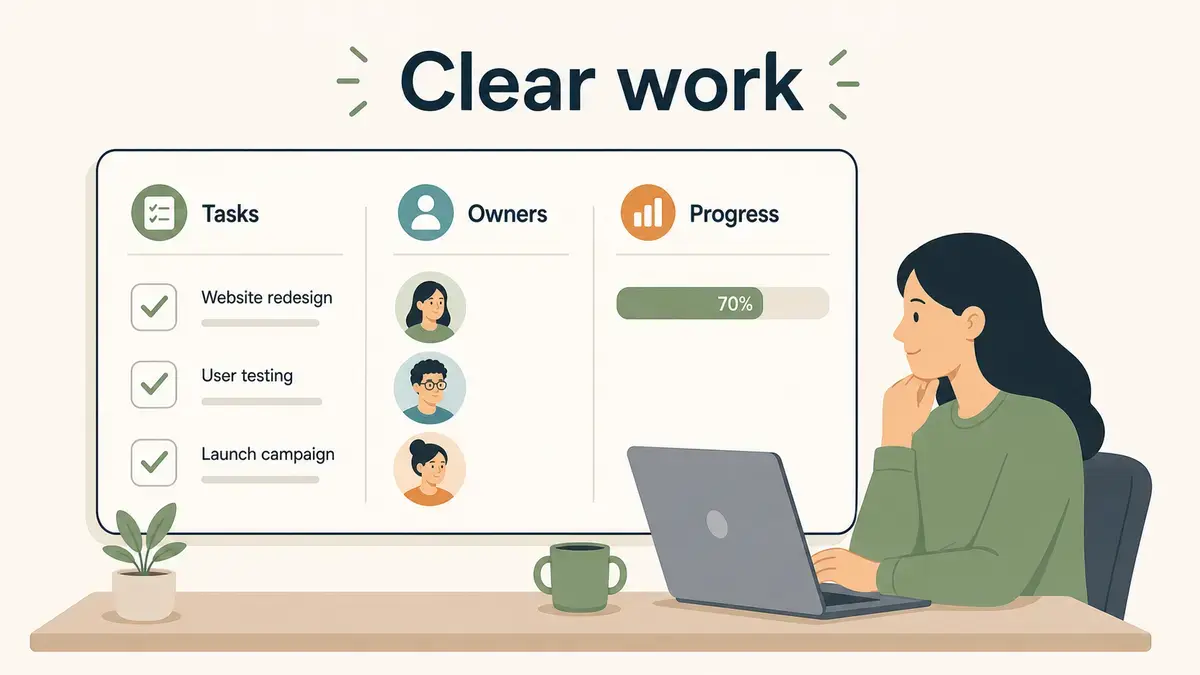
When time is tight, nobody can afford to wonder who owns what or where a task stands. This is where a shared workspace earns its keep. In Breeze, that looks like a board with one card per task, an owner and due date on each, and a quick glance telling the whole team what is blocked and what is moving, so the fifth day's worth of status meetings simply evaporates. The tool is not the point. Visible work and clear ownership are, and a board is the cheapest way to get both.
The trade-offs nobody mentions
The four-day week is not free, and selling it as pure upside sets teams up for disappointment. The first trade-off is intensity. Compressing the same output into less time means the four days you keep are denser and more demanding. For a rested team that is a fair deal, but it is not the same thing as working less, and people should know that going in.
The second is coverage and coordination. Fewer working days means a narrower window where everyone overlaps, which slows anything that needs the whole team in one place. Remote teams already navigate this, and the same discipline applies: more written updates, fewer synchronous meetings, clear handoffs. The playbook from a good time management routine carries over almost directly, because both are about doing more with less synchronous time.
The third trade-off is that it will not rescue a broken process. If priorities are unclear, meetings are bloated, and nobody knows who owns what, removing a day makes all of that worse, not better. The four-day week amplifies whatever system you already have. For well-run teams that is a gift. For chaotic ones it is a magnifying glass. That is why the preparation work is not optional, and why the teams that benefit most are usually the ones that needed it least.
Quick decision points
- Should we cut pay along with the day?
- Most of the well-known trials, including Microsoft Japan, kept pay flat and still came out ahead because overhead fell and output held. Cutting pay tends to undercut the goodwill that makes the model work. If the productivity case is real for you, the day off pays for itself.
- What if some roles cannot take the same day off?
- Stagger them. Let support and coverage roles split their day off across the week so the service stays open while everyone still gets the benefit. A four-day week does not have to be the same four days for the whole company.
- How do we know if it is actually working?
- Measure output, not hours. Track whether the work that matters is still shipping on time after the switch, and watch for burnout creeping back in. If output holds and people are less exhausted, it is working. If quality slips, your process needed fixing first.
The short version
A four-day work week can genuinely improve productivity, but the gain comes from the discipline it forces, not the day it removes, and that means it rewards teams that already prioritize well and punishes ones that do not. The evidence, led by Microsoft Japan's 40% lift, is encouraging enough to take seriously and specific enough to stay honest about.
If you want to test it, do not start by picking a day. Start by tightening the week you have: cut the meetings nobody needs, make priorities and ownership visible on a board, and protect real focus time. If output holds steady once the slack is gone, you have found your fifth day, and you can give it back to your team with confidence.