 Why choose Breeze
 Marketing
 Creative
 Sales
Sales Remote work
 Managers
 Product teams
 Project management
 Task management
 Kanban tool
 Time tracking
 Project reporting
 Project calendars
 Project timeline
 Team workload
 Project automation
 Project customization
 Chat
Chat Web forms
 Project roadmap
 AI
AI What's new
 Articles & guides
 Help center
 Mobile apps
 Integrations
 Developers & API
 Free tools
Can AI be used in project management?

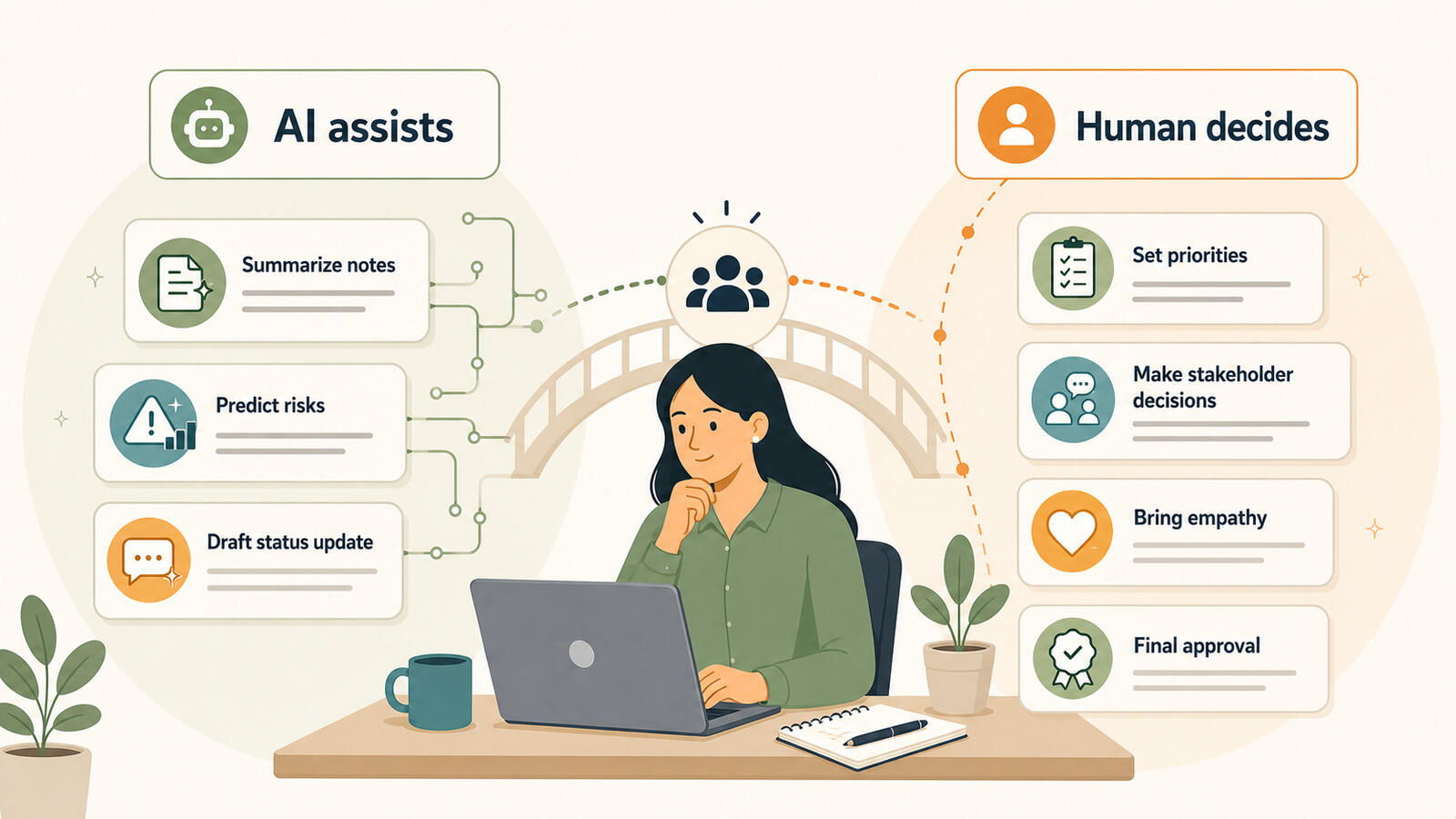
Yes, AI can be used in project management, but the honest answer is narrower than the hype suggests. The AI features bolted into project management tools today are almost all generative AI, the same large language models that power ChatGPT, and they are good at a small set of language jobs: summarizing a thread, drafting a task description, rewriting something to be clearer, pulling action items out of meeting notes. What they cannot do is run your project. They do not plan, prioritize, decide, or understand why your deadline matters. So AI is a useful assistant for the writing and reading around your work, not a replacement for the person coordinating it. Used that way it saves time. Treated as a project manager, it quietly creates work.
There is a second approach worth knowing about, because it changes what the AI is doing. Instead of a tool bolting features into its own interface, it can expose its data and actions to whatever assistant you already pay for. Breeze does this with an MCP server, so Claude or ChatGPT reads and updates your board directly. The limits above still apply, since it is the same language model doing the thinking, but you are not paying a second time for a worse assistant.
What AI genuinely helps with today
The useful uses of AI in project management share one trait: they are all about text. You feed the model words and it gives you words back, faster than you could type them and usually clean enough to edit rather than rewrite. A narrow lane, but one you drive in constantly during a project.
Summarizing is the strongest case. A card with forty comments, a wall of meeting notes, a long client email chain: AI compresses any of these into a few lines you read in seconds. It is not always perfect, but for "what did I miss" it is good, and the cost of an imperfect summary is low because you still have the original.
Drafting is the second case. Staring at an empty task description is friction, and AI removes it by giving you a first pass to react to. The same goes for a status update, a client reply, or the bones of a project brief. You are not asking the model to be right, just to get you to a draft you can fix.
Then there is tidying up: fixing grammar, tightening a rambling paragraph, making a blunt message sound more diplomatic, or translating a note for a teammate abroad. These are low-stakes edits where a wrong word costs nothing because you read the result anyway. The pattern holds across all three: AI is excellent at reshaping text that already exists and weak the moment you ask it for judgment.
What AI cannot do in project management
The limits are not a temporary rough edge, they come from how these models work. A language model predicts likely text from patterns it has seen. It does not understand your project, and that gap shows up in specific ways on real work.
It cannot do genuine reasoning or planning. AI can list tasks, but not which one unblocks the others, why the client cares about the launch date, or what happens to the budget if a milestone slips. It spots patterns in text without grasping the cause and effect underneath, so sequencing, prioritizing, and trade-offs stay with a human who understands the stakes.
It cannot be trusted on facts or numbers. Generative AI hallucinates, producing confident, fluent, completely wrong answers, and it is notoriously bad at arithmetic because it matches language patterns rather than calculating. Ask it to total hours and it may hand you a tidy number that is made up. It can also carry biases from its training data into whatever it writes. None of this comes with a warning label, so human review is not optional.
And it has no real creativity or independent learning. AI recombines what already exists, useful for a draft but not an original idea, and it does not learn from your project on its own. The cleanest way to picture it: AI can generate a pile of plausible tasks, but it takes a person to link them into a project that means something. The generating is the easy 20 percent. The judgment is the 80 percent that decides whether the project lands, which is why the 80/20 split applies here.
Helps with versus cannot do, at a glance
If you remember one thing, make it the line between these columns. The left side is safe to lean on with a light edit. The right side needs a person.
| Task | What AI helps with | What AI cannot do |
|---|---|---|
| Reading | Summarize comments, notes, and long threads. | Tell you what the summary means for the plan. |
| Writing | Draft task descriptions, updates, and replies. | Know which task actually matters most. |
| Editing | Fix grammar, tone, clarity, and translation. | Verify the facts inside the text are true. |
| Numbers | Almost nothing reliable. | Count, total hours, or do arithmetic accurately. |
| Planning | List possible tasks to react to. | Sequence work or weigh real trade-offs. |
| Judgment | Suggest options when prompted well. | Make the call or own the outcome. |
Why AI and automation get confused
A lot of what tools market as "AI" is not AI at all, it is automation, and the two do different jobs. Automation follows rules you set: when a card moves to done, notify the owner; every Monday, create this checklist; when a due date passes, flag it. It is reliable because it never improvises. AI generates new text and adapts its output to context, which is more flexible but less predictable.
The simplest way to keep them straight is a switch analogy. Automation is a light switch: on or off, no judgment in between. AI is more like a dimmer that adjusts to what you feed it, but a dimmer can land on the wrong setting. For most of the repetitive grind in a project, plain automation is what saves you time, without ever hallucinating. Tools like Zapier, Make, and Workato exist for this, and most project tools have a built-in version. Setting up that kind of project management automation is straightforward, since it just runs the steps of a workflow you have already defined.
This matters because the boring rule-based half is often the part doing the real work. When a feature impresses you, ask whether you are looking at intelligence or a well-built automation, because the answer changes how much you can trust it unattended.
What the AI in real tools actually is
It helps to look at what the big tools shipped, because it sets realistic expectations. Notion launched Notion AI in a private alpha in November 2022 and made it generally available in February 2023. ClickUp followed with ClickUp AI, branded ClickUp Brain, on May 4th, 2023. Neither company fully details the technology underneath, but the consensus is that both lean on OpenAI's GPT, with ClickUp likely mixing in other cloud services and some of its own models.
In practice these features inherit GPT's strengths and its flaws. They draft and summarize well, and they fall down on the same things: they can be factually wrong, they hallucinate, and they cannot reliably handle calculations. User reaction has been mixed for that reason. Plenty of people find AI meeting notes and summaries handy, while others feel the writing assistant adds little over using ChatGPT directly. The split is telling: the narrow, text-shaped uses earn their keep, and the grander "AI runs your work" promise does not survive a real project.
The lesson is not that any one tool is bad. It is that the AI inside your project software is, under the hood, the same general-purpose language model you can already use for free, wired into your workspace for convenience. Convenient is worth something. Magic it is not. So when choosing project management software, weigh the workflow fit first and treat AI as a nice extra, not the deciding factor.
How to use AI sensibly on a project
The teams getting value from AI are not the ones that hand it the steering wheel, they are the ones that aim it at small, well-defined chores and keep their hands on everything else. The latest adoption numbers tell the same story: the narrow, assistive uses are the ones that pay off. A few rules of thumb make the difference.
Use it for first drafts, not final answers. Let AI start the task description, status update, or summary, then read and fix it before anyone else sees it. The model's job is to beat the blank page, not to be right. Always verify anything load-bearing. If a figure, a date, a name, or a claim is going into a plan or a client message, check it yourself, because the model will not tell you when it is guessing. And give it good prompts: vague input gets vague output, so spell out the context, the audience, and the format you want.
Keep the project structure human-owned. The board, the owners, the due dates, the milestones, the priorities: these are decisions, and AI does not make decisions. In Breeze, for instance, the sensible split is to let an assistant draft a card's description or summarize a long comment thread, while you and your team decide what goes on the board, who owns each card, and what ships first. The AI tidies the words. People run the work. And mind your data, since whatever you paste into a hosted AI tool is leaving your project, so keep anything sensitive out. Stick to that and AI becomes a quiet time-saver rather than a source of confident nonsense.
The short version
AI can absolutely be used in project management, but only as an assistant for the language work around your project, summarizing, drafting, and tidying text, never as the thing that plans or decides, because it does not understand your work and it will sometimes be confidently wrong. Human judgment stays firmly in charge, and the rule-based automation you already have probably saves you more time than the AI does. A good next step: pick one repetitive text chore this week, a weekly summary or a recurring update, hand just that to AI, check the result, and see whether it earns a place in your routine before you trust it with more.